

Chuck D. Bones
Circuit Wizard
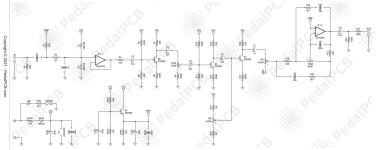
With some mods, of course. Here's the stock circuit:

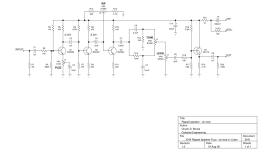
I could do without the opamps. I tossed the input buffer and replaced the active Tone circuit with a BMP-style Tone circuit followed by a MOSFET buffer. Gets the job done with a lot fewer parts. I've tried the active Tone circuit with other things and while it's clever, it has limitations. I redid the FUZZ control, tweaked a few component values and here we are. I tried Ge for Q3, but ended up liking Si better. I used a BC109C for Q1 on the breadboard. This baby has plenty of gain, over 80dB. The RIP pot varies the bias on Q3 from cutoff to saturated. Gating can be splatty, mild, or fully open. There's no clean setting unless we back the guitar's volume knob down a ways. Definitely some vintage fuzz tones in there.

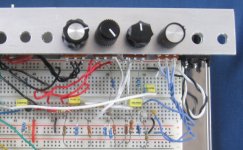
Knobs (L-R): LEVEL - TONE - RIP - FUZZ
Q4 on thr far left, Q1 on the far right.

I could do without the opamps. I tossed the input buffer and replaced the active Tone circuit with a BMP-style Tone circuit followed by a MOSFET buffer. Gets the job done with a lot fewer parts. I've tried the active Tone circuit with other things and while it's clever, it has limitations. I redid the FUZZ control, tweaked a few component values and here we are. I tried Ge for Q3, but ended up liking Si better. I used a BC109C for Q1 on the breadboard. This baby has plenty of gain, over 80dB. The RIP pot varies the bias on Q3 from cutoff to saturated. Gating can be splatty, mild, or fully open. There's no clean setting unless we back the guitar's volume knob down a ways. Definitely some vintage fuzz tones in there.
Knobs (L-R): LEVEL - TONE - RIP - FUZZ
Q4 on thr far left, Q1 on the far right.

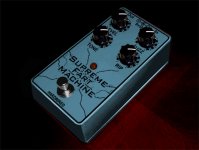


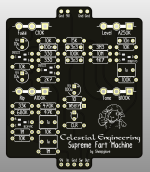
 You can have the LED in any colour you want, but the location is always 0 mm / 12.7 mm!