This Week on the Breadboard: The Tush OD

Chuck D. Bones

Circuit Wizard
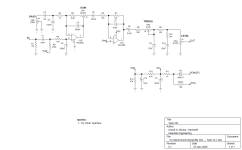
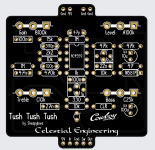
HamishR emailed me a few days ago with a mod to the Eliminator (PPCB Recycler) OD. The Eliminator bears a strong resemblance to the M.I. Audio Crunch Box, with the LED clippers deleted. Missing Link added a Vref buffer & output buffer, both of which I consider unnecessary. HamishR added the BASS pot. Then I did my thing with it. I deleted the Vref & output buffers and tweaked a few component values. I renumbered the ref des, deal with it. ;)

The OD tone is all in the opamps, so try different ones. 4558 & 4559 clip asymmetrically, producing a lot of harmonics for a rich full tone. TLC2272 clips symmetrically, for a clearer, slightly thinner tone. M.I. Audio used LM833 in the Crunch Box. When GAIN is cranked up, both opamps will saturate. With the GAIN (or guitar volume) turned down, it will run clean (or semi-clean). As shown on the demos, this pedal is very responsive to guitar knobs and picking style.
Tush v0.1.png

According to the Recycler schematic, the TONE pot is A10K. That is the wrong taper unless it's wired backwards. I listened to a demo on YouTube, but it did not give a good indication of the TONE knob's range. I can tell you that C-taper has a smooth, even sweep. I like B-taper for the GAIN knob, but A-taper works well too. If you prefer setting below noon, then A-taper is the one for you.

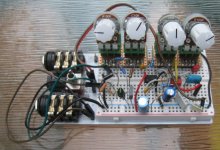
The low parts count makes it possible to build on a mini breadboard.

Knobs (L-R): LEVEL - TREBLE - BASS - GAIN
Tush breadboard 02.jpg
 
Last edited:
Nice! I had it on my list to tinker with this one. The 1458 opamp clips in a fairly pleasant way too. But how do you get asymmetrical with 4558's, given that Vref is at 1/2 of V? It shouldnt be too far from symmetrical as is, right?
 
There are two things that will make an opamp clip asymmetrically.
1. The output of many opamps cannot swing to either rail and the output voltage range is not centered between the rails.
2. Input bias current creates a voltage drop across the feedback resistor, causing the output to not be centered between the rails.

The 2nd stage feedback resistor is 1M. a 500nA bias current will cause a 500mV drop across that resistor, which causes the output pin to be 500mV different from Vref.

The bias current varies from part to part. Two opamps with the same part # could have different bias points and therefore would not clip the same. One might be slightly asymmetric and the other very asymmetric.

Rail-to-rail opamps such as TLC2272 will clip symmetrically. LM308s clip nearly symmetrically. You'd need two for this circuit.

FET-input opamps such as TL072 and CA3240 have very low bias current and as such are very repeatable.

Bottom line, opamps should be auditioned for this circuit, even opamps of the same part number.
 
Last edited:
"Bottom line, opamps should be auditioned for this circuit, even opamps of the same part number"

As I found out! I often build two of any pedal I think friends will like to try, so built two of my version (which isn't all that different from Chuck's) and found they didn't sound the same. I found that the LM1458N I had used in the second one had different writing on it, so was probably made by a different manufacturer or something. It sounded a bit fizzy and not as fat and chunky. I had already tried a TLC272 and liked it, but preferred the thicker sound of the LM1458. So then I tried an LM833N in one of them and it sounded nearly identical to the good LM1458N.

I imagine simply adding the bass pot to the PCB will be fairly straightforward, and I think it makes a huge difference. I haven't changed the stock values; I just added a pot and a 1µF cap to the stock circuit for the bass control.

I might use Chuck's idea af a B taper pot for Gain too. As it it I'm using it at around noon with a Gibson to get a light OD sound. It's one of the best Billy Gibbons sounds I've heard with my rig so far. Try some hybrid picking through it and you'll see what I mean!
 
2. Input bias current creates a voltage drop across the feedback resistor, causing the output to not be centered between the rails.
Gotcha. I had never thought of this when toying with opamp clipping. Generally bigger feedback resistor = smaller caps which makes me oh so happy, but I'll have to take that into account also.
I found that the LM1458N I had used in the second one had different writing on it, so was probably made by a different manufacturer or something. It sounded a bit fizzy and not as fat and chunky.
I've had the same experience. When building one of those small SS marshalls from the 80's, I compared the 1458 from Mouser (TI?) to another one I'd sourced from a semi-dodgy parts shop from eastern Europe. It had "TESLA" written on it and looked old as crap. It sounded better than the newer-looking one from Mouser. Of course, no difference at all under linear operation, but the rail clipping was kind of fatter and mellower.
For this kind of applications I quite like the TL062. A bit smoother than the TL072 and not much difference noise-wise, and more "focused" than a 308 or a 1458.
 
Back
Top