Modding the Vintage Distortion into Colorsound Tone Jumbo, possible?

dc1508

New member
Hi guys,

So I got this Vintage Distortion pedal and been wanting to mod it into a Jumbo Tonebender, I'm a total noob so first time trying to mod things out.

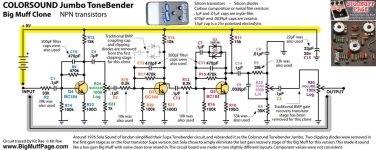
Afaik the mod is just removing the D4, D3 and C6 and the whole Traditional BMP gain recovery transistor stage includes Q1, R4, R3. So my question is, after desoldering, do you have to jump wires or something else on the board or just leave it and it'll work on its own?

Thank you so much, hopefully I get some tips on my first time!

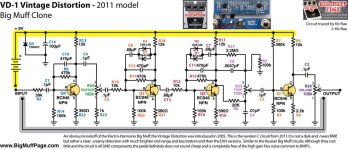
These are the 2 schematics side by side, I know the tone circuit wouldn't be the same but I've been wanting to try out the Bender for a while, think this would be great first time mod platform.

Behringer VD1 Vintage Distortion Schematic.jpg Jumbo_Tonebender_Schematic.jpg
 
It's generally pretty self-explanatory. D3, D4 and C6? just leave them off. There is no connection to complete the circuit required, so no jumpers or anything are needed. At the end leave out R3, R4, R6, R7, Q1 and C2. the only jumper you'll need is to connect C3 to Volume 3. C3 needs to connect Tone 2 to Volume 3, and that's it. How you do that is up to you - Just make sure you don't inadvertently interfere with any other components, don't overheat anything when removing parts and use some quality desoldering braid to remove any unnecessary solder. Go slowly and keep everything clean.
 
It's generally pretty self-explanatory. D3, D4 and C6? just leave them off. There is no connection to complete the circuit required, so no jumpers or anything are needed. At the end leave out R3, R4, R6, R7, Q1 and C2. the only jumper you'll need is to connect C3 to Volume 3. C3 needs to connect Tone 2 to Volume 3, and that's it. How you do that is up to you - Just make sure you don't inadvertently interfere with any other components, don't overheat anything when removing parts and use some quality desoldering braid to remove any unnecessary solder. Go slowly and keep everything clean.
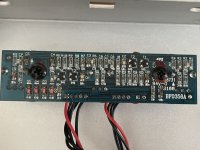
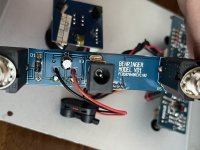
IMG_5313.jpeg IMG_5314.jpeg
Hi there, thanks for the great reply.

So this is the PCB after I dismantled my unit, it seems like the Diodes are reversed on the actual board, also resistors and caps don’t seem to line up well.

Based on Kitrae’s site circuit, diodes and transistors are reversed in his schematic?? (I’m pretty sure about diodes but not so much about the transistors).

So I figured desoldering the D3 and D4 is actually the D3 and D2 on the real unit because the D5 is on the other board. I found out the R14 is the equivalent of R7 on Kitrae’s site. and the R4 is the same name on the trace. But still I’m confused which ones are the right R3, R6, Q1 and C2 on my board.

Please let me know before proceeding everyone

Thank you so much!
 
Don't use the actual numbers on Kit Rae's diagrams! He seems to number everything backwards. Rather identify the parts by their place in the circuit. You should be able to trace from the IN jack to what we would normally call Q1 - Kit Rae calls it Q4. I see that Behringer call the transistors T1, etc. The numbers are almost always different depending on who drew the schematic. There is no one way of numbering.

I would guess that D1 (looks to be a 1N400x) is the polarity protection diode and C1 is the filter cap.

You should be able to tell which transistor is which by using the continuity setting on your meter. Once you've established which is the first transistor you should be able to work it out from there. It's unusual and really handy that component values are printed on the board!
 
Technically, you just need to leave off the two diodes, the cap does nothing if it's not connected to something at both ends.
Remove the diodes then test for continuity with the cap, and if there is none then job done.
The less invasive, the less chance of damage and more chance of success.


Personally, I'd leave the final stage in.

Taking out the final stage, the circuit will then invert phase and not react well with a clean-blend, but not a problem if not using a clean-blend.


I couldn't tell you what year a wine is just by tasting it, but I know vinegar when a crappy wine hits my palate.

Taking out 2 diodes will get you most of the way to the Colorsound ToneBender sound. Probably. Maybe. YEMD (your ears may differ).
 
Back
Top