Triad Magnetics TY-250P vs Cinemag CM-DBX?

anevilspar7an

Well-known member
I am coming to a close on a big personal project and would like to get some advice from the more experienced members here. I am using a Cinemag CM-DBX for a Pre/Post direct out as I've had good experience with it in a previous project, I would like to know if I should just use another one for an isolation transformer on a 2 amp buffer/splitter circuit block or if I would have no issues with using a Triad Magnetics TY-250P. I am primarily a bassist in a band that down tunes considerably so having the 20Hz-20kHz specs are ideal since I don't want any perceivable coloration or roll off from the transformer. I do know that I can mitigate most issues by buffering the signal before the transformer so I already have that set up.
 
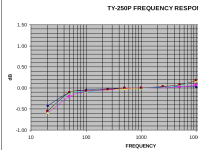
The triad datasheet shows some pretty significant roll off below 50Hz. In many cases this would be fine, but if yer bringing that doom, it may neuter the ass end a bit.
But for a buffer splitter, why not just use an active buffer out with and isolated jack and the ground lifted? Non-inverting buffer feeding 2 non-inverting stages to 2 outputs.
The ground should be established by the amps, assuming the jacks are tight and not corroded/full of beer. Since they are being fed by independent buffers, there shouldn't be any interaction. Lifting the ground on one or both would eliminate ground loops.
 
The triad datasheet shows some pretty significant roll off below 50Hz. In many cases this would be fine, but if yer bringing that doom, it may neuter the ass end a bit.
But for a buffer splitter, why not just use an active buffer out with and isolated jack and the ground lifted? Non-inverting buffer feeding 2 non-inverting stages to 2 outputs.
The ground should be established by the amps, assuming the jacks are tight and not corroded/full of beer. Since they are being fed by independent buffers, there shouldn't be any interaction. Lifting the ground on one or both would eliminate ground loops.
You do make a good point, my buffer/splitter is already setup like that minus the ground lift. I figured since I was going all out I would do all the bells and whistles, which would include galvanic isolation on the dirty amp out. All jacks minus the instrument input are isolated so no ground loops from what I can discern.
 
I will say that there's a great forum discussion about bass fundamental level vs harmonic levels on talkbass (with plots). The takeaway being that the true fundamental is often 10+db below first harmonic. Sub bass roll off might be less intrusive than you'd think.

Source: TalkBass.com https://share.google/nw5dFPsfyoe7M9vbA
 
Last edited:
Considering my lowest fundamental is 27.5Hz with the first harmonic at 55Hz I would probably want something that won't roll off until its close to 40Hz.
@YourGuitarist
I did a perusal of the post you linked and that definitely is a good source of info. My main concern is making sure that my galvanic isolation is full frequency like the opamp buffer before it.
 
I will say that there's a great forum discussion about bass fundamental level vs harmonic levels on talkbass (with plots). The takeaway being that the true fundamental is often 10+db below first harmonic. Sub bass roll off might be less intrusive than you'd think.

Source: TalkBass.com https://share.google/nw5dFPsfyoe7M9vbA
It’s a shame that many of the pictures and links in that thread went dead in the course of a few software upgrades over the years. I’ve often thought about doing a newer thread, given the many newer insights that have come to light with the greater use of ERBs. A friend of mine had a 12Hz bass in his booth one year I was there (2020 or so, Ithink) and by then he finally actually had a pretty good handle on the needed processing and crazy demanding amplification rigs to make it really work.
 
It’s a shame that many of the pictures and links in that thread went dead in the course of a few software upgrades over the years. I’ve often thought about doing a newer thread, given the many newer insights that have come to light with the greater use of ERBs. A friend of mine had a 12Hz bass in his booth one year I was there (2020 or so, Ithink) and by then he finally actually had a pretty good handle on the needed processing and crazy demanding amplification rigs to make it really work.
I was thinking today about how I've been designing/thinking of bass cab alignment in regards to excursion assuming all frequencies are equal. However...if the fundamental is several db lower than harmonics then that would permit some loosening of limits in simulation. In other words, the sub bass below 50/60 hz could be allowed to exceed linear excursion knowing that in practice a real bass has less energy there anyway. Dangerous game though
 
I was thinking today about how I've been designing/thinking of bass cab alignment in regards to excursion assuming all frequencies are equal. However...if the fundamental is several db lower than harmonics then that would permit some loosening of limits in simulation. In other words, the sub bass below 50/60 hz could be allowed to exceed linear excursion knowing that in practice a real bass has less energy there anyway. Dangerous game though
Room for experimentation though, just don't look at your bills too closely.
 
Back
Top