Big Muff: mods searching

Elijah-Baley

Active member
Hello,
I drilled the enclosure incorrectly for a different circuit, so now I want to use it for a Big Muff 2.
This enclosure has four potentiometer holes, one toggle switch hole, and one SPDT slide switch hole. I want to use all of them, of course. I can add another SPDT slide switch if needed, but I can’t add anything else.
I haven’t built it yet, nor have I breadboarded the Big Muff 2. The only information I have comes from what I’ve read here and there.

I’d like to make the Big Muff 2 more suitable for bass by adding a clean signal in parallel with the fuzz. I don’t want a blend control: the fuzz should always be present. I’m thinking of using the toggle switch to switch the circuit back to the stock version, without any interference from the clean path.
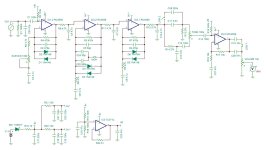
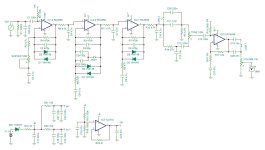
This is what I’d like to try.


(I redrawn the schematic with the new rebuilt version with some adjustment and some attempts of mod I added).

Other mods I’m considering are different diode options, less low-end cut, and more treble. I hope there’s an easy way to implement all of this using an SPDT switch.
The ones you can see in the schematic above, all the switches, are purely experimental.

How someone said in the main thread about the Big Muff 2, the most "wrong" thing in this circuit are the 4.7uF caps, because push too much bass. IF I set the value at 100nF I get a certain cut. But it's difficult to switch four parts with a SPDT without using some advanced switching system. I see that I can get about the same low end cut using a 100nF cap as output cap. Is that the same thing?

I’ll start building it on my own as soon as possible.
 
When mixing 2 signals, you should use mixing resistors. The fuzz output (from Vol-2) doesn’t have one. It might work ok since you have the resistance from Vol-3 to Vol-2. One concern would be if you have the fuzz volume relatively low, you’ll dump more clean signal to ground through Vol-2 to Vol-1. Mixing resistors isolate things like that.

I prefer to buffer (or boost) after mixing to make sure it’s solid and won’t be affected by the next pedal or amp. See the arachnid pcb for example, or seabed delay. But again, it may sound ok without buffer in this case and you can always defeat it with the switch.
 
Thanks!

There's a resistor after the Clean pot, but where exactly should I place the mixing resistor from the Volume 2 of the Fuzz?
And you see a buffer/boost after the mixing, I'll see if I have to do it.
Maybe I'd need more parts and a 3DPT toggle switch, but I guess it could be still ok. Just I'll avoid if I can.
 
I don't see anything special about the big muff 2 that would justify using it as a start point of your project for a bass fuzz with a clean blend.
 
Well, I heard all that low end make is fine on the bass, but actually that's not the point.

I mean, I built a few of two or three fuzz pedals good for bass, but no pedal at all with blend or clean pot, so I thought why not make it on this one? Is a way to use this drilled box I have.
Indeed the other mods I want to try, diodes asset, bass cut and treble boost are to have fun with the guitar. :)
 
Well, I heard all that low end make is fine on the bass, but actually that's not the point.

I mean, I built a few of two or three fuzz pedals good for bass, but no pedal at all with blend or clean pot, so I thought why not make it on this one? Is a way to use this drilled box I have.
Indeed the other mods I want to try, diodes asset, bass cut and treble boost are to have fun with the guitar. :)

You got the right mindset, sir!

My thought: Why not add (or copy and insert) a dry blend board alongside a muff 2, with a trimpot instead of a pot, and switch that in and out? This way you can tweak the amount at any time.

Like: https://jmkpcbs.com/product/panner/

From a lesson learned here: https://forum.pedalpcb.com/threads/why-your-clean-blends-suck-or-how-to-clean-blend.20986/
 
Last edited:
If you don't mind your clean getting tone controlled and you're not too precious about the circuit you could always turn one of them fancy 4k7/5n filters in to 2 x 10k to get your mix tap and use a 4n7 cap.
 
You got the right mindset, sir!

My thought: Why not add (or copy and insert) a dry blend board alongside a muff 2, with a trimpot instead of a pot, and switch that in and out? This way you can tweak the amount at any time.

Like: https://jmkpcbs.com/product/panner/

From a lesson learned here: https://forum.pedalpcb.com/threads/why-your-clean-blends-suck-or-how-to-clean-blend.20986/
But I prefer don't use a blend control, even the one you linked me I know works very fine.
I'm reading that thread, but I have to see better if there's something about just a "clean adding".

If you don't mind your clean getting tone controlled and you're not too precious about the circuit you could always turn one of them fancy 4k7/5n filters in to 2 x 10k to get your mix tap and use a 4n7 cap.

I prefer not to modify the basic Big Muff schematic, but to use switches so I can change it and switch it back to stock.
 
Last edited:
I prefer not to modify the basic Big Muff schematic, but to use switches so I can change it and switch it back to stock.
Easy, just switch the now floating 10k mixing resistor to be in parallel with the original filter resistor which you've changed to 10k which gives you 5k/4n7 which is exactly the same cut-off as 4k7/5nF.

Might not be the best place to mix dry in, but it's a relatively simple solution.
 
I thought it was like that, but after a gain/clipping stage it isn't properly a clean signal.
The tone control is post distortion, you have to tap off the input with a buffer of some description in to the 'Dry' input.

It's just a simple place to add it, you could also re-jigger the output op-amp... wherever you put it, you need a buffer from the input and some mixing resistors.
 
The JMK Panner was mentioned, but instead maybe take a look at the Paralyzer.

The Paralyzer grew out of one of our other products, the Panner. The Paralyzer is a unique effect in that it’s really more of a utility device for putting a pair (or more) of effects in parallel with each other, while giving the user a blend control to move between a full wet for either parallel effect, or a true 50/50 blend. Unlike some blenders which simply use a potentiometer to act as a variable resistor between two effects, never completely removing the effects from the signal path, the Paralyzer actually grounds the output of the two effects when they’re not in use. This gives the user a much more precise experience as they blend between their effects.

Replace the "BLEND" pot of Paralyzer with two 5k resistors.

I thought it was like that, but after a gain/clipping stage it isn't properly a clean signal.

However you do it, to get a clean signal to add to the Muff2 you'll need to split the signal actively. If you split it passively you'll have a weak Clean signal and a weak signal hitting the Muff2. Passive is like splitting a glass of water, you'll have two half-empty glasses. Actively splitting the signal you'll have two full glasses of water, one can be left pure (clean) and the other can be used to make iced-tea or whatever — 2 full glasses.

You can add a switch (toggle or stomper) to switch the clean signal in/out.
 
Ok, I think I got what do you mean. Even if the connection of the Mini Blend Jfet has the input from the jack in the buffer/blend and in the main circuit, so there's a "passive split".

I seen the Paralyzer, but I want to try to make something easier, and I drawn this, hoping that will work, even if I have to use a 3pdt switch.
When I want to add the clean signal the switch add a buffer that split the signal going into the Big Muff 2 and the booster with the clean control.
Is that could work better?
(Maybe I could add a 1k or 2.2k resistor in the output of the buffer).
 

Attachments

  • My Big Muff 2 schematic v.2.jpg
    My Big Muff 2 schematic v.2.jpg
    127.7 KB · Views: 7
I'm sure Paralyzer is great.
Actually, I built a modified ROG Splitter Blend with that same kind of blend, and my version has the blend mode and a mode with a fix side and the fade in or out the other side. :)

But now I was searching a way to get the clean add with just a mini board a a few of components.
 
Ok, I think I got what do you mean. Even if the connection of the Mini Blend Jfet has the input from the jack in the buffer/blend and in the main circuit, so there's a "passive split".

I seen the Paralyzer, but I want to try to make something easier, and I drawn this, hoping that will work, even if I have to use a 3pdt switch.
When I want to add the clean signal the switch add a buffer that split the signal going into the Big Muff 2 and the booster with the clean control.
Is that could work better?
(Maybe I could add a 1k or 2.2k resistor in the output of the buffer).


Yeah, V2 of the schematic looks better to me, well the buffer.
Since the signal is going through the buffer first (when engaging the clean blend) you won't need the second JFET booster on the clean — which is inverting the clean signal + while the Muff2 is all non-inverting = phase-cancellations.

Change the buffer you added at the front to Joel Purkiss' Buff n Blend:


Buff n blend schem dr tweek.jpg

I think the above schem of Purkiss' circuit was by Dr Tweek.

GuitarPCB has a compact PCB of the BnB, but you can build it on 9x8 perf:

BUFF N BLEND PERF.jpg

or *cough* vero...

buffnblend_v1.png
 
Inverting the phase was the thing I didn't want to do, I forgot it.
Thanks, but these layouts (I like vero!) are blend. :D

I don't want to blend fuzz and clean, there's no much sense to me turn the fuzz into clean. I want just add the clean in parallel, and I thought to have a slightly boosted clean, avoiding to get a signal too much weak comparing with the fuzz.
But if have the buffer in front I can't use a jfet boost.
Unless, I turn the buffer into a booster with less boost as possible.
 
Back
Top