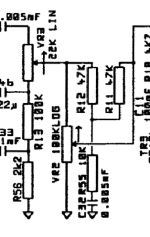
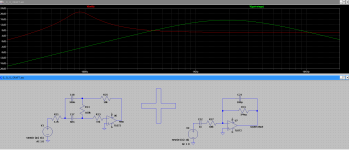
Per claude
Detailed Frequency Analysis
Input High-Pass Section
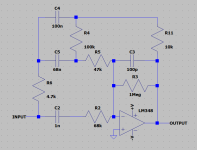
C2 (1n) + R2 (68k)
This RC pair forms the
input high-pass corner:
f=12πRC=12π×68000×0.000000001≈2,340 Hzf = \frac{1}{2\pi RC} = \frac{1}{2\pi \times 68000 \times 0.000000001} \approx \textbf{2,340 Hz}f=2πRC1=2π×68000×0.0000000011≈2,340 Hz
Signals below this are attenuated before even reaching the op-amp.
Upper Feedback Path — Low-Pass Roll-off
C4 (100n) + R4 (100k)
f=12π×100000×0.0000001≈15.9 Hzf = \frac{1}{2\pi \times 100000 \times 0.0000001} \approx \textbf{15.9 Hz}f=2π×100000×0.00000011≈15.9 Hz
C5 (68n) + R5 (47k)
f=12π×47000×0.000000068≈49.7 Hzf = \frac{1}{2\pi \times 47000 \times 0.000000068} \approx \textbf{49.7 Hz}f=2π×47000×0.0000000681≈49.7 Hz
These very low corner frequencies in the feedback path suggest this upper loop is
suppressing DC and very low frequencies from feeding back, which shapes the filter's lower passband edge.
Op-Amp Feedback — High-Frequency Roll-off
C3 (100p) + R3 (1Meg)
f=12π×1000000×0.0000000001≈1,592 Hzf = \frac{1}{2\pi \times 1000000 \times 0.0000000001} \approx \textbf{1,592 Hz}f=2π×1000000×0.00000000011≈1,592 Hz
This is the
dominant high-frequency cutoff. Above ~1.6 kHz, the feedback capacitor C3 increasingly shorts out R3, reducing gain and rolling off the output.
Input Passive Pre-filter
C5 (68n) + R6 (4.7k)
f=12π×4700×0.000000068≈497 Hzf = \frac{1}{2\pi \times 4700 \times 0.000000068} \approx \textbf{497 Hz}f=2π×4700×0.0000000681≈497 Hz
This acts as a
gentle low-pass pre-filter on the input signal before it reaches C2/R2.
Summary Table
| Components | Corner Freq | Role |
|---|
| C5 + R6 | ~497 Hz | Input pre-filter (low-pass) |
| C4 + R4 | ~15.9 Hz | Feedback DC suppression |
| C5 + R5 | ~49.7 Hz | Feedback low-freq shaping |
| C3 + R3 | ~1,592 Hz | High-freq roll-off (dominant) |
| C2 + R2 | ~2,340 Hz | Input high-pass gate |
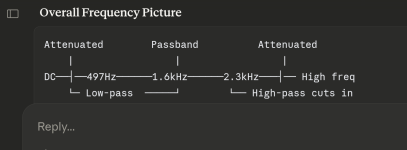
Overall Frequency Picture
Code:
Attenuated        Passband          Attenuated
    |                 |                 |
DC──┤──497Hz──────1.6kHz──────2.3kHz───┤── High freq
    └─ Low-pass  ─────┘        └── High-pass cuts in
         feedback shapes             above ~2kHz
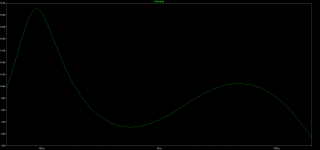
The filter appears to have a
passband roughly centered around 500 Hz – 1.6 kHz, making it well suited for
voice/telephone bandwidth filtering (the classic 300 Hz–3.4 kHz voice band), noise reduction, or audio pre-emphasis. The multiple overlapping RC corners give it a smoother roll-off than a simple single-pole filter