
I noticed this problem with compressors initially, but remembered that 15 years ago I had a chorus pedal that produced similar nasty distortions like my compressors, and now as I know the phenomenon that causes the issue I decided to rebuy that pedal and see if it could be modded to get rid of the problem.
So the pedal is a Behringer UC100, that suffers from serious intermodulation, but it is not an issue only with this pedal. I have been to a studio recently where we tried an Ibanez SC-10 chorus, and that produced the same nasty intermodulation, the only difference was that the Ibanez produced it in a narrower frequency range but still was disturbing.
Here is the problem to listen to:
 drive.google.com
I did some research on it, and I got to know about that these analog choruses have a trimmer inside, that sets the bias, and if you adjust that, you can diminish this problem. So I deassembled the pedal and found this:

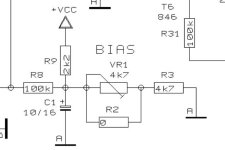
The place for the trimmer was there, but not soldered in in the factory. Instead, a resistor was placed there next to it (R3 on the photo below), to keep the setting at a fixed rate and also a jumper resistor was placed over the trimmer part of the circuit as a bridge (R2):

So I removed R3 and R2, soldered a 5K trimmer onto the VR1 pad, and put R2 to the place of R3 to have something there if I need that pad later for a resistor. And I managed to improve the sound quite much. Here is the outcome and what I found:
drive.google.com
So the way it changes throughout the resistance range of the trimmer is:
At 5K the intermodulation is strong. When you decrease the resistance, it starts disappearing, and around 50% it only appears around frets:20-24, just like on the Keeley Compressor (there I have the same intermodulation problem). But along with it, clipping appears at those frets. On the other frets the sound is clean. This is the setting you can hear on the link above.
I think this is because some thresholds are tight and the signal hits a ceiling that trigger clipping and intermodulation. My guitar sounds louder as you advance from the headstock to the body. At the lowest frets the jump in loudness in exponential, I think this causes that the intermodulation still happens at those frets. But, I have a Schecter Omen guitar with me, too, that one has more balanced volumes along the neck. However at the lowest frets, even that guitar triggers the same problem. So the thresholds are tight even for that guitar as well.
Decreasing the resistance more, under 50% the intermodulation is still there but the clipping gets worse and worse. Around 15-20% when the resistance reaches a point the chorus effect stops, and the sound becomes clean, no clipping, no intermodulation. This applies even at 0.
Here is the full test to listen to:
 drive.google.com
Any idea how to improve this? There is just very little needed for it to become perfect sounding. I guess something is limiting the signal, maybe if that part could be swapped the pedal would sound perfect and I would have an idea what I should do with the other choruses, too. The input signal is OK I think because I use and active pad in the chain and that diminishes the signal voltage to quite a low rate.
Here is the full schematic:
So the pedal is a Behringer UC100, that suffers from serious intermodulation, but it is not an issue only with this pedal. I have been to a studio recently where we tried an Ibanez SC-10 chorus, and that produced the same nasty intermodulation, the only difference was that the Ibanez produced it in a narrower frequency range but still was disturbing.
Here is the problem to listen to:
Behringer UC100.mp4
drive.google.com
I did some research on it, and I got to know about that these analog choruses have a trimmer inside, that sets the bias, and if you adjust that, you can diminish this problem. So I deassembled the pedal and found this:
The place for the trimmer was there, but not soldered in in the factory. Instead, a resistor was placed there next to it (R3 on the photo below), to keep the setting at a fixed rate and also a jumper resistor was placed over the trimmer part of the circuit as a bridge (R2):
So I removed R3 and R2, soldered a 5K trimmer onto the VR1 pad, and put R2 to the place of R3 to have something there if I need that pad later for a resistor. And I managed to improve the sound quite much. Here is the outcome and what I found:
UC100 best.mp4
drive.google.com
So the way it changes throughout the resistance range of the trimmer is:
At 5K the intermodulation is strong. When you decrease the resistance, it starts disappearing, and around 50% it only appears around frets:20-24, just like on the Keeley Compressor (there I have the same intermodulation problem). But along with it, clipping appears at those frets. On the other frets the sound is clean. This is the setting you can hear on the link above.
I think this is because some thresholds are tight and the signal hits a ceiling that trigger clipping and intermodulation. My guitar sounds louder as you advance from the headstock to the body. At the lowest frets the jump in loudness in exponential, I think this causes that the intermodulation still happens at those frets. But, I have a Schecter Omen guitar with me, too, that one has more balanced volumes along the neck. However at the lowest frets, even that guitar triggers the same problem. So the thresholds are tight even for that guitar as well.
Decreasing the resistance more, under 50% the intermodulation is still there but the clipping gets worse and worse. Around 15-20% when the resistance reaches a point the chorus effect stops, and the sound becomes clean, no clipping, no intermodulation. This applies even at 0.
Here is the full test to listen to:
Uc100 full.mp4
drive.google.com
Any idea how to improve this? There is just very little needed for it to become perfect sounding. I guess something is limiting the signal, maybe if that part could be swapped the pedal would sound perfect and I would have an idea what I should do with the other choruses, too. The input signal is OK I think because I use and active pad in the chain and that diminishes the signal voltage to quite a low rate.
Here is the full schematic:

Last edited: