Holy Island's "HOW TO BUILD A SPEED MODDED TAPE PLAYER" help?

Martial Sound

New member

In the video it's all pretty straight forward as far as wiring goes but I have 2 questions.

  1. what's the process of adding the LM317 for the power conversion and...
  2. adding the delay/PT2399 circuit into this. I actually have a shite Donner/Amazon delay pedal with that chip and I think I could just wire it into this but I'm lost on how and where it would go in placement AND if the 9v wall wart power will power the tape player and delay sufficiently? I'm sure it will but just curious.
I dont think Mr. Holy Island likes to provide much support with these things as I'm sure he's bogged down with them but any help for a fellow tinkerer would be greatly appreciated!

Thanks in advance!
 
1.)
IMG_0569.jpeg
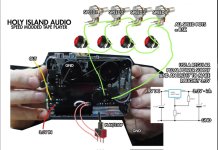
The diagram from the video shows 240 and 390R.
IMG_0570.jpeg
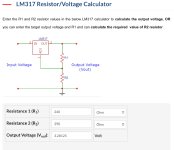
Calculator confirms this should get you to 3.3-ish V out.

You just build the little circuit he drew on a piece of perf or protoboard, and wire it in series 9V supply > LM317 board > Power In on cassette player (per his photo)

2.) What he has labeled Out (yellow wire) on that photo diagram would just go to the audio In jack of your pedal (or straight to the Audio In on the pedal’s PCB, if you’re going to unbox it and make a shared enclosure like in the video). Then the pedal’s Out is audio out for the whole deal.

You should be able to run these both off a shared 9V supply as long as it has enough mA available for both. You just split it at the DC In jack: 9V wire straight to pedal, other 9V wire > 3.3V board > cassette player.

This looks like a fun project, and I think I just found this identical cassette player on Amazon for $20! May have to give this one a try;)
 
1.)
View attachment 109339
The diagram from the video shows 240 and 390R.
View attachment 109340
Calculator confirms this should get you to 3.3-ish V out.

You just build the little circuit he drew on a piece of perf or protoboard, and wire it in series 9V supply > LM317 board > Power In on cassette player (per his photo)

2.) What he has labeled Out (yellow wire) on that photo diagram would just go to the audio In jack of your pedal (or straight to the Audio In on the pedal’s PCB, if you’re going to unbox it and make a shared enclosure like in the video). Then the pedal’s Out is audio out for the whole deal.

You should be able to run these both off a shared 9V supply as long as it has enough mA available for both. You just split it at the DC In jack: 9V wire straight to pedal, other 9V wire > 3.3V board > cassette player.

This looks like a fun project, and I think I just found this identical cassette player on Amazon for $20! May have to give this one a try;)
Thank you SO MUCH. Yeah he mentions getting those on Amazon for $20. Seems very fun just dont want to fuck up the power AND adding the delay circuit. I love low-fi sounds like this. Thank you again!
 
1.)
View attachment 109339
The diagram from the video shows 240 and 390R.
View attachment 109340
Calculator confirms this should get you to 3.3-ish V out.

You just build the little circuit he drew on a piece of perf or protoboard, and wire it in series 9V supply > LM317 board > Power In on cassette player (per his photo)

2.) What he has labeled Out (yellow wire) on that photo diagram would just go to the audio In jack of your pedal (or straight to the Audio In on the pedal’s PCB, if you’re going to unbox it and make a shared enclosure like in the video). Then the pedal’s Out is audio out for the whole deal.

You should be able to run these both off a shared 9V supply as long as it has enough mA available for both. You just split it at the DC In jack: 9V wire straight to pedal, other 9V wire > 3.3V board > cassette player.

This looks like a fun project, and I think I just found this identical cassette player on Amazon for $20! May have to give this one a try;)
In the schematic he has 2 capacitors on the board as well. that's where some confusion came as well as LM117 and LM317 in series
 
Last edited:
1.)
IMG_0569.jpeg
The diagram from the video shows 240 and 390R.
IMG_0570.jpeg
Calculator confirms this should get you to 3.3-ish V out.

You just build the little circuit he drew on a piece of perf or protoboard, and wire it in series 9V supply > LM317 board > Power In on cassette player (per his photo)

2.) What he has labeled Out (yellow wire) on that photo diagram would just go to the audio In jack of your pedal (or straight to the Audio In on the pedal’s PCB, if you’re going to unbox it and make a shared enclosure like in the video). Then the pedal’s Out is audio out for the whole deal.

You should be able to run these both off a shared 9V supply as long as it has enough mA available for both. You just split it at the DC In jack: 9V wire straight to pedal, other 9V wire > 3.3V board > cassette player.

This looks like a fun project, and I think I just found this wacky flip identical cassette player on Amazon for $20! May have to give this one a try;)
Thanks for breaking this down so clearly. The LM317 setup and shared 9V supply explanation makes a lot of sense, especially splitting the power after the DC jack. Good call on feeding the pedal directly with 9V and dropping voltage only for the cassette player. This definitely looks like a fun and affordable project, curious to see how the speed mod affects the tone once you try it out.
 
LM117 and LM317 are the same, 117 just has a wider temperature range (and thus will probably be more expensive if you find one). 317 is fine here, and you only need one regulator.
If you look at the datasheet for any voltage regulator, they always show caps in those spots. I assume they’re for cleaning up the power in some way, filtering out stray AC or noise maybe 🤷‍♀️
At any rate they’re a standard component when using a voltage regulator.
 
LM117 and LM317 are the same, 117 just has a wider temperature range (and thus will probably be more expensive if you find one). 317 is fine here, and you only need one regulator.
If you look at the datasheet for any voltage regulator, they always show caps in those spots. I assume they’re for cleaning up the power in some way, filtering out stray AC or noise maybe 🤷‍♀️
At any rate they’re a standard component when using a voltage regulator.
Thank you so much for this. Really cleared everything up!
 
Back
Top