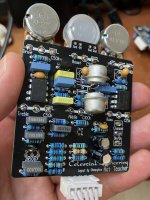
This Week on the Breadboard: The LPD Sixty8 (with some mods)

Chuck D. Bones

Circuit Wizard
A very clever circuit and makes great tones right out of the box. It's sold as the Jump Drive here. The 2nd & 3rd stage use MOSFETs as asymmetric clippers. That's clever part #1. Looking at the 2nd stage (IC1.1), when the output (pin 1) swings positive, Q1's body diode conducts and the circuit clips at about 0.6V. when the output swings negative, Q1's MOSFET conducts and the circuit clips at about 2V (depending on the gate threshold voltage). The 3rd stage does the same thing, but because it an inverter, it clips opposite to the 2nd stage. The output of IC1.2 is also asymmetric. D1 and D2 more-or-less even out the clipping at high signal levels. The net result is that the harmonic content is constantly changing with the signal level. Mostly low-order harmonics. The BASS knob doesn't do much unless DRIVE is above noon, and even then it's pretty subtle. The TREBLE knob is ok, but could go a little brighter. And then there's Vref. Pretty much everything returns to Vref. At high signal levels, Vref moves all over the place. I can't see how it affects the tone. D1, D2 and R14 can push pretty hard on Vref. I recommend changing R100 and R101 to 4.7K. But wait, there's more. WTF is going on with R7 and C5? That's clever part #2. C5 & R7 provide positive feedback around the 2nd & 3rd stages. When done right, as it is here, it's an effective way of increasing the gain and shaping the tone. But it has to be done carefully. Too much positive feedback and the circuit either latches up or oscillates. When the CHANNEL switch is In the Normal position (as shown below), the 3rd stage gain is reduced by R9 and the positive feedback is reduced by R11. When the CHANNEL switch is In the Treble position, R9 and R11 are out of the circuit. The positive feedback increases the gain, especially around 2KHz. The red curve is with the CHANNEL switch in the Treble position; the turquoise trace is the Normal position. R10 is responsible for the reduced gain below 2KHz. If you fiddle C5 or C7, make small changes because if you go too far in the wrong direction (C5 too big or C7 too small), it will oscillate.

1770840452719.png

1770839084848.png

That's all well and good, but we can squeeze a little more out of this circuit by turning the 1st stage into a Treble Booster and adding a BASS knob to the last stage. Now it goes to 11. I ditched the original BASS knob. The BOOST increases the gain, mostly in the high mids and treble. It can be used as a bass cut by turning down DRIVE and turning up BOOST. With BASS & BOOST at zero it behaves like the original circuit with BASS dimed. I disconnected R14 from Vref and return it to ground via C12. The original circuit uses 4558, but any decent dual opamp will suffice. I reduced R13 to get a little more brightness when TREBLE is turned up and changed the TREBLE pot to C-taper. I moved the LEVEL control ahead of the last stage to ensure that we don't saturate if BASS is dimed.


LPD Sixty8 cb mod v0.3.1.png

Knobs (L-R): LEVEL - BASS - TREBLE - CHANNEL sw - DRIVE - BOOST
LPD Sixty8 cb mod 0.3 breadboard 02.jpg
 
Last edited:
Wow - some great info here! I can attest to C7 causing oscillation if reduced in value. I wanted to make mine brighter so tried 2n2 there and got a lovely high pitched whine. 3n3 works fine and helps an otherwise stock circuit open up in a good way. I find in stock mode the pedal sounds great but has a slightly overbearing midrange.

I will try reducing R13 instead/as well. This is a great sounding pedal. I'm not sure it really needs the lower gain channel. The higher gain setting gets clean enough even for me. Chuck - does it add any value in other ways?
 
I'm still tweaking the EQ on the fist stage. Trying to get the mids where I want 'em. I might have to add a switch on C2.
I'll try that now! It's remarkable just how much difference changing C7 made. I guess the circuit was excellent to begin with, but that one little change made a big difference to me.
with the positive feedback, this circuit is very sensitive to C7. There's a peak in the freq response around 2KHz (see post #1). Making C7 smaller, even by a little bit, makes that peak taller.
 
I didn't even know you could use positive feedback for the forces of good like this. With this one reducing C7 has helped open it up but I have now also reduced R13, just a little, to 2K7. I liked this one from stock, and now I have got it just right for me. With a 330 it is gloriously gritty and kinda ragged Marshall. With a Les Paul it sounds like playing through a stack. And I can play rockabilly with my Gretsch 6120 with a pure, sweet sound. I've never seen a circuit quite like this one. Is it related to anything you have seen?
 
I've never seen a circuit quite like this one. Is it related to anything you have seen?
Not really. There are AIAB pedals with multiple stages of asymmetric clipping. I've seen one or two pedal circuits that use a single MOSFET in the feedback loop for asymmetric clipping, The only time I've seen positive feedback around multiple stages in a pedal was to cause oscillation. This one is pretty unique.
 
Then you're really not gonna like this one...

LPD Sixty8 cb mod v0.4.png

Q1 buffers the input and feeds the Mid Cut circuit (C2-C4, R6-R9 & the MID pot). The Mid Cut eats some bass, so in increased C5 to compensate. U1A now gets stable bias from Q1 instead of the bouncy Vref. The rest is pretty much unchanged except I renumbered all of the ref des. I tried a center-off switch for S2, but the center position is not very interesting. It's basically the high-gain setting without the 2KHz peak. The original circuit sounds very good, but it does benefit from some EQ up front.
 
Back
Top