

Chuck D. Bones
Circuit Wizard
Found this on PCBWay, designed by Glory to Ukraine. Based on the name, I half expected this to be a banjo pedal.

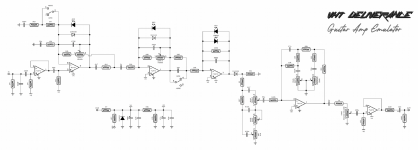
This schematic is from the build docs.

Most of it makes sense, although I fail to see the need for input and output buffers. I breadboarded it per the schematic, minus the input & output buffers. Sounded pretty good, except for three things:
1. Output volume is low.
2. Tone stack is too bright & BASS does very little above noon.
3. DEEP & PRESENCE don't do much.
Between the two GAIN knobs and the MORE-LESS switch, there is a large range of gains, tightness and harmonic content available. The MORE-LESS switch does two things: in the MORE position, the gain and bass & midrange content is is increased in the first clipping stage, simultaneously, the bass & midrange content is is decreased going into the last clipping stage. Depending on the two GAIN knobs, there may not be much volume change when switching the MORE-LESS switch. The tone is thicker in the MORE position, with more even-order harmonic content. With the switch in the LESS position and the GAIN knobs turned down, this circuit plays clean.
The diode & 5.6K resistor between the last clipping stage & the tone stack do essentially nothing. I've seen this in other AIAB circuits and it's there to simulate the slightly asymmetric drive from the cathode follower which drives the tone stack. The effect is so mild that I can't hear the difference when it is in or out of the circuit, so I ditched it.
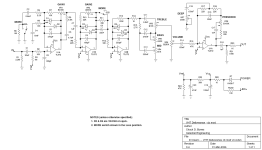
I increased the range of the DEEP control. I increased the gain of the final stage to increase the volume. I moved the VOLUME pot between the tone stack & last stage. Since the tone stack is already too bright, I changed the PRESENCE control from boost only to cut only.
I retuned the tone stack (C11 & C13) so that the BASS control is more effective over its entire range.
Here's the final result. Aside from deleting the input buffer, nothing changed in the first three stages.

I used two separate switches for the MORE-LESS switch, just to see how all 4 combinations sounded. My conclusion is that both up (MORE) and both down (LESS) is all we need.
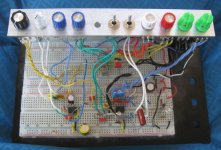
I used a 2-pin red/green LED for the LED pair in the last clipping stage. The only LED that lights up is D3 and that only happens when the GAIN knobs are dimed. So not much a light show going on.
Knobs (L-R): VOLUME - PRESENCE - DEEP - BASS - MORE/LESS (2nd-3rd stage) - MORE/LESS (1st stage) - MID - TREBLE - GAIN2 - GAIN1

This and the ENGL Powerball both sound pretty good. I might like the EQ in the cb mod Powerball better. Definitely worth breadboarding if you have the time.

This schematic is from the build docs.
Most of it makes sense, although I fail to see the need for input and output buffers. I breadboarded it per the schematic, minus the input & output buffers. Sounded pretty good, except for three things:
1. Output volume is low.
2. Tone stack is too bright & BASS does very little above noon.
3. DEEP & PRESENCE don't do much.
Between the two GAIN knobs and the MORE-LESS switch, there is a large range of gains, tightness and harmonic content available. The MORE-LESS switch does two things: in the MORE position, the gain and bass & midrange content is is increased in the first clipping stage, simultaneously, the bass & midrange content is is decreased going into the last clipping stage. Depending on the two GAIN knobs, there may not be much volume change when switching the MORE-LESS switch. The tone is thicker in the MORE position, with more even-order harmonic content. With the switch in the LESS position and the GAIN knobs turned down, this circuit plays clean.
The diode & 5.6K resistor between the last clipping stage & the tone stack do essentially nothing. I've seen this in other AIAB circuits and it's there to simulate the slightly asymmetric drive from the cathode follower which drives the tone stack. The effect is so mild that I can't hear the difference when it is in or out of the circuit, so I ditched it.
I increased the range of the DEEP control. I increased the gain of the final stage to increase the volume. I moved the VOLUME pot between the tone stack & last stage. Since the tone stack is already too bright, I changed the PRESENCE control from boost only to cut only.
I retuned the tone stack (C11 & C13) so that the BASS control is more effective over its entire range.
Here's the final result. Aside from deleting the input buffer, nothing changed in the first three stages.
I used two separate switches for the MORE-LESS switch, just to see how all 4 combinations sounded. My conclusion is that both up (MORE) and both down (LESS) is all we need.
I used a 2-pin red/green LED for the LED pair in the last clipping stage. The only LED that lights up is D3 and that only happens when the GAIN knobs are dimed. So not much a light show going on.
Knobs (L-R): VOLUME - PRESENCE - DEEP - BASS - MORE/LESS (2nd-3rd stage) - MORE/LESS (1st stage) - MID - TREBLE - GAIN2 - GAIN1
This and the ENGL Powerball both sound pretty good. I might like the EQ in the cb mod Powerball better. Definitely worth breadboarding if you have the time.

