Chuck D. Bones
Circuit Wizard
There are a lot of misconceptions floating around regarding pot tapers and parallel resistors, so I thought I'd make an attempt to clarify things. I'll explain how to read the pot taper charts in the Alpha datasheet, how the circuits react to pot taper and resistance, how to select a pot taper and what to do if you don't have the pot that the circuit requires. In this discussion, I will refer to knob positions as 0 thru 10 where 0 is 7:00, 5 is noon and 10 is 5:00.
Pot taper refers to how the divider ratio changes as we rotate the knob. Divider ratio is defined as the resistance between pins 1 & 2 divided by the resistance between pins 1 & 3. With a linear taper pot (B-taper), the divider ratio is equal to the % rotation. In other words, at full CCW, the % rotation is zero and the divider ratio is zero. At 10% rotation (1), the divider ratio is 10%. If we have 1V between pins 1 and 3, then we will have 0.1V between pins 1 and 2. At 50% rotation (5), the divider ratio is 50%. If we have 1V between pins 1 and 3, then we will have 0.5V between pins 1 and 2. and so on, all the way up to full CW (10) where the % rotation is 100% and the divider ratio is 100%.
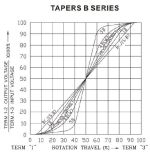
This first chart shows B-taper (the straight line marked B(JIS:B), W-taper (marked 4B(W) and similar variants. All of these tapers have a 50% divider ratio at 50% rotation. Note that the even the B taper flattens out a bit at the ends of rotation. This is a natural consequence of how pots are constructed. We'll come back to W-taper later on. Any taper other than B is a rough approximation of the desired curve (log or anti-log). This too is a natural consequence of how pots are constructed.

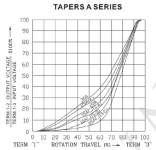
A-Taper, also called log taper or audio taper, changes the resistance ratio slowly at the CCW end and speeds up at around 50% rotation. The A-taper pots we usually buy, marked 15A(JIS:A) on the chart below, are 15% taper which means that at 50% rotation, the divider ratio is 15%. Fender uses 25% and 30% taper pots in some of their amplifiers. Occasionally, we will see 10% taper pots in pedals. Notice that all of the curves start out as a straight line at 0% rotation, then bend after 50% rotation and continue as a straight line to 100%. This is what I mean as a rough approximation of a log (or exponential) curve.

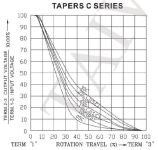
C-taper is simply the mirror-image of A-taper. The divider ratio changes relatively quickly from 0% to 50% rotation and then slows down between 50% to 100% rotation.

Pot taper refers to how the divider ratio changes as we rotate the knob. Divider ratio is defined as the resistance between pins 1 & 2 divided by the resistance between pins 1 & 3. With a linear taper pot (B-taper), the divider ratio is equal to the % rotation. In other words, at full CCW, the % rotation is zero and the divider ratio is zero. At 10% rotation (1), the divider ratio is 10%. If we have 1V between pins 1 and 3, then we will have 0.1V between pins 1 and 2. At 50% rotation (5), the divider ratio is 50%. If we have 1V between pins 1 and 3, then we will have 0.5V between pins 1 and 2. and so on, all the way up to full CW (10) where the % rotation is 100% and the divider ratio is 100%.
This first chart shows B-taper (the straight line marked B(JIS:B), W-taper (marked 4B(W) and similar variants. All of these tapers have a 50% divider ratio at 50% rotation. Note that the even the B taper flattens out a bit at the ends of rotation. This is a natural consequence of how pots are constructed. We'll come back to W-taper later on. Any taper other than B is a rough approximation of the desired curve (log or anti-log). This too is a natural consequence of how pots are constructed.
A-Taper, also called log taper or audio taper, changes the resistance ratio slowly at the CCW end and speeds up at around 50% rotation. The A-taper pots we usually buy, marked 15A(JIS:A) on the chart below, are 15% taper which means that at 50% rotation, the divider ratio is 15%. Fender uses 25% and 30% taper pots in some of their amplifiers. Occasionally, we will see 10% taper pots in pedals. Notice that all of the curves start out as a straight line at 0% rotation, then bend after 50% rotation and continue as a straight line to 100%. This is what I mean as a rough approximation of a log (or exponential) curve.
C-taper is simply the mirror-image of A-taper. The divider ratio changes relatively quickly from 0% to 50% rotation and then slows down between 50% to 100% rotation.