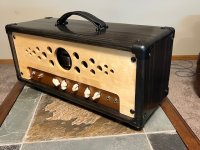
Anyone built a RR5E3(Rob Robinette 5E3 Deluxe) amp? Talk me out of it.

jwin615

Well-known member
So,
1700541054505.gif
And that means (hopefully) more available time at the bench.
I've been contemplating building an qmp for two or three years now, leaning towards a kit out of pure convenience but never found anything that seemed worth its price for me. With kits, there seems to be a void between Princetons and big boys. Then I stubbled across something that really caught my eye. Not a kit, but well documented.
Enter the RobRob Deluxe.
A stripped down, slightly modded 5E3.
Basically a 40W, single channel, no reverb, no vibrato 5E3.
Anyone have any experience with these?
Is this a ridiculous proposition for a first amp build? Because it seems like the perfect amp, for me(well, the non-chug-chug half).
Though I've yet to build an amp, toobs have been an interest for a long time and I do understand some of their basic operating principals (and dangers).
I feel like this is the one for me, but I'm a hopeless romantic...Anyway. It's fairly well documented, turret boards and chassis available, and lots of amp builders adding their bits and tweaks on the usual amp forums. And, I'd rather have something designed by Rob than a ripped off design from some random eBay company in the Pacific.
Hoffman amps sells the turret board and most of the components aside from chassis and iron, so again, not quite a kit, but not a full diy for the BOM.
Thoughts, ideas, experience?
/Rant

 
So,
View attachment 61079
And that means (hopefully) more available time at the bench.
I've been contemplating building an qmp for two or three years now, leaning towards a kit out of pure convenience but never found anything that seemed worth its price for me. With kits, there seems to be a void between Princetons and big boys. Then I stubbled across something that really caught my eye. Not a kit, but well documented.
Enter the RobRob Deluxe.
A stripped down, slightly modded 5E3.
Basically a 40W, single channel, no reverb, no vibrato 5E3.
Anyone have any experience with these?
Is this a ridiculous proposition for a first amp build? Because it seems like the perfect amp, for me(well, the non-chug-chug half).
Though I've yet to build an amp, toobs have been an interest for a long time and I do understand some of their basic operating principals (and dangers).
I feel like this is the one for me, but I'm a hopeless romantic...Anyway. It's fairly well documented, turret boards and chassis available, and lots of amp builders adding their bits and tweaks on the usual amp forums. And, I'd rather have something designed by Rob than a ripped off design from some random eBay company in the Pacific.
Hoffman amps sells the turret board and most of the components aside from chassis and iron, so again, not quite a kit, but not a full diy for the BOM.
Thoughts, ideas, experience?
/Rant

as is often agreed with pedal builds, the same runs true for amps - if you've never done it before - get a kit for your first build. saves on shipping too, for a single order.

if you have the diligence and patience to carefully collect your own parts, sure go for it.
shipping adds up, but i guess it's one of those things we concede on for the sake of getting exactly what we want instead of 'crummy kit capacitors' or whatever etc.

but hey a 5E3 build sounds like fun!
if looking at a kit, i guess you could always omit the bits you don't want/need like the vibrato or reverb and then follow rob's layout.

for what it's worth - i have built robrob's '40W SLO' and can vouch for his designs / wiring layouts

(my first build was a 2204 kit from stewmac when i was as clueless as could be, and had never even built a pedal before)
 
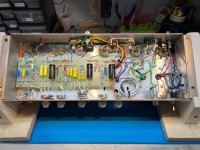
I roll my own all the time, including the layout so I can cut my own g10 board with my water cooled diamond tile saw, drill the holes and make my own circuit boards. I say go for it, the learning experience you'll get is great. Rob's circuit board is different from a standard 5e3, of which I've built a *squat load* of. The tone capacitor placement is on the board instead of on the pot, and he's got a modified cathode bias for the preamp - using a Marshall-esqe .68uf.

Solid core wire works much better for amps to prevent the placement of the wires in the preamp section from scooting around. 'Wire dressing' as it's called is crucial in avoiding run away oscillation. Wires should cross at a 90 degree angle as much as possible and be as far away from each other as possible.

This is going to be my 5F6-A

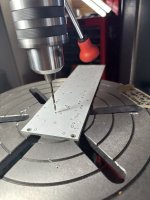
Drilling the holes in the printout glued to the g10 with Elmer's white glue
IMG_0916.jpg
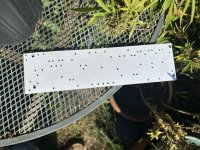
After drilling:
IMG_0917.jpg

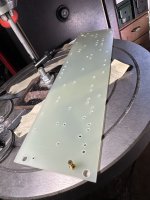
Swaging:
IMG_0920.jpg

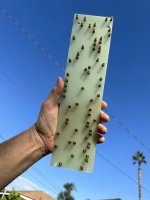
Complete:
IMG_0923.jpg

Turrets are a bit more expensive than eyelets but it's a LOT easier to build the board and you don't have to use silicone on the capacitors to keep them from vibrating on the circuit board.

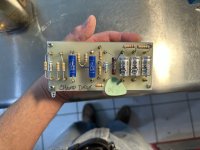
Here's a completed Champ board I made using the same techniques:

Finished board.jpeg
 
as is often agreed with pedal builds, the same runs true for amps - if you've never done it before - get a kit for your first build. saves on shipping too, for a single order.

if you have the diligence and patience to carefully collect your own parts, sure go for it.
shipping adds up, but i guess it's one of those things we concede on for the sake of getting exactly what we want instead of 'crummy kit capacitors' or whatever etc.

but hey a 5E3 build sounds like fun!
if looking at a kit, i guess you could always omit the bits you don't want/need like the vibrato or reverb and then follow rob's layout.

for what it's worth - i have built robrob's '40W SLO' and can vouch for his designs / wiring layouts

(my first build was a 2204 kit from stewmac when i was as clueless as could be, and had never even built a pedal before)
Thanks for the quick response. I don't think sourcing would be too bad. Hoffman has most of the components and the board available.
Thinking 4 sources gets me 98% there in that regard. I'll build the box. And like pedals, I'll miss something somewhere. Also like pedals, if cost were the concern, I/we wouldn't do it. I don't think it will run me the price of a vintage vibrolux(though there is a 68 bandmaster with cab that just came upn or $1100 local!?!).
I guess a little personal background that could play into it...
I have a fairly recent AAS in EE. So, basic electronics aren't a struggle for me. Also, not a valve-virgin. Done plenty of retubes and biasing, and rebiasing on a few of my own amps and of several friends. So, I feel like ---maybe--- a kit vs a well documented DIY really comes down to convenience to some extent.
But, the knowledge gained, which is 50% of the fun/goal, seems like the RobRob could yield more fruit. There are some cool builder.mods out there that alter/switch the NFB and actually seeing those links would be beneficial learning for me.(I'm a very physical/hands on learner. Pretty sure undiagnosed adhd. But anyway...)

That, and this build seems to jive so much with my current desires for a new amp, so there's the sexy factor.
Also cool to hear his SLO is solid. I've read Rob's page for a few years now, each time "getting" more and more of what he's laying out. Finally, reading today I was like, "Hey. I'm grasping 90% of this, at least in theory. Hey, reading works!"
Side note, I'm too invested in the Randall MTS stuff(egnater design pre Synergy) and want to off load it. Found the Egnater line as a good middle ground, but doesn't do everything I want. Love the tones of the 5E3 for cleans and ambient/shoegaze/etc so want an amp to occupy that space.
Also need a chugger, will get there...
 
I roll my own all the time, including the layout so I can cut my own g10 board with my water cooled diamond tile saw, drill the holes and make my own circuit boards. I say go for it, the learning experience you'll get is great. Rob's circuit board is different from a standard 5e3, of which I've built a *squat load* of. The tone capacitor placement is on the board instead of on the pot, and he's got a modified cathode bias for the preamp - using a Marshall-esqe .68uf.

Solid core wire works much better for amps to prevent the placement of the wires in the preamp section from scooting around. 'Wire dressing' as it's called is crucial in avoiding run away oscillation. Wires should cross at a 90 degree angle as much as possible and be as far away from each other as possible.

This is going to be my 5F6-A

Drilling the holes in the printout glued to the g10 with Elmer's white glue
View attachment 61083
After drilling:
View attachment 61082

Swaging:
View attachment 61084

Complete:
View attachment 61085

Turrets are a bit more expensive than eyelets but it's a LOT easier to build the board and you don't have to use silicone on the capacitors to keep them from vibrating on the circuit board.

Here's a completed Champ board I made using the same techniques:

View attachment 61086
Thanks for the detailed reply and nice units Unit!
I'm far from doing my own layouts, though it doesn't look *that* crazy.
Rob's layout(and subsequent mods) attracts me since it's single board. That *seems* way more beginner friendly. Have you used any of his layouts by chance?
My only worry, component wise, is with cap spacing. I know Hoffman has known to fit parts as a BOM, and I likely won't start from that for my first build. Use what works, learn, and then grow.
See you're implementing some mojo caps. Any sense in going down that road at all first time or will the ole mallorys suffice?
 
Thanks for the detailed reply and nice units Unit!
I'm far from doing my own layouts, though it doesn't look *that* crazy.
Rob's layout(and subsequent mods) attracts me since it's single board. That *seems* way more beginner friendly. Have you used any of his layouts by chance?
My only worry, component wise, is with cap spacing. I know Hoffman has known to fit parts as a BOM, and I likely won't start from that for my first build. Use what works, learn, and then grow.
See you're implementing some mojo caps. Any sense in going down that road at all first time or will the ole mallorys suffice?
I used to hang on the Vintage Amps Forum, aka Plexi Palace forum, and Rob was a member. I would watch in silent amazement as he and a few other members would discuss the pros and cons of different circuits and methodologies. I learned how to read schematics on his site! Even after all that time I had never seen this version of a 5e3!

I'm actually partial to paper in oil capacitors. Just trying the blue Sozo's. I have an audio capacitor tester for finding the foil end on caps that aren't marked. You want to know which side is the foil end as it is placed on the side of the circuit with the least impedance to minimize noise.

The tester works by plugging into an amp after clipping a cap into position. You place it next to a motor, or neon light or other really noisy EMR source and turn the volume up on the amp till you hear hum and buzz. Then you flip the polarity switch (shades of star trek, REVERSE THE POLARITY) and see which direction is noisier.

On paper and oil caps it is almost impossible to determine which end is the foil end because they just don't pickup EMR. On good old mallories they buzz like a chain saw when in the wrong direction and still hum even in the right direction.

So you have the same tone with the same capacitance, but the interference in the signal is drastically lower in PIO than film and foil.
 
I won't talk you out of it! Rob is a great source of knowledge. Don't let sourcing scare you, as you mentioned, you can get almost everything you need from Hoffman/Antique Electronic Supply. I say go for it!
 
I haven't seen Rob's 40W 5E3 design but I am very familiar with his site. FWIW I have built a 5E3 which I designed specifically to be able to use EL34s or 6V6s. It could also have been used with KT66s or 6L6s too. It wasn't so difficult and it sounded great! You just have to use suitably robust transformers and know how to cathode bias properly.

My main amp right now is a fairly standard 5E3 which was inspired by a very nice Clark Beaufort 5E3 which belongs to a friend. The key takeaway was that most modern 5E3 PTs supply too high a B+ voltage, so I ordered a 5E3 PT from Mercury Magnetics with a slightly lower B+ and biased it to 100% plate dissipation by using the right value cathode resistor. I also reduced the amount of bass coming through the amp by using smaller than standard coupling caps and first bypass cap. So now it's still plenty full sounding but the excessive low end of a stock 5E3 isn't causing it to flub out at all. When biased properly a 5E3 has a fair bit more headroom than most and doesn't get to fuzzed out when breaking up. It's actually a beautiful sounding amp. I LOVE the Celestion G12H Creamback in this one.

Rob Robinette knows what he is doing though. His site is very useful.
 
Back
Top