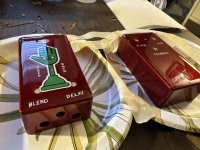
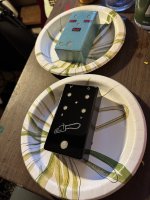
What’s on *YOUR* workbench?

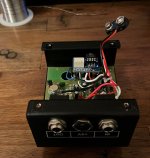
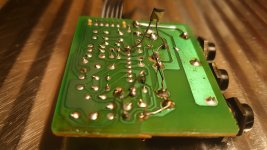
A component I don't recognize. This input pcb was snapped and glued ctudely back together and jumpered. But between ground and a pin of the dual op-amp (NJM4558SD) and linked to some other caps, there's this thing. Late 80s stuff. A cap, but what sort? Anyone?

I need to set the jacks more tightly to the board, as the middle is very wobbly and sinks about 2mm deeper into the chassis.

1000073531.jpg
 
Last edited:
A component I don't recognize. This input pcb was snapped and glued ctudely back together and jumpered. But between ground and a pin of the dual op-amp (NJM4558SD) and linked to some other caps, there's this thing. Late 80s stuff. A cap, but what sort? Anyone?

I need to set the jacks more tightly to the board, as the middle is very wobbly and sinks about 2mm deeper into the chassis.
View attachment 84440
Between ground and pin 8? I'd put my money on a 0.1uf ceramic bypass capacitor.

My own insanity:

Wah enclosures. So many.

Larry flanger (waiting on morley volume pedal In the mail for this one)

Tresonator filter

Mr multi phaser/wah

Fubble Wubble fuzz/wah

Sham-wah!

A gcb95 that I'm modding for inductor comparisons & replaced the original bjt buffer with a Jfet buffer.

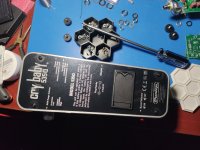
And an early 90s crybaby 535 (no Q) that doesn't work and needs to be debugged. No readily available schematics on that guy, so I'm gonna do my level best to trace the fucker.

1000006320.jpg
 
Last edited:
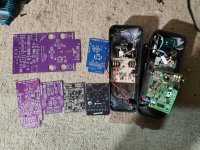
Opened up my Rat again to add relay bypass switching and replace the DC socket with a standard "outie" center-negative one. This was my first time adding relay bypass switching to a pedal with a battery. I recently revised my microcontroller code so that it puts the microcontroller to sleep when it's not actively switching the relay, which reduced the current consumption by ~1.5 mA by itself. My usual relay bypass circuit uses a 78L05 voltage regulator for the microcontroller, which has a quiescent current of 4-6 mA, which is too high for a battery-powered pedal IMHO. So I redesigned the relay bypass board, adding a polarity protection diode and replacing the 78L05 with a HT7550, which has a quiescent current of ~3µA. The result? Unless it's actively switching the relay, it has the same current consumption as it did before I added the relay bypass.

IMG_3444.jpeg
IMG_3446.jpeg
 
Last edited:
speaking of rats, today I got to hear a real deal LM308 for the first time.
a while ago i ordered and received a couple LM308HZ metal cans from a decent looking ebay seller and sat on them for a bit.

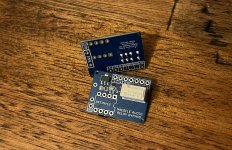
well the time came to choose opamps, and i really don't wanna use sockets in an upcoming build (life pedal) so today i made an attempt to breadboard a rat on the ProtoBoard Micro.
IMG_5848.jpeg
opamps compared:
- TI OP07
- motorola LM308HZ
- nat semi LM308HZ
Yep.
I can hear it.
My ears are certainly not golden, but I can hear 'the thing' that makes the LM308 special. OP07 might sound close enough to get you by, but there's something in the LM308 that makes me wanna play it more.

motorola / nat semi sounded pretty much the same, but i think i liked the motorola one better for possibly a crisper top end.
sample:
 
Last edited:
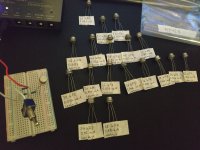
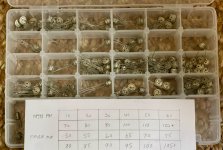
Just about through measuring my first ever batch of GE transistors. Results are somewhat disappointing considering gain range was listed as 45-100 hFE. Was hoping for at least 1 or 2 around 80 hFE for a Rangemaster build. These are from that one Ukrainian seller on eBay people keep recommending. Sovcom? Anyway, at least these are all very low leakage.
I breadboarded the RG Keen transistor tester for my measurements. My resistor values are slightly off though and so is my power supply (~9.16V) so I built a spreadsheet to get more exact results with these two factors accounted for.
Even though I didn't really get what I was hoping for this was still a fun experience. I'm one of those guys who likes recording data and doing spreadsheets and whatnot. It's kind of soothing to me so I guess this won't be my last batch of GE trannies to sort through :D

getransistors.jpg
 
Last edited:
Just about through measuring my first ever batch of GE transistors. Results are somewhat disappointing considering gain range was listed as 45-100 hFE. Was hoping for at least 1 or 2 around 80 hFE for a Rangemaster build. These are from that one Ukrainian seller on eBay people keep recommending. Sovcom? Anyway, at least these are all very low leakage.
I breadboarded the RG Keen transistor tester for my measurements. My resistor values are slightly off though and so is my power supply (~9.16V) so I built a spreadsheet to get more exact results with these two factors accounted for.

View attachment 84663

Do you think maybe there’s something off somewhere in your math or ? MP42B right? I’m sure these are from him too. 3rd and 4th row in the plano and chart. Mine seem biased a good bit above yours, measured with DCA75:

IMG_5640.jpeg

In any case it’s a good sounding transistor :)
 
Last edited:
Do you think maybe there’s something off somewhere in your math or method? MP42B right? I’m sure these are from him too. 3rd and 4th row in the plano and chart. Mine seem biased a good bit above yours, measured with DCA75:

View attachment 84667

In any case it’s a good sounding transistor :)
Yup, MP42B. I think my math is correct but the test conditions are just different with the DCA75. I'm basing this mostly on this video here:
He compares the results at the end and the difference between RG Keen and DCA75 appears comparable to your results compared to mine.
 
Yup, MP42B. I think my math is correct but the test conditions are just different with the DCA75. I'm basing this mostly on this video here:
He compares the results at the end and the difference between RG Keen and DCA75 appears comparable to your results compared to mine.

Ahh yeah makes sense.
 
Yup, MP42B. I think my math is correct but the test conditions are just different with the DCA75. I'm basing this mostly on this video here:
He compares the results at the end and the difference between RG Keen and DCA75 appears comparable to your results compared to mine.
It's not just test conditions.
I think it's because the keen method measures hfe and the DCA measures hFE.
 
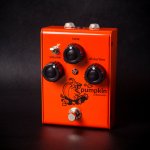
Those look superb. I can't believe how flawless the metalflake reds ones look. I'd be scared to step on it :cool:
Thanks- the metallic ones are actually more forgiving. The matte black ones, every little scuff shows. But still looks cool.
 
Back
Top