
You are using an out of date browser. It may not display this or other websites correctly.
You should upgrade or use an alternative browser.
You should upgrade or use an alternative browser.
Show me your vintage pedals.
- Thread starter UtilityBeltFX
- Start date

UtilityBeltFX
Well-known member
You know as a newfangled Maxon aficionado I want to hear about the Blubber Wah!Wall 'o baby.
Most of these are Thomas Organ. Two Jens. The Dunlops are early varieties with SOD inductors, except for the Hendrix Fuzz Wah.
Plus a few others in the periphery. Got an EME on the way too.
Wahhhhhhhh
View attachment 95160

Stickman393
Well-known member
Would you believe I haven't even plugged it in yet?You know as a newfangled Maxon aficionado I want to hear about the Blubber Wah!
Just pulled and measured the inductor, then put it back together.
One of the few that uses a Jfet input buffer stock. Otherwise, seems mostly identical to a crybaby circuit.
The Thomas Organs...I'm gonna do some minor tweaks to these...replace the pots that need to be replaced, swap to true bypass, bring it up to unity gain, replace all the resistors that have drifted out of spec, add a 9vdc input + a daughter board for power filtration and reverse polarity protection.
Just, ya know, breathe new life into em. Make 'em more feasible to use on a modern pedalboard. Then get money. Gimmie gimmie. Gimmie some of that sweet sweet skrill.
Probably wasn't the smartest thing financing my lil research project on credit cards. Hmm.

Bricksnbeatles
Member known well
Thomas Organ era Crybaby. It’s got a red-box TDK 5103 inductor. Never bothered to check the pot date code, but the serial number puts it at around 1976. I know the TDK inductor era gets a bad rap, but it sounds solid to me. Definitely a bit trashed, but I’d like to restore it a bit eventually— need to clean up the insides a bit and the outside a lot, and it needs a new rubber tread


I also have a good number of pedals that aren’t quite vintage yet, but aren’t too far off, such as this Pignose Piggy-in-a-box (he has the box!)

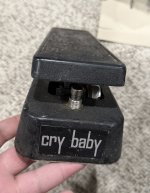
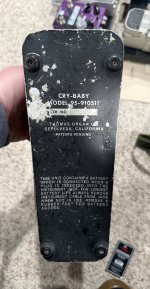
I also have a good number of pedals that aren’t quite vintage yet, but aren’t too far off, such as this Pignose Piggy-in-a-box (he has the box!)
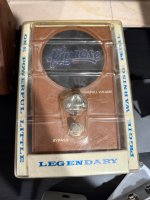
Stickman393
Well-known member
Nah my dude: I'd place that guy around late 1972- early 1973.Never bothered to check the pot date code, but the serial number puts it at around 1976.
View attachment 95185
Bricksnbeatles
Member known well
Ah really? I remember thinking that at one point (maybe I did check the pot code and forgot) but I thought the serial number starting with 19 meant it was probably 76Nah my dude: I'd place that guy around late 1972- early 1973.
Stickman393
Well-known member
Honestly: there's a bunch of stuff online about crybaby serial numbers that isn't well backed up IME.
This excel file is how I go about dating crybabies:
Don't...don't take that out of context. Stickwife gets jealous.

 docs.google.com
This excel file is how I go about dating crybabies:
Don't...don't take that out of context. Stickwife gets jealous.
Serial Numbers and Dates

Feral Feline
Well-known member
Would you believe I haven't even plugged it in yet?
Just pulled and measured the inductor, then put it back together.
One of the few that uses a Jfet input buffer stock. Otherwise, seems mostly identical to a crybaby circuit.
The Thomas Organs...I'm gonna do some minor tweaks to these...replace the pots that need to be replaced, swap to true bypass, bring it up to unity gain, replace all the resistors that have drifted out of spec, add a 9vdc input + a daughter board for power filtration and reverse polarity protection.
Just, ya know, breathe new life into em. Make 'em more feasible to use on a modern pedalboard. Then get money. Gimmie gimmie. Gimmie some of that sweet sweet skrill.
Probably wasn't the smartest thing financing my lil research project on credit cards. Hmm.
DIBS ON THE BLUBBER WAH!
You know as a newfangled Maxon aficionado I want to hear about the Blubber Wah!
I don't feel bad; you didn't say "dibs".
Seriously, I've been looking for a Blubber wah since before I was even interested in wahs. In fact, my obsession with the Blubber is
1) responsible for any interest in wahs at all, AND
2) what has thankfully prevented me from having a collection/obsession over other wahs such as Stickman's (well, that and ltd $)
UtilityBeltFX
Well-known member
There are currently 16 Blubber Wahs on Reverb.Seriously, I've been looking for a Blubber wah since before I was even interested in wahs. In fact, my obsession with the Blubber is
1) responsible for any interest in wahs at all, AND2) what has thankfully prevented me from having a collection/obsession over other wahs such as Stickman's (well, that and ltd $)
Feral Feline
Well-known member
Of course there are. When I have money there are none.There are currently 16 Blubber Wahs on Reverb.
Stickman393
Well-known member
I personally feel that anybody who offers me credit or a loan should know better, honestly, and whatever happens is their own fault.2) what has thankfully prevented me from having a collection/obsession over other wahs such as Stickman's (well, that and ltd $)
BUT...guilty. I keep digging, and I keep learning more. And then I keep buying and then I keep thinking "too...many...God..damned...wahs!!!!".
Feral Feline
Well-known member
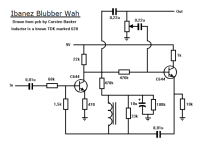
Stickman, does your Blubber wah's guts match the schematic floating around?

Stickman393
Well-known member
I'll tell ya what, the only difference between that and an early crybaby schematic is that 10uF cap.
But I'd bet that one matches the earlier blubber wah; I've seen some photos of those floating around. I'm *pretty* sure mine has a Jfet input buffer tacked on.
I'll trace mine eventually. Shouldn't be too difficult!
As for today...gents...I present...
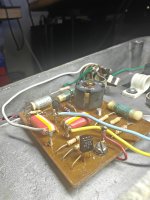
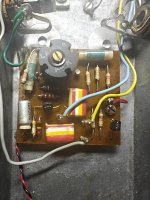
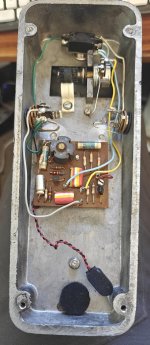
A wah from...eh...probably? The late 1960s:
I dunno if I can call it an "EME" wah. I presume that's what it is. From what I gather, it's from around the same time period as the Clyde McCoy script wah era.
The inductor is *directly wired* to the board. Fuck measuring that thing was harrowing. Its a weird fucker on the charts. Low resistance, extremely high Q, stable measured inductance value across 100hz-10khz.
Fuckin...crown jewel of my collection. Boy howdy.


But I'd bet that one matches the earlier blubber wah; I've seen some photos of those floating around. I'm *pretty* sure mine has a Jfet input buffer tacked on.
I'll trace mine eventually. Shouldn't be too difficult!
As for today...gents...I present...
A wah from...eh...probably? The late 1960s:
I dunno if I can call it an "EME" wah. I presume that's what it is. From what I gather, it's from around the same time period as the Clyde McCoy script wah era.
The inductor is *directly wired* to the board. Fuck measuring that thing was harrowing. Its a weird fucker on the charts. Low resistance, extremely high Q, stable measured inductance value across 100hz-10khz.
Fuckin...crown jewel of my collection. Boy howdy.
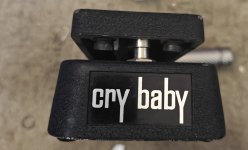
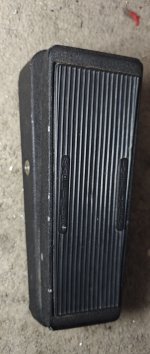
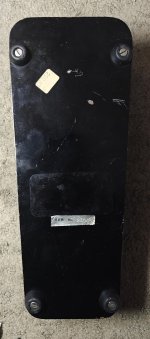
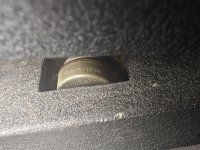
Stickman393
Well-known member
A'ite: did a little more research on the above.
Seems like this thing is from the "transition" era between the Clyde McCoy Script model and the V846.
Sometimes referred to as the "sticker" model. These came directly after the first "crybaby" top logo model as far as I can tell.
The inductor is one that I don't see talked about very often: I've read that the earliest "halo" inductors were produced in two different variants, differing only in the grade of ferrite used. A similar terminal carrier&clip is produced by TDK.
Then there are, of course, the "Trash/Film can" inductors, that were covered in a metal shield (a similar model with a center hole is currently produced by ferroxcube). Both the Halo and the Trash Can used 1811P ferrites.
Then, of course, you have the "Fasel", in all of its glorious colors. The round "TDK" inductor as is found in the maxon blubber is supposed to have been TDK's attempt to copy the Fasel. Those are 1408P ferrites...I think. I confirmed that on a red fasel, I don't have the heart to risk cracking open the TDK.
In the states, the Stack O' Dimes was produced for Thomas Organ, and that one was a 1107P ferrite. No idea what the boxed TDKs were. I've got two of the later model variants with DCR in the 150ohm range, I might go ahead and slice one of those open to see what's going on inside the thing.
But this one? Its mounted directly to the board. The inductor's magnet wire is routed directly to a pair of wire wrap terminals on the board. Which makes me suspect that these were wound and assembled shortly before being mounted to the board. This would have likely been done in the same facility, rather than bought from a supplier. Those little magnets wire ends on these things are thin and delicate, the ferrites themselves are quite easy to shatter: terminal carriers make these things much easier to transport from place to place.
From a little more research: it looks like these were deemed the "clover leaf" inductor. Some were coated in silicone, some were not. Likely production date between 1967-1968.
Seems like this thing is from the "transition" era between the Clyde McCoy Script model and the V846.
Sometimes referred to as the "sticker" model. These came directly after the first "crybaby" top logo model as far as I can tell.
The inductor is one that I don't see talked about very often: I've read that the earliest "halo" inductors were produced in two different variants, differing only in the grade of ferrite used. A similar terminal carrier&clip is produced by TDK.
Then there are, of course, the "Trash/Film can" inductors, that were covered in a metal shield (a similar model with a center hole is currently produced by ferroxcube). Both the Halo and the Trash Can used 1811P ferrites.
Then, of course, you have the "Fasel", in all of its glorious colors. The round "TDK" inductor as is found in the maxon blubber is supposed to have been TDK's attempt to copy the Fasel. Those are 1408P ferrites...I think. I confirmed that on a red fasel, I don't have the heart to risk cracking open the TDK.
In the states, the Stack O' Dimes was produced for Thomas Organ, and that one was a 1107P ferrite. No idea what the boxed TDKs were. I've got two of the later model variants with DCR in the 150ohm range, I might go ahead and slice one of those open to see what's going on inside the thing.
But this one? Its mounted directly to the board. The inductor's magnet wire is routed directly to a pair of wire wrap terminals on the board. Which makes me suspect that these were wound and assembled shortly before being mounted to the board. This would have likely been done in the same facility, rather than bought from a supplier. Those little magnets wire ends on these things are thin and delicate, the ferrites themselves are quite easy to shatter: terminal carriers make these things much easier to transport from place to place.
From a little more research: it looks like these were deemed the "clover leaf" inductor. Some were coated in silicone, some were not. Likely production date between 1967-1968.
Stickman393
Well-known member
More wah?
These two came in today:
Jordan gig wah/volume pedal. Bipolar 9 volt circuit, never heard one, inductor-less and has me quite curious.
Some folks see it and say "ass can". Others see and say "garage goodness". We shall see.
The other, ho hum. Just another Organ->Dunlop transition era crybaby from 1982, p#5117 transistors, stack o dimes inductor, and an old Thomas organ circuit board from before they ran out of those.
These two came in today:
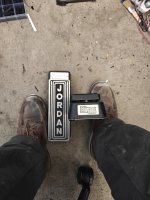
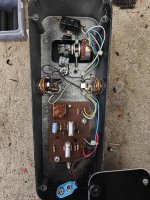
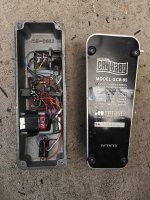
Jordan gig wah/volume pedal. Bipolar 9 volt circuit, never heard one, inductor-less and has me quite curious.
Some folks see it and say "ass can". Others see and say "garage goodness". We shall see.
The other, ho hum. Just another Organ->Dunlop transition era crybaby from 1982, p#5117 transistors, stack o dimes inductor, and an old Thomas organ circuit board from before they ran out of those.
Last edited:
Stickman393
Well-known member
A'ite. Little more.
Boomerang and colorsound organ swell wah:
Boomerang and colorsound organ swell wah:
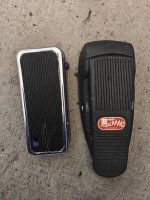
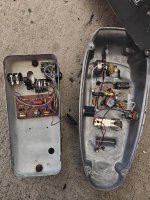
UtilityBeltFX
Well-known member
A'ite. Little more.
Boomerang and colorsound organ swell wah:
View attachment 95602
View attachment 95603
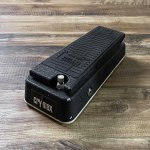
Just stumbled across this fun looking guy on the Internet today! Seems super unique and stupid.
Stickman393
Well-known member
Jeeeeeze! Never seen one of those before. Thought it was AI generated for a second.
Nope. Early guyatone, turns out.
Looks like it's a Shin-Ei on the inside.
Nope. Early guyatone, turns out.
Looks like it's a Shin-Ei on the inside.
Feral Feline
Well-known member
I love how the Cry-Max's stomper is exposed and not hidden under the treadle.
UtilityBeltFX
Well-known member
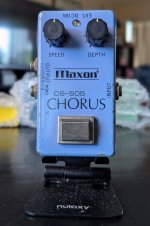
18v lavender stereo chorus has joined the party!
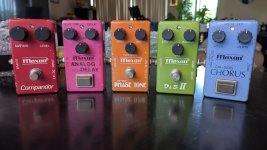
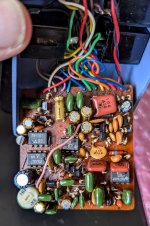
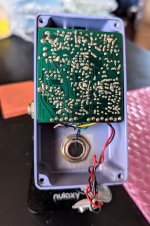
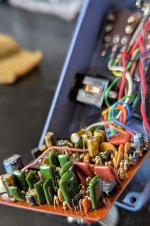
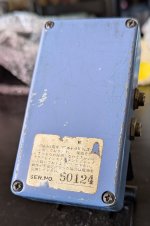
I really have to make demos for all these...
This chorus errs on the subtle end of the spectrum and is very musical. Sounds fantastic with distortion for an almost Brian May esque tone.
I also tried out it's stereo capabilities and although the 2nd output is a little weaker than the primary one, with a little DAW magic you can bring it up to unity and get a very wide effect.