
Cybercow
Well-known member
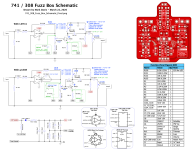
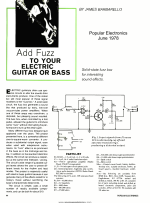
And here I was thinking I was done with working out any new dirt circuits. Then, in an old stack of papers, I very recently found a printed article from a June '78 Popular Electronics magazine. (With no recollection of how it got there.) It caught my interest and I went down a rabbit hole. The initial allure is the oddball dual-rail supply voltages - +1.5V and -3.0V, resulting in a less than perfect VRef value.
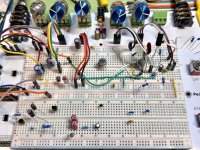
First, I redrew it for study and started tweaking & modifying. Then I built it on a breadboard, applying more mods and improvements, for proper testing. (After all, analysis is not always spot-on.)
The article's use of an LM741 single opamp to drive a PNP germanium BJT got me thinking to try out an opamp with an even slower slew-rate that the 741's 0.5V/µs value. So I swapped it out for µA308 can with its 0.3V/µs slew-rate. And after sorting out squealing with an added compensation cap, other caps were added to investigate potential boosts and/or tone controls.
Turns out that the 741 exhibited a significant difference with a 22µF drain cap to ground at its output. Without the added cap, the 741 renders a rather sharp (trebly) texture to the guitar's attack transient. Adding a 22µF cap smooths out that attack.
The 308, however, lost a lot of volume & went full-on muffled with a similar cap addition. But by trying out some lower cap values, the 308 started to get interesting. Thru further experimentation, I discovered that using just a 4.7µF cap after C1K rheostat, the addition of the rheostat and lowered cap value created a nice "Attack Tone" control. At its minimum sweep, the C1K renders a nicely subdued attack tone while rotating towards its maximum sweep, the C1K delivers a sweet, trebly attack tone.
The PNP germanium BJT needs to be low-leakage device with a gain value between 50 & 150. Outside those parameters, the circuit gets forty, splarty & altogether naughty.
The sustain in either configuration (741 or 308) is a bonus.
In summary, this is a very flexible etymology with regard to supporting component values and tweaks. Next, I'll be swapping the 741 for a LT1490 with a slew-rate of only 0.06V/µs. And while the LT1490 is a dual opamp, it's easy enough to use just one of the channels and isolate the other.
Next, I want to generate a PCB in KiCAD or EasyEDA. But I suk at getting started with new designs in either. Anyone interested in an assist? I can modify an existing PCB layout, but I've still a LOT of reading to do to get starting one.
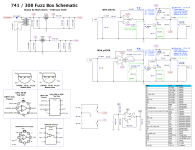
{EDIT}: Corrected schematic posted further down the thread. Got rid of the chargepump and regulators, going with a simpler resistor-based voltage divider with caps for a smaller parts-count.


First, I redrew it for study and started tweaking & modifying. Then I built it on a breadboard, applying more mods and improvements, for proper testing. (After all, analysis is not always spot-on.)
The article's use of an LM741 single opamp to drive a PNP germanium BJT got me thinking to try out an opamp with an even slower slew-rate that the 741's 0.5V/µs value. So I swapped it out for µA308 can with its 0.3V/µs slew-rate. And after sorting out squealing with an added compensation cap, other caps were added to investigate potential boosts and/or tone controls.
Turns out that the 741 exhibited a significant difference with a 22µF drain cap to ground at its output. Without the added cap, the 741 renders a rather sharp (trebly) texture to the guitar's attack transient. Adding a 22µF cap smooths out that attack.
The 308, however, lost a lot of volume & went full-on muffled with a similar cap addition. But by trying out some lower cap values, the 308 started to get interesting. Thru further experimentation, I discovered that using just a 4.7µF cap after C1K rheostat, the addition of the rheostat and lowered cap value created a nice "Attack Tone" control. At its minimum sweep, the C1K renders a nicely subdued attack tone while rotating towards its maximum sweep, the C1K delivers a sweet, trebly attack tone.
The PNP germanium BJT needs to be low-leakage device with a gain value between 50 & 150. Outside those parameters, the circuit gets forty, splarty & altogether naughty.
The sustain in either configuration (741 or 308) is a bonus.
In summary, this is a very flexible etymology with regard to supporting component values and tweaks. Next, I'll be swapping the 741 for a LT1490 with a slew-rate of only 0.06V/µs. And while the LT1490 is a dual opamp, it's easy enough to use just one of the channels and isolate the other.
Next, I want to generate a PCB in KiCAD or EasyEDA. But I suk at getting started with new designs in either. Anyone interested in an assist? I can modify an existing PCB layout, but I've still a LOT of reading to do to get starting one.
{EDIT}: Corrected schematic posted further down the thread. Got rid of the chargepump and regulators, going with a simpler resistor-based voltage divider with caps for a smaller parts-count.
Last edited:
 Could this be done without a charge pump?