Rangefinder schematic question

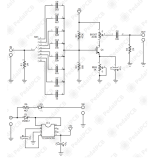
Hi there, I'm planning on building out a Rangemaster soon but I'd like to breadboard the circuit first... this is my first time using NOS parts and I just want to ensure everything works properly before doing the PCB work. I'm fairly new to the hobby so there's probably a pretty obvious answer to this question... I see there are two circuits in the schematic, what looks to be the main one, and then one for the that contians the IC/LED/1N5817. Is the latter one just for the switch/LED stuff? This would be my first build where there's an IC in the circuit.

Also, for the IC and GE transistor, would a TC1044SCPA and an MP20A be good options?

Thanks so much.

1777911251664.png
 
The bottom section is the power section. It uses a TC1044SCPA and few other parts to be able to provide -9V along with polarity protection (1N5817) from your wall wart or other power supply and powering on a LED.. If you're going to breadboard this first there is no need to use it. Simply flip your power rails (ground is positive rail and 9V is negative rail).

As to the transistor to use, I'll let others chime in, but that's the beauty of a breadboard. Just pop another sucker in there to see if you like it. I would also only choose one of the capacitors connected to the rotary switch just to make sure your circuit passes signal. It will make things less messy, but you'll have to swap out caps manually.
 
The bottom section is the power section. It uses a TC1044SCPA and few other parts to be able to provide -9V along with polarity protection (1N5817) from your wall wart or other power supply and powering on a LED.. If you're going to breadboard this first there is no need to use it. Simply flip your power rails (ground is positive rail and 9V is negative rail).

As to the transistor to use, I'll let others chime in, but that's the beauty of a breadboard. Just pop another sucker in there to see if you like it. I would also only choose one of the capacitors connected to the rotary switch just to make sure your circuit passes signal. It will make things less messy, but you'll have to swap out caps manually.
Wow, thanks so much! This is super helpful. So when I breadboard this, I can just build out the schematic and then essentially just plug the + side of my power source into the ground rail, - into vcc, and then swap any polarized components so their positive goes to ground?

And re: transistors, that makes sense--I'm planning on trying out a few different ones and see what I like best. I really appreciate the help!
 
Last edited:
I can just build out the schematic and then essentially just plug the + side of my power source into the ground rail, - into vcc, and then swap any polarized components so their positive goes to ground?
Yes, into the ground rail (9V plugged in).

You can also play around with different values for C3 and C4 to find what you like.

The Test Kitched forum has some great breadboarding tutorials.
 
Back
Top