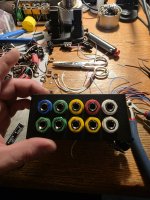
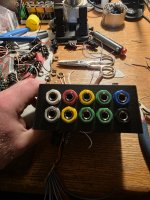
All In One Buffered Instrument Interface

anevilspar7an

Well-known member
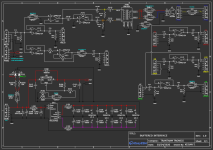
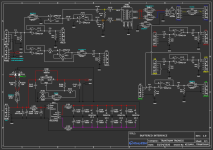
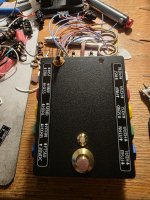
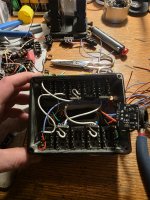
I am posting this to get some feedback on my schematic for my end all be all interface box with extras. I have buffered instrument in, buffered amp out, buffered send in and buffered return out. Additional features include a dedicated tuner out that functions as an instrument in split with phase inversion switch, an active xlr out based on Robert's MicroXLR project with a Cinemag DBX for galvanic isolation and a phase switch for pins 2 and 3. The power supply is based on a TRACO TEC 3-2423 to achieve ±15V for the OPA2134 opamp buffers. I have an LM317T to provide +18v/+9v for my phantom power depending on the instrument I use. I am also using a 1/4 jack for my power plug because I feel like it.
Schematic_buffer_2026-05-27.png
 

Attachments

  • Schematic_buffer_2026-05-27.png
    Schematic_buffer_2026-05-27.png
    154.8 KB · Views: 11
Gonna want to ditch the ground to the xlr and use an insulated jack.
Otherwise your ground lift isn't a ground lift. The xlr shield should be getting it's ground from the next device inline anyway.

If you're going full bells and whistles, an oscillator test signal wouldn't be a bad thing to have. With that much IO, it could be nice to replace the input with a test tone to find a bad patch/cable.
Maybe instead of a switch, use a pot with a switched off, to kill the power to the oscillator(avoid bleed). Use a cmos 555 (not a ne555)or a simple bit circuit.
 
Gonna want to ditch the ground to the xlr and use an insulated jack.
Otherwise your ground lift isn't a ground lift. The xlr shield should be getting it's ground from the next device inline anyway.
Gotcha, the xlr is the insulated plastic type like the one Robert specs for his MicroXLR so I just need to erase the ground coming off the xlr. The oscillator tester is intriguing, I'll have to study the circuit to see if I want to implement it into the box or have it as a standalone device. Everything else checks out in your opinion?
 
I'd go with modern FET opamps in the high impedance slots, IME something like OPA1641/1642 will likely sound nicer for this application.

Beyond that, I've had good experiences with the Traco power bricks and have been messing with various outboard power schemes for one of my basses for some time, so I'll be interested to see how this all works out for you.
 
Last edited:
I'd go with modern FET opamps in the high impedance slots, IME something like OPA1641/1642 will likely sound nicer for this application.

Beyond that, I've had good experiences with the Traco power bricks and have been messing with various outboard power schemes for one of my basses for some time, so I'll be interested to see how this all works out for you.
Just looked those up, SMD only so I'd need adapter boards since I'm doing through-hole for personal enjoyment, I'll throw those in my Mouser cart to test. This LM317T circuit is actually the second version, I had made a prototype and stuffed it in my old I/O box, it was essentially the example circuit in the data sheet with the potentiometer. I used a multimeter to monitor and turned it until I hit 18V, with this one I wanted to add 9V since some onboard circuits either can only handle 9V or sound better on it.
 
Just looked those up, SMD only so I'd need adapter boards since I'm doing through-hole for personal enjoyment, I'll throw those in my Mouser cart to test. This LM317T circuit is actually the second version, I had made a prototype and stuffed it in my old I/O box, it was essentially the example circuit in the data sheet with the potentiometer. I used a multimeter to monitor and turned it until I hit 18V, with this one I wanted to add 9V since some onboard circuits either can only handle 9V or sound better on it.
Ah, I saw an SMD device in your pic and thought you were maybe going that route anyway. Personally, I actually find SMT boards more enjoyable to work with by now, but vive la difference. For straight up buffers I'm not so sure you'll hear a meaningful difference with OPA1642 vs. the 2134, but in some clean bass preamp builds it's been pretty noticeable for me, and I'm no magic bean afficionado.
 
Back
Top