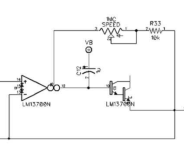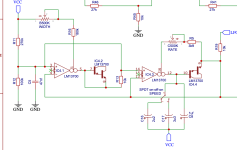

Small Stone circuit - reducing maximum LFO speed

dicecard

New member
Hi pedal wizards, got a simple question.

What are the required steps to reduce the maximum available LFO speed on a Small Stone circuit?

Let's take the LectricFX Space Harp v1 for example - I love its sound and the musicality of the Color mode, but the taper of the rate pot goes from a fast Leslie type sound to ring modulations in a few degrees of rotation.
I'd like to tame it somehow so that the entire sweep would be musical and easy to dial. As I understand it, changing the taper of the pot wouldn't do much here and changing the value to a smaller one would affect the minimum speed, not the maximum one. Any advice?
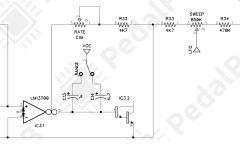
 
I compared the Space Harp (Small Stone) v1 circuit to the Circulator (Grand Orbiter), which is also a Ross/Small Stone type and has a variable rate range and found this.

Would I be correct in assuming that the C12 Capacitor (1uf) in the Small stone is analogous to C13 and C14 in the Grand Orbiter?

Since 1uf is the "default" value in both and the 4u7 cap is the "slower" range on the Orbiter, I can also assume that the larger the capacitor, the slower the sweep range. The 4u7/slow setting on the Orbiter is glacial while the 1uf goes from reasonably slow to unreasonably fast. The available inbetween values are 2u2 and 3u3, should I just buy one of each, socket them and see which I like the most? Are there any other parts I'd need to switch out then? (doesn't seem to be the case on the Orbiter as the switch controls only the capacitor value)
 

Attachments

  • OrbiterLFO.png
    OrbiterLFO.png
    78.1 KB · Views: 10
  • Smallstonev1LFO.png
    Smallstonev1LFO.png
    54.8 KB · Views: 10
I'm not an LFO expert but I simulated the PH-1 LFO the other day and more resistance made it slower

That makes sense to me because the corner frequency of an RC filter moves down when you increase the resistance

In your second example you could increase R33 to set a higher minimum resistance, and therefore reduce the maximum speed. If you're adding a lot of resistance you may want to decrease the pot by a similar amount else you may end up with an LF across the first half of the dial and an O on the other. Slow LFOs don't generally do the O bit quite as well
 
You could wire a smaller pot in series as a "fine" control.
There are 1Meg/100k dual concentric pots made for guitars. But that's not going to be C taper. I would try a 100k in series. Maybe with a center detent.
 
You're right about R33, but why would you want to reduce the speed? I love to increase the speed to get a ring mod sound.
I don't really have a use for that sound, a speed range like the Phase90 where it gets a perfect "fast Leslie/vibe" sound when cranked is optimal for me, as I can easily manipulate the knob with my foot while playing and not have to worry about messing up the sound
 
You're right about R33, but why would you want to reduce the speed? I love to increase the speed to get a ring mod sound.
To make it float even more nuanced in the back. Surely you've seen the little reviews under phasers here and there saying "good phaser, only wish it went slower" ?
 
Anyway, all this talk about resistors doesn't answer my question about the comparison with the Grand Orbiter circuit - on that one the range switch changes the Capacitor-to-ground between pins 5 and 7 of the opamp, not a resistor, so what's what?
 
Sorry I missed the grand orbiter question.

Yes you're right, increasing the value of c12 will slow the speed. Here is a Ross phaser I made with a few mods. I have adjustable speed like the grand orbiter. Try putting a 4u7 there and it will get pretty slow. This also slows down the max speed.

At 1uf this is a ringmod at fast speeds but at 4u7 the fast speeds are more tame.


Screenshot 2026-11-21 at 9.02.37 PM.png
 
Sorry I missed the grand orbiter question.

Yes you're right, increasing the value of c12 will slow the speed. Here is a Ross phaser I made with a few mods. I have adjustable speed like the grand orbiter. Try putting a 4u7 there and it will get pretty slow. This also slows down the max speed.

At 1uf this is a ringmod at fast speeds but at 4u7 the fast speeds are more tame.


View attachment 128187
I've seen the Grand Orbiter demos and 4u7 might be overkill, it's glacial at the slowest speeds and not fast enough for that Black Hole Sun-ish faux-Leslie effect. Could you post demos of your own phaser's rate range with the 2u2 and 3u3 caps? AFAIK the Orbiter is based on the Ross so it should be a fair comparison (also where did you get a Ross PCB? or is it a breadboard build?)
 
I've seen the Grand Orbiter demos and 4u7 might be overkill, it's glacial at the slowest speeds and not fast enough for that Black Hole Sun-ish faux-Leslie effect. Could you post demos of your own phaser's rate range with the 2u2 and 3u3 caps? AFAIK the Orbiter is based on the Ross so it should be a fair comparison (also where did you get a Ross PCB? or is it a breadboard build?)
Sure I’ll take a video and share it. 4u7 is probably too slow. The medium position on mode is 3.3uf and might be more what you are looking for.

And I had the pcbs made by JLCPCB. It’s something I put together. A Ross phaser with too many mids such as selectable stages from 2 to 8.
 
I've seen the Grand Orbiter demos and 4u7 might be overkill, it's glacial at the slowest speeds and not fast enough for that Black Hole Sun-ish faux-Leslie effect. Could you post demos of your own phaser's rate range with the 2u2 and 3u3 caps? AFAIK the Orbiter is based on the Ross so it should be a fair comparison (also where did you get a Ross PCB? or is it a breadboard build?)
Here is a video. the switch on the top right is speed. Slowest is up. Top right pot is width which is the shape of the lfo. This affects the speed as well
 
Back
Top