Posts are limited to 10000 characters — I never new that before...
Cont from post above:
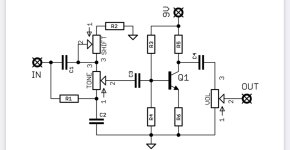
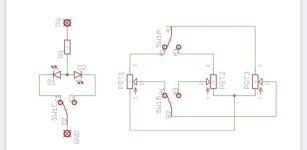
I often see "+" connected intersections in pedal schematics as opposed to "T". Not a big deal to me if I can see the connection easily. Some people loose their poopy if they see an arc where lines cross (see schematic below), doesn't bother me.
What I've learned is mainly that everyone who draws a schematic has their own way of doing it.
Here's one way to draw a simple two transistor fuzz, for instance:


REALLY? I'd rather look at a sloppy hand-drawn schematic that follows L-R & top-to-bottom flow (inputs left, outputs right) than burn my retinas with the above... At first glance it is legible and clear but... Has the person who drew it ever seen another schematic? A lot of what I've learned is just from looking at LOTS of schematics — most have a standard orientation and flow, and as a budding circuit builder I copy the common standard practices of what I see.
I've seen a circuit where one of the gain stages was inverted, took me a while to realise it, something was off/weird — once I figured out one gain stage was flipped I recognised it was Just Another Muff.
More 101 I've collected:
Resistor values should use the correct suffix (K not k), tolerance should be handled in notes, “e.g. all resistors 1/4W 5% unless noted otherwise”, and the “noted” should be another note.
SPECS: Capacitors, inductors, and resistors get specs instead of part numbers, BUT…
PART #s: Diodes, chips, fuses, oscillators, etc get actual part numbers.
BOM: include a bill of materials that contains all of the information (quantity, designator, manufacturer, part number, description, and other notes) for each and every component on the schematic. So the schematics show only the designator (C1, R45, L2) and the value (0.1uF, 47K, 680uH) for simple parts.
REFERENCE DESCRIPTIONS (ref des) and values go near the part and not near other parts. Be consistent, ex: if the horizontal resistors have ref des above and value below make sure ALL horizontal resistors have ref des above and value below.
'M' and 'm', have entirely different meanings: Big "M" is Mega- and little "m" is milli.
Convention is that positive exponents are uppercase and negative exponents are lowercase, so 'M' is always Mega and 'm' is always milli.
'm' is also the unit for meters
Technically the metric prefix for "kilo" is lowercase "k".
Uppercase "K" is the unit for Kelvins.
LESTRAVELED: I have compared schematic drawing to public speaking. You are communicating to others through the schematic. The schematic is not just a bunch of connections, it is a series of statements that communicate function and intent. Make each sub-schematic a clear statement or function. A badly drawn schematic makes the reader struggle to understand it. A well drawn schematic is understood in seconds.
A schematic is a language, learn to speak it well and everyone will listen. Do it poorly and you will speak to an empty room.
Sorry, don't have links for all the above sources of info.
BEARS REPEATING


:
Good schematics show you the circuit. Bad schematics make you decipher them.
So while I've toyed with some schematic concepts such as having all resistors and caps lay horizontally (really weird, really wide),
I generally just try to make my schematics as simple and clean-looking as possible.
C L A R I T Y