
Chuck D. Bones
Circuit Wizard
Those long wires don't help. Try to shorten the input & GAIN pot wires. This thing has a max gain of 500x and any cross-talk between wires can cause oscillation. A 100nF cap from pin 4 to pin 7 would be good too.


The only reason you can get away with leaving out the 100uF power supply bypass cap is because Robert put one on the circuit board. It's still a good idea to have local bypass on the power rails.I also don't need the 100uf cap in the power rails.
You're saying that from 0 (7:00) to 1 (8:00) not much goes on. I suppose that makes sense. Above that, you should get a steady increase in gain and then a HUGH jump in gain from 9 to 10. You did use C50K, right?The DRIVE control doesn't do much until about 8 o'clock regardless of the opamp used.
Yep.You're saying that from 0 (7:00) to 1 (8:00) not much goes on. I suppose that makes sense. Above that, you should get a steady increase in gain and then a HUGH jump in gain from 9 to 10. You did use C50K, right?
 ).
).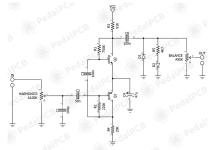
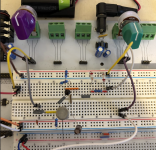

The Harmonic Percolator is a really fun little circuit. If you still have it on your breadboard, try playing with different values of R1. You can get some cool sub-octave undertones with large values (2.2M-5M). Replacing R3 or R4 with potentiometers is also a cool mod (try a B250k and a 62k limiting resistor for R3 or an A100k and a 1k limiting resistor for R4) that makes the texture more sputtery and changes where on the fretboard the sub-octave effect occurs.Our own @Stickman393 was super cool to throw some GE transistors my way for a few "classic" circuits. So here I decided to whip up a PPCB Percolation Station (Harmonic Percolator). Q1 had a hfe of 53 and Q2 had hfe of 174. What intrigues me about this circuit is that both transistors work together similar to a Fuzz Face.
First and foremost, I am not a fan of fuzz. It does not jive with my style of playing (I'm primarily a metalhead), however I do get the sonic appeal of this circuit and it was fun noodling around making some riffs. IMO this sounds best with the HARMONICS control wide open and adjust your guitar's volume knob to taste. For my setup there was a pretty high noise floor, but for now I'll chalk that up to it just being on a breadboard. Tons of harmonics come through to make a lot of 8-Bit sounds.
I did document my build process, so I'll throw together a breadboard tutorial for those that are interested. From what I have heard this circuit sounds better with some leaky transistors. Perhaps Chuck would be able to shed some light on this if he feels like being super cool and helpful (it IS holiday season after all
For the fuzz collector, this is a definite "yes". It's incredible unique.
View attachment 107084

I haven't done much tinkering with the circuit myself, but I picked out that 2N3565 towards the bottom of the gain bucket 'cause I'd read that was the ticket to getting them low octave toanz.The Harmonic Percolator is a really fun little circuit. If you still have it on your breadboard, try playing with different values of R1. You can get some cool sub-octave undertones with large values (2.2M-5M). Replacing R3 or R4 with potentiometers is also a cool mod (try a B250k and a 62k limiting resistor for R3 or an A100k and a 1k limiting resistor for R4) that makes the texture more sputtery and changes where on the fretboard the sub-octave effect occurs.