Bass with Onboard Nobellium

I was wondering if the twin tubes served as seperate preamps for the XLR and 1/4” out whether it was possible to run the two circuits in series. Drive (overdrive) one with the other. Not really something that’s important to me, was just thinking that if I was going to have a tube sitting there doing nothing, I might try and make use of it. Sadly I’m not the sort of guy who can look at a circuit diagram or PCB and say “so that’s how it works”, so I may ask some silly questions.

I tune my bigger basses down to F#0 (23ish hertz). A spectrograph of some recordings I have done shows basically zero content that low, however. The bulk of the notes come from the second and third harmonics (46hz and 69hz). The same applies to notes much higher.

Perhaps the Steddi Go fed by a traditional onboard EQ will accomplish what I am chasing and be easier to integrate in the bass?

Is there anywhere I can buy a completed Steddi Go? @SamuelG we might need to talk 😁
Building a nobellium right now, when that’s complete I will have a steddi go that will likely be sitting unused. I am in US so aus shipping probably isn’t worth it. But I highly recommend building it. Sounds great! I am using it with an active bass but with an amp/cab sim. I am switching to the nobellium to get rid of the cabsim and just run the eq. Maybe I need to mess with my bass eq more and see if I can get more out of the steddi go?
 
I mean I could build you a Steddi Go and ship it to Australia, I still send things down there from time to time. Let me know if the other options don't pan out and we can figure something out for you.
 
Hey Alex,
I got the iron on to do some soldering... but then I need to ask a few questions before I make that less-populated board for you.

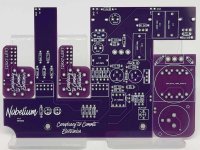
This PCB board is normally installed using two purpose made screw holes with the HPF switch and the 3 pots directly soldered onto the board.

If you don't want the switch and or pots directly soldered to the PCB, it will leave you with only two purpose made screw holes to fix the board in place. You'll want a 3rd (if not 4th) fixing point for the board?

This is super important: I am pretty sure that you need to be aware that you cannot safely cut or drill a hole in the PCB board.
There is a high-voltage flood plane on an inner layer of the PCB. If you cut into this, it will expose around 230V DC and that certainly can kill you.

So, before I begin soldering up a board. Would you please check that you are confident you can install this PCB board with only two screw hole mounts. In terms of your planning, it is the tube in the middle of the board that's used for the 1/4" out. So the tube needed for the XLR will be on the outside V1 position.

#vigilante398, would you please confirm or otherwise the High-V flood plane?
 

Attachments

  • C2CE NB.jpg
    C2CE NB.jpg
    185.8 KB · Views: 3
The power plane is a split plane with a HV section and a 9V section. I can pull a picture when I get home and show which is which, I'm in the bleachers at a swim meet right now
Hey Alex,
I got the iron on to do some soldering... but then I need to ask a few questions before I make that less-populated board for you.

This PCB board is normally installed using two purpose made screw holes with the HPF switch and the 3 pots directly soldered onto the board.

If you don't want the switch and or pots directly soldered to the PCB, it will leave you with only two purpose made screw holes to fix the board in place. You'll want a 3rd (if not 4th) fixing point for the board?

This is super important: I am pretty sure that you need to be aware that you cannot safely cut or drill a hole in the PCB board.
There is a high-voltage flood plane on an inner layer of the PCB. If you cut into this, it will expose around 230V DC and that certainly can kill you.

So, before I begin soldering up a board. Would you please check that you are confident you can install this PCB board with only two screw hole mounts. In terms of your planning, it is the tube in the middle of the board that's used for the 1/4" out. So the tube needed for the XLR will be on the outside V1 position.

#vigilante398, would you please confirm or otherwise the High-V flood plane?
Is this a suitable solution -
The bass and treble pots get wired to the board and mount directly to the wood on the bass, same goes for the HPF switch. A third pot (volume for XLR) would be remotely mounted. Basically the whole things hangs off the two pots and the switch.
 
Is this a suitable solution -
The bass and treble pots get wired to the board and mount directly to the wood on the bass, same goes for the HPF switch. A third pot (volume for XLR) would be remotely mounted. Basically the whole things hangs off the two pots and the switch.
I would like to ask Alex some things, where would you prefer the tube to be mounted on your bass guitars ?
Next to the pots and switches or removed from them ?
Do you have a preferred alignment of the pots and switch ?
Do you need the HPF switch at all with your extra low frequency setups ?
If the tube / PCB is set away from the pots / switch how would you like to mount it (pick guard, onto wood etc ) ?
If it is possible to add a Mid pot would you like one added (R21 could be a 5k or 10k pot) ?
I have noticed that you sometimes have no faceplate for the pots and no pick guard so I am wondering what would be best for you.

The power plane is a split plane with a HV section and a 9V section. I can pull a picture when I get home and show which is which, I'm in the bleachers at a swim meet right now
I would love to see a picture of the Cu flood plane of the internal layers, it would be very useful.
Would you make the current volume pot a fixed 250k resistor or just omit it altogether since the second tube will not be used ?

Thanks
Mick
 
Last edited:
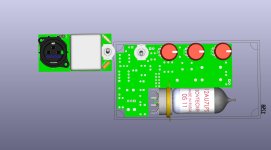
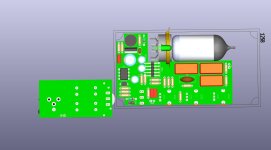
If the XLR daughter card is used then all the components could fit on a standard 125B size PCB, I threw all the components on for a quick check.
It would just be a matter of working out where the tube and pots should be located in relation to each other, and also mounting holes if needed. Nobelium XLR only1.jpg Nobelium XLR only2.jpg
 
I would like to ask Alex some things, where would you prefer the tube to be mounted on your bass guitars ?
Next to the pots and switches or removed from them ?
Do you have a preferred alignment of the pots and switch ?
Do you need the HPF switch at all with your extra low frequency setups ?
If the tube / PCB is set away from the pots / switch how would you like to mount it (pick guard, onto wood etc ) ?
If it is possible to add a Mid pot would you like one added (R21 could be a 5k or 10k pot) ?
I have noticed that you sometimes have no faceplate for the pots and no pick guard so I am wondering what would be best for you.


I would love to see a picture of the Cu flood plane of the internal layers, it would be very useful.
Would you make the current volume pot a fixed 250k resistor or just omit it altogether since the second tube will not be used ?

Thanks
Mick
Hi Mick,

I will confess that we’re starting to talk at an electronic level on the limits of my knowledge.

1. Preferably, if put the tube under the strings, but it really doesn’t matter
2. No preferred alignment, but I guess bass should be at the bridge end, treble at the nut end of the body.
3. Definitely do not need the HPF switch
4. I was thinking the whole setup would be recessed and mounted to as 3-4mm thick piece of wood (from the underside) mounted on the front. Think a recessed pickguard made from wood.
5. A mid pot would serve some use for sure, but not essential.

It would be great to have a PCB designed around my basses, but I also have the ability to design a bass around a PCB. I certainly like how you are thinking, however!

Referencing your second post, it almost looks like it could all fit in the normal electronics cavity area.

My basses often have no controls, as I do my tone shaping offboard. This is a little different though, as it will go into my gigging bass, where I need a high quality pre and DI onboard.
 
Back
Top