
Hi all,
Schematic is over here: Link
I wanted to try this out for quite some time. But I wanted to build it without the 8V regulator. Going from 9V to 8V seems a bit meh. The problem is, in my opinion, that the TLC2272 opamp is max rated for -8V to +8V, so in that sense the regulator makes sense.
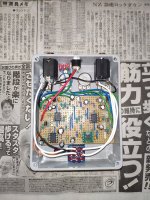
TLC2272 seems to be CMOS input rail-to-rail and if I'm not mistaken it's only used as a bit of an input boost and gain recovery stage after tone stack at the output. So I replaced it with an OPA1678, which is also CMOS input and rail-to-rail, but it can handle higher supply voltages, I think. And then I dropped the regulator and instead went with 1N5817 and a 27r in series with the power supply. I get about -8V to +8V from that, depending on the power supply. I also added a 12V Zener to protect the charge pump.
I tried both opamps TLC2272 and OPA1678… obviously not a proper A/B test, but I couldn't tell any difference. So I kept the OPA in the pedal as planned.
The pedal sounds great. It's a mild to high gain distortion as advertised. Not the highest gain pedal I ever played, but it has a really good amount. It can rock out, no booster required.
It sounds like a distortion, sure, but it has a bit of a fuzz texture. Not too much so, but it has that character. And it stays pretty tight as far as low end is concerned.
Speaking of low end, with humbuckers when you turn up the bass at ca. 2 o'clock it starts to overload a bit and if you dial bass higher it sounds like the pedal is dying. I saw the same on some youtube video. But well, could be used for effect as well I guess.
What I don't like is that when you turn down the gain all the way the pedal goes silent. Anyway, moving on.
All in all I like it. It's got character and background noise is low .
P.S.: not posting a pic of the front of the pedal. I used a lot of red on the decal and it completely bled out. Will have to redo the case at some point.
P.P.S.: The note decay is quite natural. Not fizzing out. Often that is not the case with distortion pedals, so this one gets it right.
Schematic is over here: Link
I wanted to try this out for quite some time. But I wanted to build it without the 8V regulator. Going from 9V to 8V seems a bit meh. The problem is, in my opinion, that the TLC2272 opamp is max rated for -8V to +8V, so in that sense the regulator makes sense.
TLC2272 seems to be CMOS input rail-to-rail and if I'm not mistaken it's only used as a bit of an input boost and gain recovery stage after tone stack at the output. So I replaced it with an OPA1678, which is also CMOS input and rail-to-rail, but it can handle higher supply voltages, I think. And then I dropped the regulator and instead went with 1N5817 and a 27r in series with the power supply. I get about -8V to +8V from that, depending on the power supply. I also added a 12V Zener to protect the charge pump.
I tried both opamps TLC2272 and OPA1678… obviously not a proper A/B test, but I couldn't tell any difference. So I kept the OPA in the pedal as planned.
The pedal sounds great. It's a mild to high gain distortion as advertised. Not the highest gain pedal I ever played, but it has a really good amount. It can rock out, no booster required.
It sounds like a distortion, sure, but it has a bit of a fuzz texture. Not too much so, but it has that character. And it stays pretty tight as far as low end is concerned.
Speaking of low end, with humbuckers when you turn up the bass at ca. 2 o'clock it starts to overload a bit and if you dial bass higher it sounds like the pedal is dying. I saw the same on some youtube video. But well, could be used for effect as well I guess.
What I don't like is that when you turn down the gain all the way the pedal goes silent. Anyway, moving on.
All in all I like it. It's got character and background noise is low .
P.S.: not posting a pic of the front of the pedal. I used a lot of red on the decal and it completely bled out. Will have to redo the case at some point.
P.P.S.: The note decay is quite natural. Not fizzing out. Often that is not the case with distortion pedals, so this one gets it right.
Attachments
Last edited: