Analog Tube Power amp simulator: studying possibilities

Could you share preamp schematic?
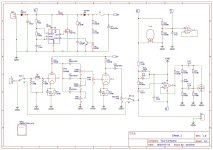
Sure. It's a simplified Fender AB763. The schem is the preamp with the DI Out. The Astrosim would go in between.
Preamp+DI-out.jpg

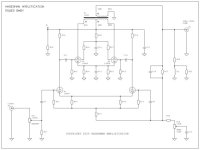
Edit. Looked astrosims schematic. 1M/470K divider before IC and some EQd feedback part to make the amp simulation going there too. I’d try replacing 470k resistor with 1M pot or add 500k pot before 470k resistor to see what it does.
You're talking about R3, correct?

Thanks :)
Cheers
Sono
 
Last edited:
Sure. It's a simplified Fender AB763. The schem is the preamp with the DI Out. The Astrosim would go in between.
View attachment 117275

Thanks :)
Cheers
Sono
For my taste and needs 100nF between tube stages is just too much and lets too much lows through which only causes problems. And I play with low tuning. 47uF cathode bypass cap is also one I’d change.

I’d do it like this:
C5 1-4.7uF
C9 20-25uF
C10 10-22nf

Maybe you overload ampsim with low freq content & gain?
 
For my taste and needs 100nF between tube stages is just too much and lets too much lows through which only causes problems. And I play with low tuning. 47uF cathode bypass cap is also one I’d change.

I’d do it like this:
C5 1-4.7uF
C9 20-25uF
C10 10-22nf

Maybe you overload ampsim with low freq content & gain?
Maybe you're right. I'll try what you suggest and report back :)
Thanks!
 
Has this been traced at all or is there a schematic for something similar?
There was one attempt, but so far there is silence on the subject.

Am I mistaken or these are digital units? As a building hobbyist, I'd rather stay away from digital (at least for now hehe)

Yes, digital. If there was anything sensible in the analog version, we would probably have recommended it long ago.

I just read through that thread and that Bajaman circuit sounds (no pun intended) quite interesting and promising actually.

P&R isn't a PA simulation. It's just a small area of operation of a tube power amp—the interaction between the PA and the speaker. And if you look at the frequency response, it's actually a bit of EQ. It sounds good, it brings the sound to life. But it doesn't pretend to be a tube sound.

I also realized that I missed your post on the first page of THIS thread where you mention many Bajaman circuits that all seem to include a poweramp simulation...🤦‍♀️
Also, on the thread you linked about Bajaman's Presence and Resonance circuit, there's a link to Bajaman's Reactor. After also reading that thread I've got a couple of questions that maybe you could clarify for me :)

- The poweramp sims on the Bajaman circuits (Humble, TW, HiWatt, 5e3, etc) are they the same as the P&R circuit, or more like the Reactor, or a completely different approach?

These are different approaches. In the case of the Bajaman (Humble, HW, 5e3), pay attention to the diodes and transistors used to clip the signal (symmetrically or asymmetrically). P&R doesn't do this.
Reactor - does the same as P&R plus diodes to simulate the power amp tube saturation.
There are my samples in the threads on fsb, but you'll probably have to try it yourself, with your own equipment.

One thing to note: these circuits operate on 9V. The headroom is rather small. From a tube preamp, you'll probably get a signal like a train horn at a railway crossing...


- Are the Thunderbird or the Mofeta power stages any different or the same concept?

- You seem to have built and heard a few of these circuits. Which one would you recommend to build and test, using a tube preamp and Deadasronaut's Astrosim as a speaker emulation into a mixer?
Not really... PAE2 looks promising (my opinion based on Gearpage comments) but I doubt the schematic will appear anytime soon.
I'm still waiting for something big. Not a good chance considering a lot of things have moved to 0110011001
 
You're talking about R3, correct?
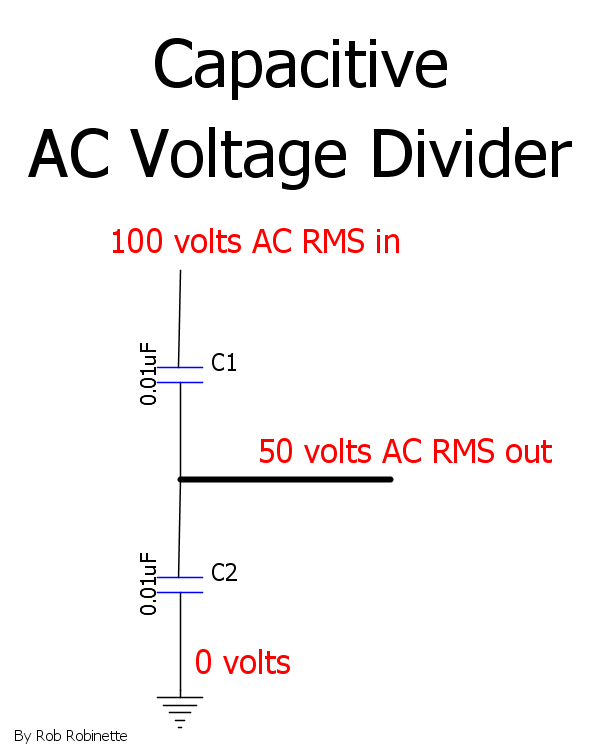
Yeah, BUT maybe this could work better attentuating AC signal going to IC.

Capacitive_Voltage_Divider.png


So maybe a quickie with alligator clipping 22nf cap between C2 and R3 to ground could do the trick. It would halve input signal strength.
 
These are different approaches. In the case of the Bajaman (Humble, HW, 5e3), pay attention to the diodes and transistors used to clip the signal (symmetrically or asymmetrically). P&R doesn't do this.
Reactor - does the same as P&R plus diodes to simulate the power amp tube saturation.
There are my samples in the threads on fsb, but you'll probably have to try it yourself, with your own equipment.

One thing to note: these circuits operate on 9V. The headroom is rather small. From a tube preamp, you'll probably get a signal like a train horn at a railway crossing...

I guess it's time to che ck it out and breadboard then !!
Thanks for all the info Temol :)
 
Yeah, BUT maybe this could work better attentuating AC signal going to IC.

Capacitive_Voltage_Divider.png


So maybe a quickie with alligator clipping 22nf cap between C2 and R3 to ground could do the trick. It would halve input signal strength.

Johnny thanks a lot for your suggestions. I think that before modding the Astrosim I'm going to try Bajaman's Reactor in between the preamp and the Astrosim and I'll report back. ;)
 
FWIW, there are a few commercial amps that feature specific emulations of tube poweramp dynamics:

- The Traynor DG60 and DG65 have an LM13600-based compressor with moderate clipping,

- The Ampeg SVT-8 pro has a full sag, dynamics and crossover distortion emulator as last stage of the preamp,

- The Peavey Transtube series feature a dynamic crossover distorion emulator coupled to the poweramp.

Any of those before a reactor / cabsim and after a preamp should give a bit more liveliness to the signal. Some are quite picky about input amplitude though, so a bit of experimenting will be needed.
 
I don’t have a link handy because I’m on my phone but I know there is a lot of documentation about Peavey’s methods of emulating tube sound with solid state. I can’t remember off the top of my head if the writing I’m thinking of gets into power amp emulation but I’ll edit this post with a few links once I’m at a computer today.
 
Back
Top