Aleph Null Cremulator Troubleshooting Low Frequency Oscillation

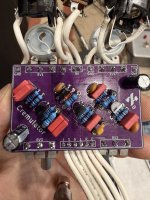
Got it built up, everything seemed fine at first but when I take the fuzz knob to the last 1/4 or so of its travel I get a strong low frequency oscillation. Worked with @Aleph Null via DM and tried swapping several components to no avail, so it was suggested to come here and seek the wisdom of the forum sages...
 

Attachments

  • IMG_9567.jpeg
    IMG_9567.jpeg
    534.1 KB · Views: 26
While it's oscillating, does manipulating the wiring change the sound?
No, I’ve played with lead dress and wire proximity every which way and nothing diminishes the hum.

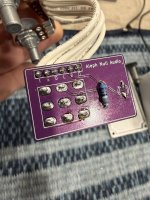
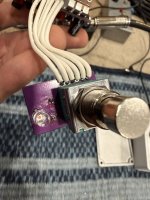
Can we also get pictures of the top and bottom of the bypass board?

IMG_9581.jpeg
IMG_9582.jpeg

did the film cap at the top left, 1 down, get a little toasted with the iron?

The housing got chewed up when it was initially pulled for the first round of component swaps. It’s socketed now and different values have been auditioned to no avail, so now it’s back to the stock cap that got mangled slightly.

——

It’s curious that it doesn’t present when nothing’s in the input. It’s like the pot itself is hella microphonic but that doesn’t explain why it only presents when there’s a plug in the input.
 
Well, I'd say cut the trace at the gate of Q1, then tack on a 10K resistor from the gate pad to the pad of C1.

Edited post to change value to 10K
Extreme measures my be required. The capacitor should look like a short to an AC signal. Any reason not to tack the resistor in front of the cap? Might be a less invasive procedure.
 
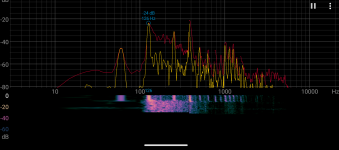
I used a spectrum analyzer on the recording you shared.
Screenshot_20261007-220254.png
It looks to be a multiple of 60Hz which would support jubal81's hypothesis that it's related to dirty power. You said that it oscillates when the guitar is plugged in, but not when it's disconnected, right? If you connect the guitar and turn the guitar volume down does it still oscilate?
 
I used a spectrum analyzer on the recording you shared.
View attachment 125808
It looks to be a multiple of 60Hz which would support jubal81's hypothesis that it's related to dirty power. You said that it oscillates when the guitar is plugged in, but not when it's disconnected, right? If you connect the guitar and turn the guitar volume down does it still oscilate?
Yeah, oscillates regardless of instrument volume position.

Has anyone tried using a fresh 9V battery as the power supply to rule out or further implicate dirty power?

I’ve tried a battery, One Spot, and a isolated power supply - no change.
Well, I'd say cut the trace at the gate of Q1, then tack on a 10K resistor from the gate pad to the pad of C1.

Edited post to change value to 10K

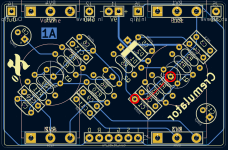
Where are these points on the PCB?
 
Cremulator Back.png

Here's the view from the back of the board. Jubal81 is suggesting you cut the trace in red, then reconnect the pads circled in red with a 10k resistor. I'd recommend soldering the resistor to the back of the board.

A less permanent, though possibly less effective, approach would be to replace the wire that connects the "S" pads on the main and bypass boards with a 10k resistor.
 
View attachment 125826

Here's the view from the back of the board. Jubal81 is suggesting you cut the trace in red, then reconnect the pads circled in red with a 10k resistor. I'd recommend soldering the resistor to the back of the board.

A less permanent, though possibly less effective, approach would be to replace the wire that connects the "S" pads on the main and bypass boards with a 10k resistor.
Hold off on that, I tested the proposed fix and it made things worse. Stand by.
 
Okay here's my methodology before we get into some possible solutions to try.

- I breadboarded the circuit
- I tried benchtop, pedal board brick with and without filtering, and battery.
- Battery is the only place where I experienced any oscillation, and my mains power is the cleanest of trash.
- Tried series resistance between IN and Q1 gate and also with Q2, and I didn't hear any marked improvement and most times made it worse

I would omit C3, and reduce the value of C4. I did this on a whim, and making C4 to be 1n5 completely eliminated the oscillation. Stepping up values as well: 2n2, 2n7, 3n3, 3n9 were passable, then to 4n7 where it was really the ceiling in my opinion. This fix does somewhat dull the highs when you roll off Fuzz from full CW (with C4 = 1n5). but you can recuperate some of that with the Tilt and Mids control. It doesn't bother me much, to be honest.
 
Just finished populating a Cremulator board in plain vanilla fashion, as laid out in the build BOM, and fired it up. I got the LF oscillation in the last ¼ to ⅓ rotation of the Fuzz pot too. I pulled C3 and just see/hear what it does in the circuit, I fired it up again without C3 and kept touching it back in its place with audible difference. So I agree with jessinator's point that it can be removed. I left C4 at the original 15nF value.

I thought maybe the A100K pot was a bit much so I replaced it with an A50K, but still got the LF oscillation in the last ¼ to ⅓ rotation of the Fuzz pot. So I put the A100K Fuzz pot back, but lifted leg 3 and inserted a 47K resistor between lug 3 and hole where it's supposed to go. That greatly tamed the oscillation in the last ¼ to ⅓ rotation of the Fuzz pot. However, it somewhat diminished the guitar volume pot ability to clean up when the Fuzz pot is below ~50%.

I tried the above scenarios with both a fresh 9V battery and Trutone One Spot with no detectable differences in the anomaly.

 
Last edited:
Just finished populating a Cremulator board in lain vanilla fashion, as laid out in the build BOM, and fired it up. I got the LF oscillation in the last ¼ to ⅓ rotation of the Fuzz pot too. I pulled C3 and just see/hear what it does in the circuit, I fired it up again without C3 and kept touching it back in its place with audible difference. So I agree with jessinator's point that it can be removed. I left C4 at the original 15nF value.

I thought maybe the A100K pot was a bit much so I replaced it with an A50K, but still got the LF oscillation in the last ¼ to ⅓ rotation of the Fuzz pot. So I put the A100K Fuzz pot back, but lifted leg 3 and inserted a 47K resistor between lug 3 and hole where it's supposed to go. That greatly tamed the oscillation in the last ¼ to ⅓ rotation of the Fuzz pot. However, it somewhat diminished the guitar volume pot ability to clean up when the Fuzz pot is below ~50%.

I tried the above scenarios with both a fresh 9V battery and Trutone One Spot with no detectable differences in the anomaly.
I'm greatly comforted to not be the only one having this experience. Wracking my brain to try to figure out if I'd somehow done something wrong somewhere but couldn't point to anything, so I'm glad I'm not alone.
 
I'm sorry guys. I can't get my PCB or the circuit on the breadboard to oscilate. Battery or PSU.

@Cybercow would you be willing to test a 1.5nF cap for C4 and report back? Also, are you using regular ceramic caps for the picofarads caps, or MLCCs? I'm trying to think of other differences between my build and yours.
 
I'm sorry guys. I can't get my PCB or the circuit on the breadboard to oscilate. Battery or PSU.

@Cybercow would you be willing to test a 1.5nF cap for C4 and report back? Also, are you using regular ceramic caps for the picofarads caps, or MLCCs? I'm trying to think of other differences between my build and yours.
not sure if useful - but i still have my breadboard build (didn't notice any oscillation at maximum fuzz)
 
Okay, another interesting fix:

I replaced all of my BS170s with 2N7000s, and with everything else in the stock configuration, no oscillation at all.

I went back, tested, and I can get away with replacing only Q1 and I get the same result. I then swapped Q1 with 8 different 2N7000s just to make sure. Completely oscillation free on all power types.

The 2N7000 pinout is just 180° from the BS170, so an easy swap.
 
I'm sorry guys. I can't get my PCB or the circuit on the breadboard to oscilate. Battery or PSU.

@Cybercow would you be willing to test a 1.5nF cap for C4 and report back? Also, are you using regular ceramic caps for the picofarads caps, or MLCCs? I'm trying to think of other differences between my build and yours.
I use MLCC pF caps where pF is called for - always.
Sure. I'll swap out C4's 15nF for a 1.5nF in the morning and report back. (The house is in quiet-time mode for the evening.) I'll even jumper the 47K resistor I placed between lug 3 of the Fuzz pot and the board to hear how that goes.
not sure if useful - but i still have my breadboard build (didn't notice any oscillation at maximum fuzz)
To my ears, it's not really an "oscillation", rather a low, somewhat cyclic 'thrumbing' - an exaggerated boominess if you will. Not sure if it's from palm muting & picking up my pulse or micro hand movements - or if it's an interaction between my guitar's impedance and the circuit. But it goes away when I turn the volume full CCW on my guitar.

I'll also unplug the guitar while it's fired up and hear what happens then report back.

And as a shot in the dark, I wonder what happens when a 1M resistor is placed in parallel with the input before and/or after C1. Can't help but think the circuit "might" have an issue with certain guitar impedances.
 
I've tested with PAFs, hot strat pickups, vintage tele pickups, and EMGs. No oscillation on any power source. I can get boomy low end with the Fuzz up, but it sounds like speaker/pickup interaction, not the foghorn oscillation that ThomasAvenue is getting.
 
Okay, another interesting fix:

I replaced all of my BS170s with 2N7000s, and with everything else in the stock configuration, no oscillation at all.

I went back, tested, and I can get away with replacing only Q1 and I get the same result. I then swapped Q1 with 8 different 2N7000s just to make sure. Completely oscillation free on all power types.

The 2N7000 pinout is just 180° from the BS170, so an easy swap.
Now I’m glad I socketed Q1!
…but, naturally, I have no 2N7000s…
 
Back
Top