0.2V determines whether pedal powers on or not?

pricklyrobot

Well-known member
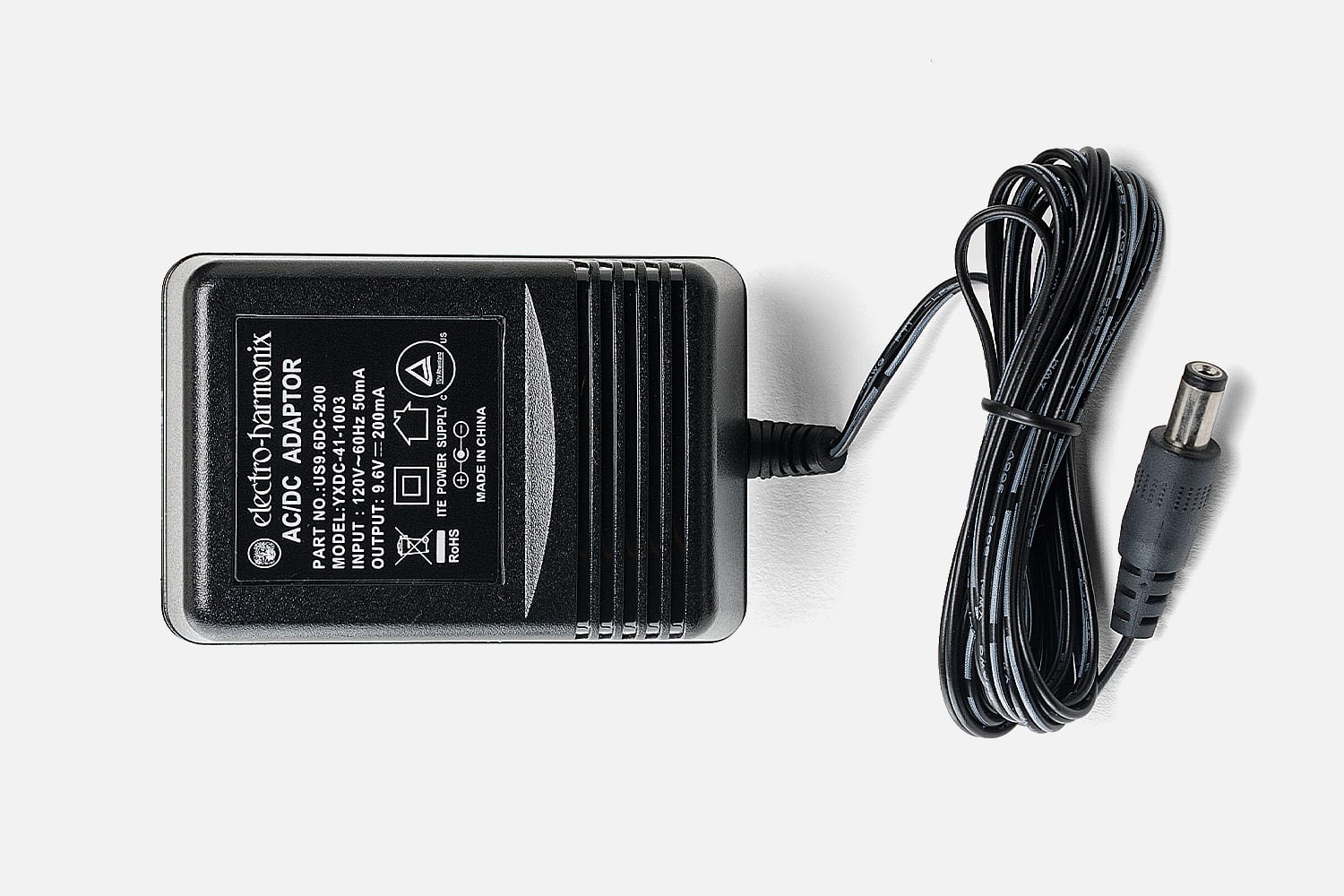
Pulled out my EHX V256 Vocoder pedal after not having used it in a little while (maybe a few months) plugged it in with the EHX power supply that it came with (9.6V 200mA center neg.) and nothing. No LEDs.
So quickly grabbed a couple other pedals to see if the supply was faulty. Had a Cathedral and a Ring Thing handy. They both lit up right away.

Happened to have two other EHX supplies (same exact specs) handy. Plugged them into the V256, and it turned on with both.

So now it’s time to break out the meter. The supply that wouldn’t power the V256, but would work with everything else I tried, measured 9.6V
The other two that did power the V256 measured 9.8V

So, did the original supply ‘lose’ .2V, or did the V256’s voltage demand somehow go up by .2V?
And how would either of those things happen? And why would it have such a narrow voltage range that it works in, in the first place?

Debating whether I should open up the V256 and poke around, or just swap in one of the power supplies that works and call it a day.
 
Check the voltage of the original supply under load. Put a beefy 50ohm resistor (1w or more) across its output (to draw about 200mA) and see if it holds the voltage. You can make a beefy 50ohm out of 4x 200 Ohm in parallel if you don't have one.
 
Check the voltage of the original supply under load. Put a beefy 50ohm resistor (1w or more) across its output (to draw about 200mA) and see if it holds the voltage. You can make a beefy 50ohm out of 4x 200 Ohm in parallel if you don't have one.
👍 Sounds easy enough. Will give this a try tonight or tomorrow and report back.

I tend to agree with @DDad . A voltage drop could be a symptom of a resistive internal short using up current internally.
You mean internal to the power supply, or the pedal?
 
Strange behavior there.

Those are all fairly high draw pedals, I can't imagine why three identical PSUs wouldn't work for all three.

Any chance the "faulty" PSU has a 2.5mm barrel plug on it and the pedal has a 2.1mm jack?

It's an arrangement that *can* work if you nudge it just right.
 
  • Like
Reactions: spi
So, just had a chance to get back to this today.
I tried the “questionable” power supply again with the Cathedral and Ring Thing and now it appears to not be powering them correctly. All preset LEDs come on and stay on, rather than the normal start up state. Seems like they’re getting stuck in “boot up”. So it seems this power supply has decayed even more from a few days ago.

I remembered I had one of those One Spot mA meters in the closet, so I pulled that out and did some checking with the good power supply. Cathedral and Ring Thing are both pulling 185-ish mA, but the V256 is pulling a consistent 230-235 mA.
All the EHX supplies are rated for 200mA, and the V256 manual claims 200 is all it needs.

I guess if the V256 was pulling too much current through that original supply, maybe the excess heat degraded the transformer over time? 🤷‍♀️

Anyway, thinking I should look around for a 300mA + supply for the V256, just to be safe.
 
The current limit in a power supply is there to protect the power supply. It is not going to be precise and the corner between constant-voltage mode and current-limit mode may be soft. All this is to say that we don't want to run the power supply anywhere it's rated current if we want reliable operation. There may not be anything wrong with the power supply.
 
So now the question is:
• is there something wrong with the pedal that’s making it pull too much current?
• or did EHX just cheap out and give it an under-spec power supply they figured was close enough?

Anyone else got a V256 they can measure and see if 235 mA is normal or not?

** I just tried hooking up what should be a really low draw pedal (my old GGG Foxx Tone clone). On the good supply it shows 2mA, on the ‘bad’ supply the pedal LED lights up but the meter reads 000.

Sooo, that supply definitely seems wonky. But that doesn’t necessarily mean the V256 isn’t also gobbling too many electrons… 🤷‍♀️ 🤔
 
Last edited:
Is it this one?


Thoughts:

Its a "linearly regulated power supply".

Pretty simple. Transformer, bridge rectifier, couple of caps, voltage regulator. Probably an Lm7809, or a similar arrangement.

The PSU I'd venture a guess that the large smooting electrolytic capacitor has failed or is failing. That would result in reduced voltage under load and possibly higher current...depending how the pedal is designed.
 
I might be off base here, but I have seen the following behavior at work:

I've seen something similar happen with belt drives on big fan assemblies with AC motors being controlled by VFDs at work.

This has to do with "Watt's law". Watts = Volts X Amps. If Watts remains the same, but voltage decreases, amps must increase.

The motor in question was a 460vac, 15HP motor rated at 18 amps at full load.

The problem was that the person who did the work went from like a 2:1 ratio (1800rpm motor @ 60hz, 900rpm fan) to something like a 1.5:1 ratio (1800rpm motor @ 60hz, 1350rpm fan)

Here's why that was too drastic of a change:

The power requirement to operate that specific fan in that specific system at 900RPM is a *constant* it does not change.

The motor had been operating previously at 60hz, 460volts, and 12amps driving the 900rpm fan.

The motor had some headroom: it was capable of driving the fan a bit faster and getting a bit more airflow out of the fan. But the dude who redid rhe pulley ratio went *way too far".

Now, with the new pulley arrangement, the same motor was driving the fan at 900RPM while the motor was rotating at 1200RPM, at an AC frequency of 40hz. Decreasing the frequency delivered to AC motors like this decreases the voltage that they "see". If voltage decreases but the energy required to drive the load remains the same, then the motor will "attempt to make up the difference" by drawing more current.

In this case, the voltage was 330vac @ 40Hz, and the motor was now drawing 1I've seen this happen with belt drives on big fan assemblies with AC motors being controlled by VFDs at work. Somebody fucks with the pulley ratio on a fan trying to get more airflow out of the fan, overshoots their target, and suddenly the motor is drawing full load amps.

So...why did I go into all that? I think there's a good chance that the voltage of that PSU is dropping when you plug it into a load. The excessive amp draw could be the result of the load "attempting to meet" its operational energy requirements while the voltage sags.

This could be caused by a connection that has developed a bit of resistance. Or it could be a failed or failing smooting capacitor. Both, under load, would result in a reduced DELIVERED voltage, but sitting idle with no current demand the voltage would appear normal.

I'm comparing a little bit of an apples to oranges situation here: an AC motor versus A DC pedal, and there could be blind spots to my own knowledge base.
 
Back
Top