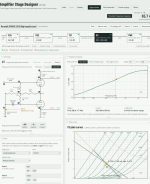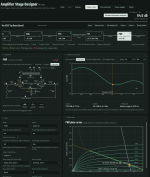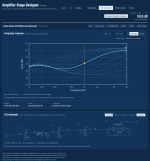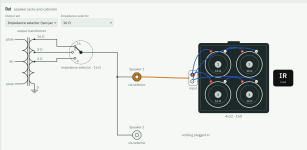
WIP - Amplifier Stage Designer (tool) - v0.3 (15.11.26)

Asdrael

Well-known member
Shortcut: v0.3 released in this post below so taking v0.1 and v0.2 down

Hi all,

Out of frustration with LTSpice, I've been building a tool for designing guitar tube amps stage by stage, and it's at the point where I need people other than me to use it. It's a single HTML file: no install and no account, and it (should) run offline in any browser.

What it currently does:
  • You build the amp from blocks: triode, parallel triode, cathode follower, tone stack, long-tailed pair, cathodyne, push-pull or single-ended power stage, and global NFB to any point. The networks between blocks are editable too: coupling caps, volume pots, dividers, bright caps.
  • The whole amp is solved as one circuit, so loading between stages, local feedback, NFB, bias and the supply all interact the way they would in a real amp.
  • For each stage you get:
    • the operating point,
    • DC and AC load lines on the plate curves,
    • clean swing and headroom,
    • gain,
    • warnings when something exceeds a rating.
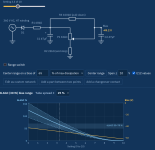
  • Frequency response per block and for the whole amp, with a pot sweep that overlays settings 0–10 of any pot with a front panel type simulation.
  • Any part can be a network, e.g. 2.7k || 680nF or 10k + pot#gain. Named pots work anywhere, as a pot or a rheostat. Parts can be dragged onto the schematic or moved, and right-click rotates them.
  • Tube models are Koren fits to datasheets, including grid current and Miller capacitances. A Tubes tab lets you fit your own models to points read off plate curves.
  • Output transformers include primary inductance, leakage and winding resistance, and you can pick from Hammond's 1750, 1608–1650 and 1650A series. Other series are easy to implement, the issue is finding the data in a way that makes sense.
  • Bias can be set by voltage, mA or % of plate dissipation. Typical circuits are included.
  • A couple of Stock designs to start from, inspired from available schematics and should in no way be seen as 100% truth.
  • Power Supply can be either ideal (ease of use) or modeled with a supply line, transformer, rectifier etc.
  • (Channel) switching.
What it doesn't do (yet)
  • It's small-signal and DC only. No clipping, compression, class AB behaviour, sag, ripple or hum. A transient engine will be coming once the fundation (UI, power supply etc) is solid enough that it makes sense.
  • Import/export to LTSpice / KiCAD / Eagle etc. Not sure how I would go about that but I can try. I think Netlists are manageable, but there might be conflicts with (custom) components.
What I would appreciate feedback on:
  1. Accuracy. If you've built or measured one of the stock amps, how close are the plate and cathode voltages and the stage gains? Also, which values in the stock designs are wrong? Several are marked as assumptions, and I'd rather fix them than guess. Same goes: if you manage to implement your amp in this tool, how close are the predicted readings to your actual readings?
  2. Usability and accessibility. What did you try to build and couldn't? Where did you get stuck or confused?
  3. Missing basics. Which stage types, tubes or transformers would you expect that aren't there?
  4. Bugs. If something breaks, please use Export and attach the design file, plus a screenshot.

Designs are saved in your own browser, so nothing is uploaded anywhere. It's entirely offline.

The download link is below. Thanks in advance for any time you put into it, critical feedback very welcome. Rest assured - I am not trying to exploit anyone to get rich afterwards. I am just building something I myself feel like I need with (a lot) of AI help as coding was a long time ago for me.

Current version: v0.3


1792773853354.png

1792774077993.png

1792774194489.png
 
Last edited:
Amazing idea and just what I need! Gonna give it a try and report back. Add Superbass with 390-390-0-55 trafo for it and I’ll measure my model t alike voltages.
 
Amazing idea and just what I need! Gonna give it a try and report back. Add Superbass with 390-390-0-55 trafo for it and I’ll measure my model t alike voltages.
Sounds great!

I added a few screenshots to the first post so people know what they are getting into (and hopefully what it looks like when you open it).
 
That is beautiful.

As a (casual) programmer of 40 years, I'm not afraid to admit Claude is a better programmer than I ever was.

I don't consider what I do "vibe coding" (maybe I'm giving myself too much credit) but I've definitely stepped back and allowed it to take the senior programmer role for most tasks.
Thanks, appreciated!

Honestly the way it’s going, as long as you have the overview, know what to put in and know how to hunt for issues properly, the actual code writing task can be passed on to AI for a reasonable task like this one.
 
Looks great for where you're at in the development cycle!

For myself, I'd like to see some octal preamp tubes (6SL7 and 6SN7 for starters), and more transformers including some line level ones. And dynamic power supply modeling is pretty much a must, when you can get to that.
 
Looks great for where you're at in the development cycle!

For myself, I'd like to see some octal preamp tubes (6SL7 and 6SN7 for starters), and more transformers including some line level ones. And dynamic power supply modeling is pretty much a must, when you can get to that.
I ll put more preamp tubes in the next version then. I already have power tubes in and working so octal pre shouldn’t be an issue.

I honestly haven’t thought about line level yet. I think currently it would be more beneficial for all interested parties to have a solid power supply Modeling (including idle versus full load, but without time domain just yet) before I expand towards more exotic options.

If you have decent spec sheets for out of the ordinary tubes, feel free to post them. Some can be a pain to find.
I think 6SL7 and 6SN7 are in the Koren Spice models, I will take a look later today. Line level stuff certainly may be an outlier and modeling mojo parts would always be secondary in my book in any case. ;)

Are you a Mac user or are you frustrations wirh LTspice based on other factors?
 
I think 6SL7 and 6SN7 are in the Koren Spice models, I will take a look later today. Line level stuff certainly may be an outlier and modeling mojo parts would always be secondary in my book in any case. ;)

Are you a Mac user or are you frustrations wirh LTspice based on other factors?
Nah, PC user. I always despised the UI of LTSpice, the lack of native tube and pot implementation, and how counterintuitive it was to simulate anything time based. For tube amps it feels like it’s fighting you the entire way (imo). I just thought “why not have a purpose made tool that facilitates the Modeling and design part”. But now I am exploring some ideas and it might end up being way more than that. Let’s see.
 
This is really cool! If you ever need any help with building things like this, let me know! I'm always happy to pitch in.
 
Nah, PC user. I always despised the UI of LTSpice, the lack of native tube and pot implementation, and how counterintuitive it was to simulate anything time based. For tube amps it feels like it’s fighting you the entire way (imo). I just thought “why not have a purpose made tool that facilitates the Modeling and design part”. But now I am exploring some ideas and it might end up being way more than that. Let’s see.
Makes perfect sense. I've been using it for so long that the UI just is what it is, and tubes get about 2% of my attention these days, tops. But a better tool for that 2% would be great, and you're certainly well on the way!
 
Amplifier Stage Designer v0.2 (beta) is up.

The main focus is the power supply: v0.1 used fixed, ideal supply voltages, v0.2 simulates the real thing, has transformer recommendation etc. But also: much more flexible stage design (with local and non-local feedback), relays, automatic part shopping list...


Power supply (new)
  • Full steady-state supply from the mains to the last filter node, solved together with the amp: transformer, rectifier, reservoir cap, dropping resistors, chokes and filter caps. The supply now interacts with the amp: B+ drops as current rises, and the screens sag with the plates.
  • Rectifiers: silicon (bridge or centre-tapped), GZ34, 5U4GB and 5Y3GT. The tube rectifiers are fitted to RCA and JJ data.
  • Two ways to set the voltage:
    • the transformer’s secondary at its rated current, as printed in catalogues;
    • or simply the B+ you know from a schematic or your meter, from which the tool works out the secondary.
  • Mains settings: measured mains voltage and 50/60 Hz.
  • Readouts: idle and full-drive B+ on every node, ripple, source resistance, winding currents. The Nodes table and schematic can switch between idle and full drive.
  • Power transformer picker:Hammond 290 series and others, colour-coded against what your design needs (HV voltage and current, heaters, 5 V rectifier winding). Adequate transformers are automatically recommended with a fit and priority order.
    • Winding resistances are shown green when taken from a datasheet and orange when estimated.
    • If you have datasheets or measurements of your own transformer’s winding resistances, please post them; each one improves the estimates. I still need to find the courage to DL every Hammond spec sheet... this will happen at some point but it's a pain.
  • Bias supply: fixed, pot or rheostat networks. Custom will come soon.
  • Heater wiring: 6.3/12.6 V, AC or DC. This is mostly for power transformer design.
  • Filter caps: can be set as two in series, with balancing resistors. Made sense to implement now even if there is no time domain yet, due to the part picker function I wanted to implement (see below).
Ratings and parts
  • Part ratings: voltages and dissipations are checked at idle, at full drive and at cold start (tubes not yet conducting, supply unloaded). The worst case sets the required rating. You should be able to adjust for the tolerance in the Settings.
  • Parts list per stage and as a shopping list, with supplier part-number columns and CSV export. Basically you should be able to select a provider, and then put in the reference of the part you want of this time and the tool should remember it for your next orders. For the lover of bbq sauce though triple check everything if you ever think about using this tool for ordering.
Signal path
  • Channel switching: named switches and switch groups. Signal paths can branch and merge.
  • New stock design: Soldano SLO-100 with both channels (from Rosamp, itself based on the sloclone iirc).
  • FX loops: a first, generic version with an automatic unity-gain option. Not validated yet, so treat the results with caution.
  • Wiring across blocks: parts can now connect any two points in the amp, even in different blocks. Have fun with local feedback etc.
  • Frequency response:
    • front panel simulation in real time;
    • a Hold button keeps a curve on screen for comparison.
  • New power tubes: KT66, 6550, KT90 and KT120. Several existing tube models were refitted for more accuracy.
  • Bug fixes in the signal path. Stock-design gains changed slightly since v0.1 because of these fixes and the real supply.
Still not included, will come at some point.
  • No transient simulation: no clipping waveforms, compression or dynamic sag. “Full drive” is a steady-state average, not a time simulation.
  • Transformer approximations: leakage inductance and core losses are not modelled, and winding resistances are often estimates.
  • Saved designs: designs saved in v0.1 may not load correctly. Re-create them or start from a stock design.

As last time, feedback really appreciated! Whether you need more funky tubes, find the UI clunky, have a stock schematic you would like implemented, whatever, I'll take it. Of course, is anything is off or plain wrong, just tell me. Post here and attach your exported .asdd file if it’s about a specific design.


Have fun! Amplifier Stage Designer v0.2beta
 
Well... spent way too much time on this. My goal is still to do away with LTSpice almost completely, with a easily accessible interface but still have massive flexibility.

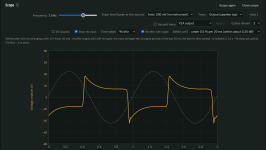
Time domain is in with a scope ; speaker simulation with IR loading ; effects loops ; redisigned switching...

1794758356422.png 1794758445547.png 1794758621195.png

Amplifier Stage Designer v0.3 (beta): changes since v0.2​

  • New Scope: time-domain simulation of the whole amp with a sine (waveform, harmonics, THD), with NFB, supply sag and an optional real rectifier (ripple, charging pulses)
  • New In block: input jacks (single, high/low, bright/normal, 4 jacks) with channels routed to any stage
  • New Out block: output jacks, impedance selector, cabinet wiring, speakers with a real impedance curve, and IR loading
  • Output transformer now with primary and leakage inductance; NFB can be taken from the impedance selector
  • Effects loops: tube, op-amp, LND150 and NoLoss templates, real send/return jacks, optional true-bypass switch
  • Bias: custom bias networks, Valve Wizard style bias with tube spread, bias range switch, "Centre on" 65 %
  • DC heater supplies (RECOM / LM317) and relay supply / footswitch wiring
  • Frequency response: sweep any pot or switch, test parts with front-panel knobs, noise and hum estimate
  • New paraphase inverter and multi-way selector switches
  • Tubes: power-tube ratings from datasheets, grid current, 5881 and 6CA7 added, 12AT7 and 12AY7 refitted
  • Heater-cathode voltage check, schematic export (PNG/JPG/PDF), jacks on the parts list
  • More robust: bad edits are undone instead of breaking the page, damaged saves recover
  • Stock gains differ from v0.2 (up to about 2 dB), mainly because of the speaker model
  • Designs saved with v0.2 may not open correctly
Download here: Amplifier Stage Designer v0.3(beta)

As usual, feedback welcome! There is no way I can test everything mysel now (even with testing scripts). I am particularly interested in:
- Is it intuitive?
- Can you obtain an answer to your design questions? If no, what is missing?
- Any significant deviations from known data points?
- The ultimate: if you can compare your own build to your scope data... you get your name in the About / Acknoledgment list ;)

I have managed to replicate fairly complicated designs in it, including my owns with half a dozen relays, stage jumping, etc and everything seemed easy and accurate. But it's just me...

Enjoy!
 
I need to take a break from it before I don’t have time myself 😁
I'm way down the NAM rabbit hole right now, which is facsinating but also a huge time suck. The developer of the iPad app I'm using (NAM Live) would love what you're doing, especially since importing LTspice files into his app is on his radar. Right now the app just has a simple passive tone stack builder applet, which he says hardly ayone seems to use.
 
Last edited:
You had me at dark mode ha. Looks fabulous mate. I want to learn how amps work, this seems an ideal way

Lately I've been bodging simple tools together to try and make LT Spice a little less 'crisis hotline', but nothing on this scale. I can appreciate the effort
 
I'm way down the NAM rabbit hole right now, which si facsinating but also a huge time suck. The developer of the iPad app I'm using (NAM Live) would love what you're doing, especially since importing LTspice files into his app is on his radar. Right now the app just has a simple passive tone stack builder applet, which he says hardly ayone seems to use.
Thing is, I doubt anyone is dabbling with tone stacks only. For a lot of us, it's all or nothing.

You had me at dark mode ha. Looks fabulous mate. I want to learn how amps work, this seems an ideal way

Lately I've been bodging simple tools together to try and make LT Spice a little less 'crisis hotline', but nothing on this scale. I can appreciate the effort
Hey, I also did it to grasp better what does what. And with the warnings built in, there are some rails to avoid stupidity.

Once I am done with what I want to do with it, I'll take one for the team and plan a build entirely with it from a schematic I have in mind but want to modify, including shopping list generation. If it works like it should, it would have saved me money already on fucking up my last freestyle bias network and a pair of tubes :cautious:
 
Back
Top