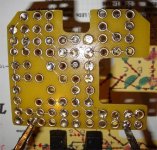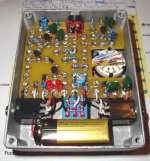
Bad traces: PCB defect, soldering technique issue, or???

I've knackered a couple of traces in my time, through cack handedness I assume. I think certain traces may be more easily damaged than others which would account for >1 people having problems in the same area
 
The old NASA guidelines specified that leads should be cut before soldering. The idea being that cutting a lead could compromise a solder joint.
Interesting. I've been cutting the leads down first lately but leaving a little excess to snip afterwards. Maybe I should go the whole hog

Access is much better this way and I find it easier to get a clean joint. Perhaps the pad conducting heat more predictably?
 
You're being way too aggressive with your trimming and could probably use less solder.
I've brought up over trimming leads to a couple members before and it seems comments like " I've always done this and never had an issue" seem to follow. But yeah, even with real sharp flush cutters, it still puts a lot of mechanical stress on the joint and if the through hole plating actually moves, the weak link is at the plating and the trace.
+1 for soldering axials from the component side. You need a fine tip and steady hands but it's faster and leads to cleaner trimming. Ine does need to control your solder amount a little finer. You shouldn't get blobs out the other end. Just a nice concave hump.
 
The real reason I was trying for shorter clipped leads isn't so much for aesthetics, but for making it easier to clean up the flux residue. With "pointy" or rough clipped leads, it makes for a sandpaper-like surface that is hard to clean neatly. Nice, smooth, flush- or nearly-flush clipped leads make for a smoother surface that cleans more easily.
It makes it more difficult to clean, but I use MG "no clean" solder and don't need to scrub down the board after. If I have to do any rework with solder braid, I'll clean that up, but it's localized so not bad
 
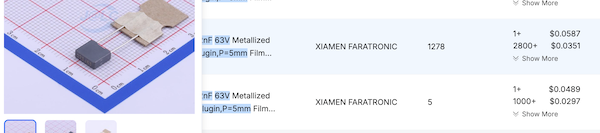
I was appalled to find that JLC stocks 630V film caps and their through-hole assembly costs are extremely reasonable, so I use through-hole film caps that I also do not solder myself.

Not a bad selection of smaller box caps, too. TDKs are about 15 cents. Curious about the Chinese brand which is only 5 cents each.

I'd do more, but my quantities are so small it doesn't make sense with the extended component fees.

Screenshot 2026-11-17 at 10.26.49 AM.png
 
You're being way too aggressive with your trimming and could probably use less solder.

But I've been doing it this way for years and never had a... oh wait...

It seems this kind of soldering is fairly forgiving, if we can generally get away with sub-optimal technique over the long-term.

even with real sharp flush cutters, it still puts a lot of mechanical stress on the joint and if the through hole plating actually moves, the weak link is at the plating and the trace.

Briefly, on my own PCBs, I was using "teardrops". You can see them somewhat in this build report. The idea is, instead of the trace simply touching the through hole plating, it "flares out" or gets wider as it approaches the hole. As the name implies, the trace plus hole then creates a teardrop shape. I'm assuming the point of the teardrops is precisely to make trace-hole boundary more rugged. Clearly I need to work on my soldering and trimming/clipping technique, but I'll probably go back to using teardrops for a belt-and-suspenders approach.

Edit:
could probably use less solder.

I just started on a new 1lb roll of solder, and I went through the previous pound in about two and a half years. Mounting evidence I am indeed probably using too much solder.

Edit2: @Robert - instead of saying "Well-known member" under my name, can you make it say "King of self-sabotage"? Or, even better, "Hoists own petard". :ROFLMAO:
 
Last edited:
Not a bad selection of smaller box caps, too. TDKs are about 15 cents. Curious about the Chinese brand which is only 5 cents each.

I'd do more, but my quantities are so small it doesn't make sense with the extended component fees.

View attachment 127986
That's the cool part about through-hole, there's no extended component fee. Extended component fees for SMD are essentially feeder-loading fees, and with through-hole there's obviously no feeders. You pay a flat fee (~$1) for hand-assembly, and no additional per-component cost regardless of extended.
 
That's the cool part about through-hole, there's no extended component fee. Extended component fees for SMD are essentially feeder-loading fees, and with through-hole there's obviously no feeders. You pay a flat fee (~$1) for hand-assembly, and no additional per-component cost regardless of extended.
WHAT? How did I not know that? Damnation.

tumblr_m0wb2xz9Yh1r08e3p.jpg
 
WHAT? How did I not know that? Damnation.

View attachment 127987
RIGHT? I did an all through-hole board for a friend and total assembly cost came to like $12, I was shocked. So now I have them do film caps and electrolytics for me, since SMD electros usually push you to standard assembly but through-hole electros can stay at economy assembly.

Throw a design in for quote and see where it lands, you may be pleasantly surprised.
 
The real reason I was trying for shorter clipped leads isn't so much for aesthetics, but for making it easier to clean up the flux residue.
tip:
if you use this solder, you'll probably never/rarely have to use alcohol to clean a board and 'rough' back surfaces will be a total non-issue.
https://www.mouser.com/ProductDetail/Chip-Quik/SMDSW.031-1LB?qs=1mbolxNpo8cW51lNrH1W7w==
1742263568004.png


with this stuff, all i have to do is rinse the board under a warm tap in the laundry sink and then dry it with a hair dryer (bonus points if you can use one with a 'cool shot' trigger mode so you don't cook it)

seriously though, this chipquik stuff is so much better to work with than traditional non-water soluble fluxes.
has saved me so much time and bullshit that i previously tolerated with having to use IPA and other tediously ineffective 'PCB cleaners'.
 
I use the same solder. After ride or die kester for 20+ years, I'll never buy anything else.
It also helps with the solder8ng from component side aspect since the flux just rinses off.
Edit, I use the version with silver because I'm a fancy bitch.
I think @jessenator has converted to chip quik as well.
 
i'm using a roll of 60/40 from 1980's ratshack.
my stepdad had a bunch lying around so yay me
i'm going to be sad when i have to use new crappy solder..
 
Briefly, on my own PCBs, I was using "teardrops". You can see them somewhat in this build report. The idea is, instead of the trace simply touching the through hole plating, it "flares out" or gets wider as it approaches the hole. As the name implies, the trace plus hole then creates a teardrop shape. I'm assuming the point of the teardrops is precisely to make trace-hole boundary more rugged.
They also reduce acid traps in the corners of traces, when you have two meeting a hole at a 45 degree angle from each other, but I'm not sure it's relevant with modern PCB production.

Is there a setting to "auto teardrop?" Or you do you have to apply it each time?
 
I use the same solder. After ride or die kester for 20+ years, I'll never buy anything else.
Hmmmmm J you have praised this CQ from your pulpit before, but I may actually have to try it. I'm pretty happy with 44 but if this is better...

So - going from Kester 44, I don't really have to do anything differently but... use this instead and not cry when I clean a board?

Same heat (~700)? Same Kester flux pen I rarely use but when I do I'm like "oh, this helps"??

:)
I'm running around 650 on my iron with it but I'm not convinced that's all that accurate(20+ yo 936 station). I can toss a couple feet in a PWE if ya want.
 
Back
Top