


OD is Glorious
Well-known member
- Build Rating
- 5.00 star(s)
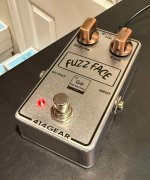
Unity is at 1pm on the volume and there is good enough headroom. The circuit is not hissy when engaged. The fuzz it delivers is wonderfully uneven and saturated all the way at the top of the fuzz pot. But at the bottom you get gritty crunch - in the middle, harmonic overdrive. I found the Les Paul showed this circuit's ability to do hardcore metal with sustain, but the Telecaster (bridge pickup) really made it sing in a song that I enjoyed immensely. It was balanced and in front - harmonic. It does not gate or spit and stutter but you can almost get some flub all the way at the top. Best of all, the circuit in this configuration made me want to play.
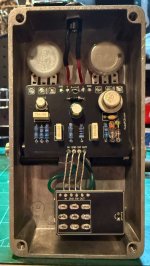
I have some yin-yang going on with a silicon 2N2222 can in Q1 and a Russian Germanium MP26 in Q2 - build documents for Q2 called for a silicon 2N3906. I have had good luck with my lot of MP26s but the pinout was opposite the 2N3906 so I did a 180 degree flip of the MP26. I considered mounting that big MP26 can under the board for fear it was too tall for a 1590b build, but I decided to leave it up top and seat it low because it is the star of the show.
For diodes I settled on a 1N914 and a D9B Germanium - build documents call for 2 1N914 diodes. I socketed them and auditioned several - silicon was too bright, other Ge made it darker, but the D9B was just right.
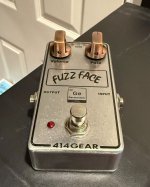
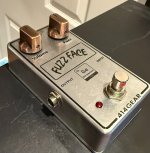
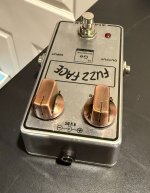
It was an easy build, and this circuit fits easily in a 1590b. I spent quite a bit of time sanding the bare aluminum before the finishing. Like all of my builds the enclosure takes days but populating the board and wiring the circuit only takes a few hours. I settled on these lovely brass finish 1510 knobs. I used the PPCB LED footswitch breakout board and shorted the LED connection on the main PCB. The graphic is a nod to the famous fuzz face, but with the atomic symbol for Germanium (32). It is film-free and the enclosure is protected with 2k clear. The LED is a 3mm red diffused in a red Freznel.
After building a variety of fuzz circuits I recommend this one in this configuration. It is also a good build for a beginner if you just follow the build documents. If you follow the build documents the circuit is more harmonic with more more compressed saturation - thinner tone with sustain.
I think the waveform of the saturation with the Ge and silicon is terrific.
Attachments
Last edited: