Big Muff: mods searching

Inverting the phase was the thing I didn't want to do, I forgot it.
Thanks, but these layouts (I like vero!) are blend. :D

I don't want to blend fuzz and clean, there's no much sense to me turn the fuzz into clean. I want just add the clean in parallel, and I thought to have a slightly boosted clean, avoiding to get a signal too much weak comparing with the fuzz.
But if have the buffer in front I can't use a jfet boost.
Unless, I turn the buffer into a booster with less boost as possible.

But... You wouldn't "turn the fuzz into clean". 🧐

"But if have the buffer in front I can't use a jfet boost."
You can still have the JFET boost, but I think you'll need another inverting stage in the clean path so overall the clean doesn't invert.

Others have already made suggestions on various ways to accomplish exactly what you describe, getting a clean signal parallel to your dirt-signal. At some point the two signals will meet up somehow.


Your own schematics show the clean signal joining the dirt signal before final output. You have a volume on the clean and a volume on the dirt. Even though the clean was parallel to the dirt at one point, the two signals are joining together — This in itself is a "mix" or "blend" of the two signals at output.


To use the analogy of the glasses again, you've got two separate signals — two separate glasses, one is pure water the other is iced-tea (made by using the pure water 😉). The only way to have the liquids NOT blend-mix at some point is to have a friend drink one of the glasses — even then, down-stream they'll mix in the sewer. 🤪


SO, I really don't get your aversion to the terms "blending, mixing";
I guess I don't understand what you are trying to accomplish. 🤷‍♂️

What am I missing, what am I not getting? Please explain further?

Cheers, 😺
FF


PS: for anyone interested, here's a perf of the Nucleon I drew up. Unverified.
 
Thank you for your help and courtesy 🙂

First point: By blend I don’t mean a classic mix pot where CCW = 100% fuzz / 0% clean, noon = 50/50, CW = 0% fuzz / 100% clean.
What I want instead is to keep the fuzz always at 100%, and use a pot to add the clean signal from 0% to 100%.
I already achieved this behavior with my modified ROG Splitter Blend (not the original schematic, as mentioned before), but that circuit is more complex than what I want to build now.

Second point: I’m aware there is some interaction between the clean level pot and the Big Muff 2 volume control.
Another thing I realized is that the JFET boost, unlike the JFET buffer, inverts the phase.

In general, I’d like to avoid adding a second, much larger board. That’s why I’m sticking with JFET-based circuits; even using two of them is still ok.

What I think I’m learning is that putting a buffer before splitting the signal is a good idea. I hope this won’t significantly change the character of the Big Muff 2, like to the traditional Big Muff.
Then, I should isolate the clean and volume pots to avoid interaction, and I need to pay closer attention to signal phase.

That said, I’m probably going to step back, save some space with a smaller circuit, and settle for a classic blend control that goes from full clean to full fuzz.
I’m fairly sure the Mini JFET Blend works, since it’s non-inverting like the Big Muff 2. The Buff’n’Blend (like the ones you linked) would also work, but it doesn’t provide any boost.
Because of that, I’m considering turning the JFET buffer into a JFET booster (inverting) and then adding a second JFET booster to invert the phase again before the blend/balance pot.
 
Can we see your splitter blend schematic?

There's really only two ways of doing it... either a single pot blends between wet & dry or there's two separate pots for wet & dry, both ultimately produce the same outcome only the latter never goes full dry in which case, you may as well use the single pot blend method and a stopper resistor.

I'm curious as to the choice of J-FET's too, a dual op-amp set up is going to be simpler and require far fewer components... if you put your mix point before the last op-amp in the original BigMuff2 schematic, your dry signal will be boosted by the existing design.
 
I replaced the Blend pot of the ROG Splitter Blend with a pan pot like this:
8Nt8Oqd.png


But the two outputs are not joint, but each goes into an op-amp gain stage (yes, they boost a little bit to pair the volume of the two loops, just in case) and then they are joint in the output.
To make pass just one signal always full at 100% is enough disconnect its side of the pot, so only the other side fade in and blend from 0% to 100%.
And when I jumper the second loop I got the clean signal.

I don't remember I found the idea somewhere, I remember tried several approach and make some tests until I found this, and it worked ok.
Now, replace all that seems to me a bit overwhelm.

I'll build the Blend board with stripboard, probably, and if the two jfet layout si bigger than a similar dual op-amp layout, so I'll choice the op-amp version.
 
Thanks, EB, for the clarification in post #22.

I've got a wacky idea to replace a blend pot, say it's a B100k, with a fixed 50k resistor on the Dirt side, and then an A50k pot on the Clean side.

I'll thinker-tinker more about my silly idea later; right now I'm off to a friend's house to A/B some pedal circuits.
 
I’m taking a break to decide whether to build the version with the buffered voltage reference, as in the original JHS schematic and the Red Muffin Fuzz documentation.
 
Hello,
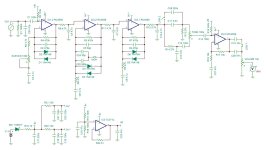
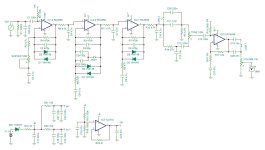
I built my own layout using the JHS schematic, and I’ve started testing some mods. I can only use an SPDT switch, so can't do all the mods I potentially could.

Personal Big Muff 2.JPG

- To get more high end, a switch can remove a pair of ceramic caps, changing the original 470pF value to 50pF. For some reason, the second stage is the one that works; leaving off the other two 470pF caps doesn’t do much. Honestly, I hoped for a bit more high end.
- To cut the low end, I added a 47nF cap in parallel with the output cap. It’s totally irrelevant when paired with the original 10uF, but the switch removes the big one, and the 47nF cuts the excess bass.
- Another low-end mod is adding a 220nF cap to the 3.3nF in the tone section. It might seem insane, but with this, the tone pot keeps a lot of bass, even at higher settings.
I’m not sure what I have to do with the 4.7nF cap across the ground. I’ve soldered them, but to see if removing just one will give me more high end, I need to desolder it.

I tried replacing the 4.7uF in the three stages and 47uF caps in the last stage with 100nF caps, and it sounds wonderfully balanced. But that’s a mod I can’t do right now. The output cap mod works fine, though.

I didn’t like the sound when I removed the 10nF cap in the tone section.

I replaced one 1N4148 diode in the first and second stages with a BAT41 diode (I only have two). It seems to reduce the volume and add a bit more distortion. I’ll try other combinations out of curiosity, though.

By the way, regarding the distortion, I find it smoother and less aggressive than the stock Big Muff. Although I soldered the resistors onto the board, I might try some lower values for R5 and R8. I’m not sure about the 470k in the feedback loop, I think the distortion is pretty much maximized as it is. At least at our ears.

Maybe I can see what a pair of 1N4148s diodes as hard clipping does, but someone said it sounds bad.
I don’t want to add extra gain stages.

I tried removing the 4.7uF cap in the first stage. I got just a little bit of distortion, and it sounded a bit duller. The Sustain pot became useless.
If I replace the cap with a smaller one, like 470pF, I get a bit more distortion, slightly more than with no cap at all, but a little brighter sound. The Sustain pot became just a subtle coloring control. With a 2.2nF cap, it became a bit more aggressive and brighter, and the Sustain pot gave more grit.
This is useful if you want a bit of break-up and sparkle, which works more evenly with the guitar's volume control. In some cases, the Tone knob helps to make it more glassy or sparkly.
An 1nF cap could be the right spot.

I’ll get back to the parallel clean blend later.
 

Attachments

  • Personal Big Muff 2.JPG
    Personal Big Muff 2.JPG
    177.7 KB · Views: 0
Back
Top