
A friend dropped off a Frontman 15G for repair. No LED or sound on power-up.
I wanted to try it, knowing full-well it's not a financially wrothwhile project. I have a lot of memories with my old frontman from middle and high school, learning to play electric guitar on it. Also, the input jack broke and I was able to solder it back on, which was a defining moment for my interest in engineering and electronics. But mainly, this opportunity to get more familiar with Solid State amplification, and try out some mods was appealing.
Failures identified:
TDA2050 amp chip - I found a 75ohm short from Pin3 to GND. Apparently this is a common failure mode of these amps.
In turn, that seems to have fried the Power Transformer. (120VAC going in, nothing coming out).
Replacement parts:
I purchased an LM1875 as a replacement for the obsolete TDA2050 from Digikey. The de-soldering went incredible smoothly with my new pump that has a hollow solder iron tip, to heat the joint and pump simultaneously.
I replaced the power transformer with a Hammond 166K35 (center tapped). At this point the cost is starting to overshadow a used amp cost. But again, it's more for the experience.
Further Issues:
While the repair seemed successful and the DC voltages were correct, I was getting excessive noise and some splatty distortion (even at low volumes on the clean channel). Reading some online there can be issues with the LM1875 oscillating at ~50kHz, and while you can't hear this, it severely limits the amp chips ability to perform, and possible overloads the power section filtering caps so that noise bleeds in. The suggested fix was to solder 100nF capacitors right at the LM1875 pin3 to GND and pin5 to GND. This seems to have worked perfectly to solve the issues and now the amp sounds good. I did one more fix, just in case they were deteriorated, which was to replace the 2200uF filter caps, although I'm not sure if it was necessary.

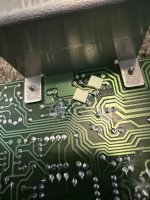
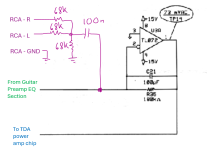
The schematic I was using was an older version of the amp (from thetubestore.com). Thankfully most of the RefDes match. I traced out the AUX input, just for reference, since the old version didn't have that. Very simple summing resistors coming in after the EQ section.

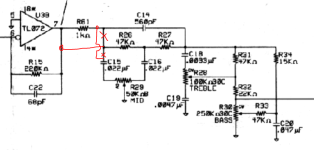
Also, I discovered a slight discrepancy with the schematic and the actual pcb connections. This is either a mistake, or the new version intentionally modified this.

Now for the actual fun, I wanted to see if I could improve the brittle sound.

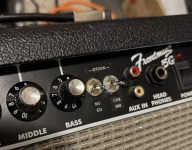
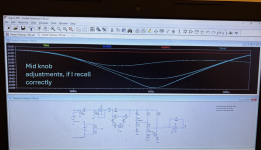
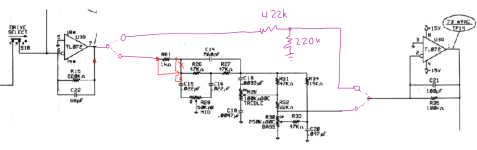
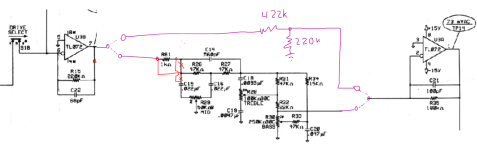
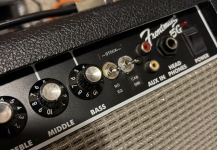
1. The BMT EQ section is similar to Fender blackface amps in that it creates a mid-scoop with all knobs at noon. The frontman eq circuit is different that those tube amps, and it seems that the frontman mid-scoop is even more extreme. It can be improved by MAX-MID and MIN Bass and Treble knob settings, but I wanted a way to bypass it completely. The DPDT switch sends the signal through a 422k series resistor and 220k to ground to drop the volume similar to the EQ stage volume drop. I think this is a significant improvement in the sound, even though you lose the ability to adjust EQ. An even better design (imo) would be to use active EQ with the opamps, such as the Tone Job circuit (3-band baxandall), so that noon is flat, and you can cut or boost.


2. The 8" speaker seems to cut some high-end, but not as much as a quality 12" speaker (typically 4~5kHz steep high-cut). Especially with the drive channel, this 8" speaker sounds very fizzy, but even clean there is some annoying ice pick. I thought that the amp sounded better when I ran my Joyo American Sound (based on Tech 21 blonde) in front, to simulate a 12" speaker high-cut. But, I wanted this speaker sim AFTER the distortion in the amp, so it can cut down on the higher clipping harmonics. So I built the cab sim section of the Joyo circuit on stripboard and inserted it (on a switch) right before the R36 of the power amp section. I had to convert that circuit snippet to +/-15V. This works beautifully and sounds quite good. Even the drive channel sounds good now with the EQ-bypass and Cab-sim both engaged.


I do think my cab sim circuit in the amp sounds noticeably darker than the Joyo (with all EQ/Voice knobs at noon). I don't yet know why. My understanding was that with the EQ/Voice at noon, the Joyo would sound very close to neutral EXCEPT for the cab sim section. So, I'm not sure if:
-the trace on FSB was incorrect
-or another part of the Joyo schematic significantly affects the tone, even with EQ/Voice knobs at noon
-or I made a mistake with the build, or my schematic isn't a good adaptation.
-or implementing it late in the frontman circuit just sounds different than the pedal in front of the amp (even when clean)
On the other hand, I'm quite happy with the final amp sound. To further study the cab sim discrepancy, I think my next step will be to build a regular 9V pedal with the Joyo cab sim circuit snippet, and compare that.
I wanted to try it, knowing full-well it's not a financially wrothwhile project. I have a lot of memories with my old frontman from middle and high school, learning to play electric guitar on it. Also, the input jack broke and I was able to solder it back on, which was a defining moment for my interest in engineering and electronics. But mainly, this opportunity to get more familiar with Solid State amplification, and try out some mods was appealing.
Failures identified:
TDA2050 amp chip - I found a 75ohm short from Pin3 to GND. Apparently this is a common failure mode of these amps.
In turn, that seems to have fried the Power Transformer. (120VAC going in, nothing coming out).
Replacement parts:
I purchased an LM1875 as a replacement for the obsolete TDA2050 from Digikey. The de-soldering went incredible smoothly with my new pump that has a hollow solder iron tip, to heat the joint and pump simultaneously.
I replaced the power transformer with a Hammond 166K35 (center tapped). At this point the cost is starting to overshadow a used amp cost. But again, it's more for the experience.
Further Issues:
While the repair seemed successful and the DC voltages were correct, I was getting excessive noise and some splatty distortion (even at low volumes on the clean channel). Reading some online there can be issues with the LM1875 oscillating at ~50kHz, and while you can't hear this, it severely limits the amp chips ability to perform, and possible overloads the power section filtering caps so that noise bleeds in. The suggested fix was to solder 100nF capacitors right at the LM1875 pin3 to GND and pin5 to GND. This seems to have worked perfectly to solve the issues and now the amp sounds good. I did one more fix, just in case they were deteriorated, which was to replace the 2200uF filter caps, although I'm not sure if it was necessary.
The schematic I was using was an older version of the amp (from thetubestore.com). Thankfully most of the RefDes match. I traced out the AUX input, just for reference, since the old version didn't have that. Very simple summing resistors coming in after the EQ section.
Also, I discovered a slight discrepancy with the schematic and the actual pcb connections. This is either a mistake, or the new version intentionally modified this.
Now for the actual fun, I wanted to see if I could improve the brittle sound.
1. The BMT EQ section is similar to Fender blackface amps in that it creates a mid-scoop with all knobs at noon. The frontman eq circuit is different that those tube amps, and it seems that the frontman mid-scoop is even more extreme. It can be improved by MAX-MID and MIN Bass and Treble knob settings, but I wanted a way to bypass it completely. The DPDT switch sends the signal through a 422k series resistor and 220k to ground to drop the volume similar to the EQ stage volume drop. I think this is a significant improvement in the sound, even though you lose the ability to adjust EQ. An even better design (imo) would be to use active EQ with the opamps, such as the Tone Job circuit (3-band baxandall), so that noon is flat, and you can cut or boost.
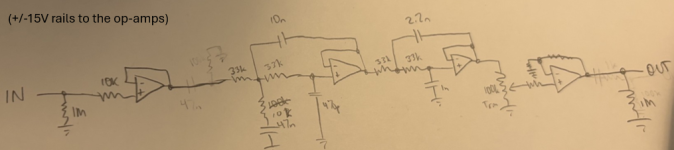
2. The 8" speaker seems to cut some high-end, but not as much as a quality 12" speaker (typically 4~5kHz steep high-cut). Especially with the drive channel, this 8" speaker sounds very fizzy, but even clean there is some annoying ice pick. I thought that the amp sounded better when I ran my Joyo American Sound (based on Tech 21 blonde) in front, to simulate a 12" speaker high-cut. But, I wanted this speaker sim AFTER the distortion in the amp, so it can cut down on the higher clipping harmonics. So I built the cab sim section of the Joyo circuit on stripboard and inserted it (on a switch) right before the R36 of the power amp section. I had to convert that circuit snippet to +/-15V. This works beautifully and sounds quite good. Even the drive channel sounds good now with the EQ-bypass and Cab-sim both engaged.
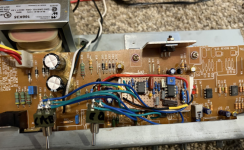
I do think my cab sim circuit in the amp sounds noticeably darker than the Joyo (with all EQ/Voice knobs at noon). I don't yet know why. My understanding was that with the EQ/Voice at noon, the Joyo would sound very close to neutral EXCEPT for the cab sim section. So, I'm not sure if:
-the trace on FSB was incorrect
-or another part of the Joyo schematic significantly affects the tone, even with EQ/Voice knobs at noon
-or I made a mistake with the build, or my schematic isn't a good adaptation.
-or implementing it late in the frontman circuit just sounds different than the pedal in front of the amp (even when clean)
On the other hand, I'm quite happy with the final amp sound. To further study the cab sim discrepancy, I think my next step will be to build a regular 9V pedal with the Joyo cab sim circuit snippet, and compare that.
Attachments
Last edited: