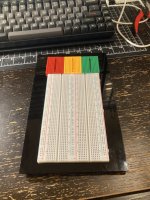
First crack at breadboarding, any words of wisdom?

Just a +1 to what everyone else said; break the schematic into sections, tap the output as you go to figure out where things are going wrong, if you're not quick with colour band codes (or the light in your room isn't great), tagging the resistors helps immensely. Solid core wire works great for jumpers, the bags with the little needle-y ends break immediately. Maybe the only thing I'd add is to use trim pots on the breadboard instead of trying to wire actual offboard pots. Alligator clips are fussy.

Breadboarding can be super frustrating in my limited experience, but it's satisfying to make things work. Be prepared to do a lot of random tapping on/wiggling around of caps and resistors, and anything with more than a couple gain stages will probably turn into a very effective shortwave radio.

99YdH9N.jpg
 
Having a very "peak breadboard" moment this am.
Circuit sounded great last night.
Turned it on this morning, squealing uncontrollably.
Was something loose yesterday that's no longer loose?
Is something loose now that wasn't loose yesterday?
Is the fan blowing in the other room borking my electrical?
FUN
 
Having a very "peak breadboard" moment this am.
Circuit sounded great last night.
Turned it on this morning, squealing uncontrollably.
Was something loose yesterday that's no longer loose?
Is something loose now that wasn't loose yesterday?
Is the fan blowing in the other room borking my electrical?
FUN
That's still better than;

Turning it on and nothing...
Turning it on and it goes POOF!
Turning it on and it goes POOF! (in case you missed it)
Turning it on and it the PSU goes POOF!
Turning it on and the overhead bulb explodes
Turning it on and it launches missiles in Siberia

Squeal? You got it made brah!
 
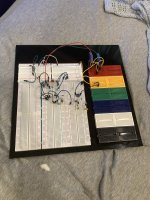
My main breadboard setup is too large to be as useful as I want it to be in my space and I'm gonna be changing it around soon. That said there's two things I like about it that I don't see that often that I figure might be worth sharing:
- Different colored boards help mentally segment parts of the schematic for me. These would have been much more useful mounted differently, but I like using one color for power filtering (or the top brighter white one), another for i/o, another for switches, etc. These don't have power busses otherwise I would use them for all parts of it.
- Plexiglass mounted - I think this square foot was $10. Good enough to satisfy my desire for things to look a way I consider nice. I put some rubber pads on the bottom.

As I retool this I'm gonna pare it down to maybe 6"x6", get rid of the black and blue breadboards (really hard to see where the holes are, esp on black plexiglass), position a go to power filtering board either on top of the main bottom left boards, or at least make them parallel to the main ones. Might mount a small case or cable clips for jumpers if there's space.

IMG_6740-(50).JPG
 
Nice! I was thinking about using that as a strategy, delicate certain boards for specific parts of circuit (power, gain staging, eq, pots and switches.) we will see how well that works out for me.
 
Finebyfine's colour-coding has given me the idea to take some felt-markers to the main breadboards, colour in sections. I've got a couple of the smaller coloured breadboards, but don't even remember which colours I have (shows you how often I use them — but now I see the light-colour...).
 
Finebyfine's colour-coding has given me the idea to take some felt-markers to the main breadboards, colour in sections. I've got a couple of the smaller coloured breadboards, but don't even remember which colours I have (shows you how often I use them — but now I see the light-colour...).

Relatedly: I've toyed around with the idea of mounting breadboards on a whiteboard (or just a white piece of plexiglass, probably cheaper) to let me use whiteboard markers to annotate, but I couldn't really come up with a way that it wouldn't take up a ton of space. Going off even my smallest handwriting with a sharpie to test it they had to be spaced so far apart.

Breadboarding is really difficult for how my brain works but I've probably spent as much time thinking about making it easier as I have actually used them. Probably should have just practiced more instead lmao
 
The whiteboard idea is cool, but yeah, it'd be real-estate intensive.

By colouring in, I just meant it'd be just like working off of only your row of coloured breadboards (poorman's purchase of coloured breadboards) — I'd still have to use masking tape or painters tape to flag components.

I definitely don't breadboard enough, and instead socket PCBs too much...
 
Back
Top