
SOLVED Fornicus Weight Issue

Having a perplexing time with the Weight switch on my Fornicus. Set to the 'Heavy' position (I believe engaging the 10u cap C13), the crackle is quite underwhelming and the 'Light' setting (1u cap C12) has no crackle at all - despite the LED pulsing to the input.

I pulled C12 to test it (fine) and there was no change in the Light sound but the Heavy position now produced a wonderful roar of crackle. Any value cap I tried putting in the C12 position and the Heavy sound went back to low crackle blah.

I tested the continuity of the switch, cap pads, earth, etc., which all seemed fine. Checked values, voltages, replaced opamp. Everything else works great but I can't figure out the issue with C12. Anybody else experienced this issue? Thanks!
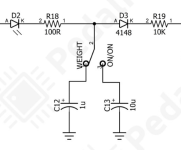
 
I keep looking at this section and I don't understand how C12 affects C13 when C13 is selected. Could the switch be bad even though the continuity checks out? No solder bridges under switch, R18 and D3 are connected to SW2. Stumped!
 

Attachments

  • Screenshot 2026-01-06 at 8.48.20 AM.png
    Screenshot 2026-01-06 at 8.48.20 AM.png
    155.4 KB · Views: 4
If you used a SPST on-on switch, C12 and C13 do not interact. They are swapped. The 1uF allows less signal to ground than the 10uF.
That circuit appears to be a complex sag effect on Q2's power supply, so the 1uF will sag less than the 10uF. Tone wise, it should get spitty with loud notes.
 
Yes, that is how I understand it to work but what can be causing the presence of C12 to affect the tone from C13? No C12 and the heavy C13 setting sounds glorious, add C12 and it sounds lame. The light setting has no sag effect with or without C12. This is what is baffling me
 
I realized that I thought the switch was working the opposite way. The C12 + is connected to the top pin of the SPDT, the C13+ is connected to the bottom pin. When the switch is DOWN, it connects to the C12 and that is actually the setting that sounds really good with the C12 removed! Adding the 1u C12 sounds very mild. It is the 10u C13 when the switch is up that has no crackle, with or without C12. So it now makes sense that C13 is unaffected by C12.

Why does C13 not crackle? Why does the down position sound much better without C12? Am I right to assume that a larger cap will give a bigger crackle effect?

I'd really appreciate any suggestions to guide my trouble-stumbling
 
I think you have the wrong understanding about how each capacitor affects the crackle. C13 is 10uf and this will have the biggest impact on the crackle. C12 being 1uf means that the crackle is significantly less.

In my build I swapped C12 from 1uf to 4.7uf so that the crackle was still noticable but less than in the heavy position. Try this.

EDIT

If your 10uf isn't working then there is something wrong with that cap. Have you measured that one? Have you confirmed with a multimeter that the cap is connected to the switch? Maybe check with the multimeter that the cap is connected to ground?
 
Last edited:
I think you have the wrong understanding about how each capacitor affects the crackle. C13 is 10uf and this will have the biggest impact on the crackle. C12 being 1uf means that the crackle is significantly less.

In my build I swapped C12 from 1uf to 4.7uf so that the crackle was still noticable but less than in the heavy position. Try this.

EDIT

If your 10uf isn't working then there is something wrong with that cap. Have you measured that one? Have you confirmed with a multimeter that the cap is connected to the switch? Maybe check with the multimeter that the cap is connected to ground?
Thanks for the suggestion. I tested that the caps were connecting to the switch, all the switch pins connected as they should and all earths were connected. I ended up socketing the two caps and I have it 'working' but it makes no sense. The strongest crackle fuzz is with C12 removed, and a 220n in C13 gives a thicker, slightly tamer fuzz. From what you said, the caps are doing the opposite to what they should? The trimmer is set fully clockwise, everything else works as expected.
 
I think you have the wrong understanding about how each capacitor affects the crackle. C13 is 10uf and this will have the biggest impact on the crackle. C12 being 1uf means that the crackle is significantly less.

In my build I swapped C12 from 1uf to 4.7uf so that the crackle was still noticable but less than in the heavy position. Try this.

EDIT

If your 10uf isn't working then there is something wrong with that cap. Have you measured that one? Have you confirmed with a multimeter that the cap is connected to the switch? Maybe check with the multimeter that the cap is connected to ground?

100%.

D2 and D3 convert AC signal to DC saw-tooth pulses, actuating Q5 like a toggle switch, which sends the 9VDC power closer to a short, reducing the voltage for all the audio signal transistors. C12 & C13 filters that and makes the sag duration longer. It is almost like a decay speed function. The 1uF would be short duration and 10uF or higher would be longer. I suspect the absence of filtering would be very short and produce harsh crossover artifacts into the audio, which may be what @Footsolder is experiencing.
The sockets and experimenting is a great idea.
 
Thanks for the info, that's interesting (although I'm not sure I follow it completely!). Do you know why the regular values don't seem to work? I was under the impression that the 'weight' switch controlled the amount of crackle, not sag. Just trying to understand the circuit
 
Thanks for the info, that's interesting (although I'm not sure I follow it completely!). Do you know why the regular values don't seem to work? I was under the impression that the 'weight' switch controlled the amount of crackle, not sag. Just trying to understand the circuit

Transistors eventually 'spit and crackle' when they are starved for voltage. Their duration for actual 'sag' is a lot shorter than vacuum tubes.
 
For anyone experience similar issues, I subbed C12 for 10n and C13 for 220n. I think it's gnarlier than the original but found the right blends of spitty, acted fuzz and nice beefy distortion to be pretty inspiring. I found that the dynamics were great too, light picking creates a percussive attack, then dig in to get the nasty. Fun circuit after the wrestling was over.
 
Back
Top