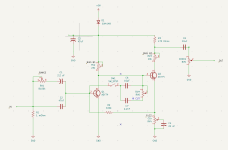
I'm working on an NPN Fuzz Face with a fully variable input filter (from the Chickenhead) and I'm trying out a similar approach as a fully variable LPF using a pair of miller caps across Q1's base and collector and a pot that wipes between the 2 values. I've settled on a 10pf and a 2.2 nF (C6/C7). When the pot is fully clockwise (10pF) , the HF response is pretty much unaffected in the guitar spectrum and when it's counter-clockwise (2.2nF), it's extremely rolled off. I'm quite happy with the range that this produces and I've included an on/off switch that takes the caps out entirely. The result is essentially a stock Fuzz face when the input is wide open and the caps are switched out. When the input filter is turned up, it sounds less like a fuzz and becomes a really great distortion. The only downside is that when the lows are filtered out and the fuzz is turned down and volume turned up for unity gain, the treble range can become a bit overbearing, which is where the Miller caps can be engaged as a fully variable LPF. I'm guessing it's a crude approach to EQ, but it works and is less lossy than every other tone control I've tried on a Fuzz Face.
My question:
For RV6, I experimented with various pot values and I noticed that the higher the value, the less volume loss occurred. I ended up at 1 mOhm because that's the largest value I have on hand. Would the volume loss be even less if I ordered a 2mOhm pot? I understand how the miller cap value affects the corner frequency, but please help me understand the role that the pot's value plays in this?
Thanks!
My question:
For RV6, I experimented with various pot values and I noticed that the higher the value, the less volume loss occurred. I ended up at 1 mOhm because that's the largest value I have on hand. Would the volume loss be even less if I ordered a 2mOhm pot? I understand how the miller cap value affects the corner frequency, but please help me understand the role that the pot's value plays in this?
Thanks!