Aleph Null
Well-known member
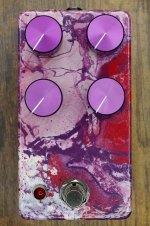
Designing the Moka Pot got me interested in analog octave up circuits. Nothing sounds quite like the Green Ringer to my ears, but it generally needs help to sound its best. Grawlix is a Green Ringer with some quality-of-life features added. Few players use the original analog octave up on its own, but tend to combine it with an overdrive or a fuzz. The Grawlix builds some of those features into the effect itself.

I repurposed an old enclosure as the original occupant had been superseded by a newer design.
The PCB follows my standard four-knob template.
The first half of the circuit is the classic Green Ringer topology with modernized and streamlined values. The bias network is a little eccentric, but it gets the necessary voltage at the base of Q2 to maximize the headroom and octave effect. Instead of a fixed gain, Q1 can now be adjusted. This lets you set the level that hits the rectifier section for the most prominent octave. It can also be cranked up to some serious fuzz. The Texture control pans between metallic fuzz and full octave up. The further clockwise, the more prominent the octave will be. This also makes diode matching less critical, as the Texture control can be adjusted until the octave pops. Q3 buffers the output—I tried to ditch this, but the rectifier is very picky about what comes after it!
The octave section is followed by clipping diodes. These have a similiar effect to placing an overdirve after a Green Ringer; they act as a crude form of compression to keep down the crazy transients the octave can produce. With the Gain control low, they don't do anyting. After about half way, they start to color the signal.
Tone is a tilt EQ with a mid bump around 800Hz. Clockwise, it cuts the thump of strong transients that can be created with the Gain set low. Counterclockwise, it cuts the fizz and treble without getting too dark. In the middle, it gives you a throaty midrange, similar to running a Tube Screamer after your octave.
Last is a make-up gain stage to ensure a good amount of boost is available at all times.
This circuit definitely does the Green Ringer thing, but I think it's also a reasonable substitute for a Moonrock or a Superfuzz. It can fuzz, but it's more open and dynamic than most octave fuzzes.
Here's a demo:
As always, I have extra PCBs. If you'r interested, DM me!

I repurposed an old enclosure as the original occupant had been superseded by a newer design.

The PCB follows my standard four-knob template.

The first half of the circuit is the classic Green Ringer topology with modernized and streamlined values. The bias network is a little eccentric, but it gets the necessary voltage at the base of Q2 to maximize the headroom and octave effect. Instead of a fixed gain, Q1 can now be adjusted. This lets you set the level that hits the rectifier section for the most prominent octave. It can also be cranked up to some serious fuzz. The Texture control pans between metallic fuzz and full octave up. The further clockwise, the more prominent the octave will be. This also makes diode matching less critical, as the Texture control can be adjusted until the octave pops. Q3 buffers the output—I tried to ditch this, but the rectifier is very picky about what comes after it!
The octave section is followed by clipping diodes. These have a similiar effect to placing an overdirve after a Green Ringer; they act as a crude form of compression to keep down the crazy transients the octave can produce. With the Gain control low, they don't do anyting. After about half way, they start to color the signal.
Tone is a tilt EQ with a mid bump around 800Hz. Clockwise, it cuts the thump of strong transients that can be created with the Gain set low. Counterclockwise, it cuts the fizz and treble without getting too dark. In the middle, it gives you a throaty midrange, similar to running a Tube Screamer after your octave.
Last is a make-up gain stage to ensure a good amount of boost is available at all times.

This circuit definitely does the Green Ringer thing, but I think it's also a reasonable substitute for a Moonrock or a Superfuzz. It can fuzz, but it's more open and dynamic than most octave fuzzes.
Here's a demo:
As always, I have extra PCBs. If you'r interested, DM me!