High Voltage Hijinks

So fun to read your updates. I have a lot of weird preamp boards (from Merlin’s old PCBs he sold) that are ready to go, but time and other stuff get in the way

Re: Trainwreck - go for it. I’m debating for my next preamp rack if I go full Fender variants or 3 Trainwreck channels (Express, Rocket, Songwriter). Gah… choices.
 
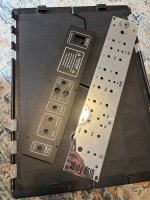
Got my decals in today, didn’t turn out perfect but that’s on me rushing the application. But I think the turnaround out ok. Now to mount pots and switches then start wiring.

They turned out great! Daaaammn. I don't see the imperfections you see, but when I see imperfections in my own stuff I always remind myself - made by hand.

I've been hemming and hawing about what to work on next. Mostly playing a video game haha.

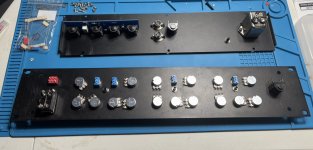
Today I started on my Soldano preamp boards and while listening to new The Amp Panel podcast which just happens to be about the SLO and how closely the Dual Rect and 5150 copy it. It's a really good episode and it covers a good bit of the circuit.


My progress on the boards:
Photo Nov 03 2025, 7 01 42 PM.jpg
 
View attachment 105694
Got my decals in today, didn’t turn out perfect but that’s on me rushing the application. But I think the turnaround out ok. Now to mount pots and switches then start wiring.
Looks mostly fine to me? Or are the decals on the black panel slightly crooked?

They turned out great! Daaaammn. I don't see the imperfections you see, but when I see imperfections in my own stuff I always remind myself - made by hand.

I've been hemming and hawing about what to work on next. Mostly playing a video game haha.

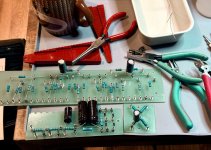
Today I started on my Soldano preamp boards and while listening to new The Amp Panel podcast which just happens to be about the SLO and how closely the Dual Rect and 5150 copy it. It's a really good episode and it covers a good bit of the circuit.


My progress on the boards:
View attachment 105695
I had no idea about the Amp Panel podcast! I'll give it a shot, thanks. Hoh and aren't the legs of the filter caps fairly close to your ground bus? I would be really scared of arcing there and probably run a transparent heatshrink on the legs of those two caps.

this is the exact reason I have always wanted a Soldano.
There is a “shape”switch on the lead channel of this I’m going to wire it as a gain boost hopefully to give it more of a 5150-ish flavor.
I have a Rosamp SLO30 built and while it's a really good amp, it is not modern sounding by any means. It needs a gate and a fairly high-mid heavy boost to feel tight enough. But it loves pedals, so you can experiment a lot with it.
 
Hoh and aren't the legs of the filter caps fairly close to your ground bus? I would be really scared of arcing there and probably run a transparent heatshrink on the legs of those two caps.

Pfft. I'm no EE by a long shot but arcing distance at 500V is less than a millimeter, 7.5 micrometers. Another way to think about it is, the leg spacing on the 450V caps is 4 or 5mm. It's hard to see from a picture but the turret board is three dimensional, at no time the B+ gets closer to the ground than 3.5mm.

What spacing do you use on your PCBs? Online calcs say 2.5mm for 500V which is likely conservative.
 
Last edited:
I admit I am mostly concerned about creepage ("surface" distance) and not clearance ("floating" distance) when I do my PCB because it's usually way smaller. For standard JLCPCB, its CTI is 200 (Mat group IIIa) so you can approximate 1mm creepage / 100V potential difference and be safe at normal humidity and polution level even around the pads. My rule of thumb is clerance is half of creepage.

The actual rules (I had to look them up) are obviously conservative but under IPC-2221B, 0.6 mm + 0.005 × Vpeak = clearance so that would be north of 3 mm for a 500V under normal conditions. Considering air humidity and potential vibrations if your caps are floating (and the angle of the picture) I just thought I would drop a line about it.

Then again, for both creepage and clearance I am fairly sure you can go under half of it and still be safe but I usually go by "better really safe than really sorry" when i build. My deliverance does go under that, sometimes significantly, and I had no problems so far but it's a very stable and controlled environement.
 
I admit I am mostly concerned about creepage ("surface" distance) and not clearance ("floating" distance) when I do my PCB because it's usually way smaller. For standard JLCPCB, its CTI is 200 (Mat group IIIa) so you can approximate 1mm creepage / 100V potential difference and be safe at normal humidity and polution level even around the pads. My rule of thumb is clerance is half of creepage.

The actual rules (I had to look them up) are obviously conservative but under IPC-2221B, 0.6 mm + 0.005 × Vpeak = clearance so that would be north of 3 mm for a 500V under normal conditions. Considering air humidity and potential vibrations if your caps are floating (and the angle of the picture) I just thought I would drop a line about it.

Then again, for both creepage and clearance I am fairly sure you can go under half of it and still be safe but I usually go by "better really safe than really sorry" when i build. My deliverance does go under that, sometimes significantly, and I had no problems so far but it's a very stable and controlled environement.

My "pfft" was humor - I appreciate you mentioning it! It's good info to talk about (for anyone in this thread), and to give each other some sanity checks haha. It's all fairly rigid but I should probably put a dab of silicon adhesive on the caps.

I actually have 400 feet of 18 gauge milspec Teflon tubing I bought for stuff like this but I guess I'm getting lazy. I use it on the heaters and sometimes for running B+ if I'm using solid bus wire instead of stranded (also in Teflon).
 
Looks mostly fine to me? Or are the decals on the black panel slightly crooked?
Yeah the 2nd input labeling is a little off and a couple of the smaller letters got goofed a bit, like the bright switch on the rhythm channel lost the “t “ and I didn’t notice it right away so I wasn’t able to try and save it so now it’s says “brigh” 🤣. Annoying but not the end of the world. These were way less forgiving to apply that I originally thought they would have been… lesson learned.
I have a Rosamp SLO30 built and while it's a really good amp, it is not modern sounding by any means. It needs a gate and a fairly high-mid heavy boost to feel tight enough. But it loves pedals, so you can experiment a lot with it.
The Anvil was based off the SLO but it’s not a direct clone, the clean channel is supposed to be more fender like, the rhythm light crunch to almost high gain and the lead is supposed to be more modern… we will find out though.
 
Last edited:
My "pfft" was humor - I appreciate you mentioning it! It's good info to talk about (for anyone in this thread), and to give each other some sanity checks haha. It's all fairly rigid but I should probably put a dab of silicon adhesive on the caps.

I actually have 400 feet of 18 gauge milspec Teflon tubing I bought for stuff like this but I guess I'm getting lazy. I use it on the heaters and sometimes for running B+ if I'm using solid bus wire instead of stranded (also in Teflon).
No worries ;) I always think it's good to get a refresher. As for teflon tubing, I would use it strategicaly to make sure that I have high voltage "lines" around points I might want to probe later on protected. Just to make sure I don't jump anything with my multimeter.
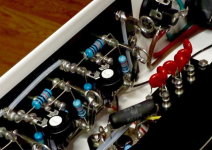
 
No worries ;) I always think it's good to get a refresher. As for teflon tubing, I would use it strategicaly to make sure that I have high voltage "lines" around points I might want to probe later on protected. Just to make sure I don't jump anything with my multimeter.

One hand on the belt (or in the pocket) when one is in the amp!

I do actually try to design for testing. I watched a video where a tech was biasing an OR120 and he had to put his probe deep in the packed cavity to measure the plate voltage. It looked sketch AF and I could tell it (suitably) spooked him having to do it. On the GT120 I have little rings you can easily, safely, clip leads to bias and bias trimmer easily accessible:

1762271627256.png

On the Model T I'm putting all the test points and trims accessible while it's in the cab.

In the interest of safety and cautionary tales of being lax - once when I was working on the GT120 I turned the amp off. I tested to make sure my caps were drained. I stuck a little screw driver in to pop a internal fuse out, and boom. I had accidently bridged live to the chassis from the power switch. It was still plugged in. Needless to say making sure it's actually unplugged is one of my safety rituals now haha.
 
Yeah the 2nd input labeling is a little off and a couple of the smaller lettering letters got goofed a bit, like the bright switch on the rhythm channel lost the “t “ and I didn’t notice it right away so I wasn’t able to try and save it so now it’s says “brigh” 🤣. Annoying but what not the end of the world. These were way less forgiving to apply that I originally thought wouldn’t have been… lesson learned.

When I am doing the vinyl on these preamps I try to cut a 2nd copy (without waste) because it's so easy to fuck it up.
 
When I am doing the vinyl on these preamps I try to cut a 2nd copy (without waste) because it's so easy to fuck it up.
You ain’t lying… especially with the tiny details that surface better be ABSOLUTELY clean, I remembered after the fact someone said ( I would tag you right now but for the life of me I can’t remember 🤪) to use water and a drop of dish soap to give yourself more wiggle room, if there is a next time I’m definitely trying that.
 
Last edited:
You ain’t lying… especially with the tiny details that surface better be ABSOLUTELY clean, I remembered after the fact someone said ( I would tag you right now but for the life of me I can’t remember 🤪) to use water and a drop of dish soap to give yourself moisture re wiggle room, if there is a next time I’m definitely trying that.

Yep, clean with 99.9% reagent grade isopropyl.

The soap thing... I'd be worried it would mess with the adhesive. The Oracal stuff anyway, part of the longevity is fancy the adhesive. I use non-stick baking parchment between the sticker and the chassis during placement, I slowly pull it out as I apply the vinyl. You may get tiny bubbles that you cannot squeegee/burnish out. I have pin pricked those but I've found that after a week or so they have just disappeared as the vinyl cures.
 
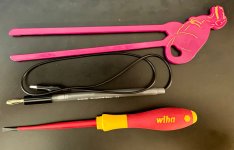
While we are on the subject here are some easy to make or cheap safety tools: Photo Nov 04 2025, 10 33 48 AM.jpg

Plastic kids (or unskilled white dude) chopsticks. If you feel the need to move a wire or whatever. I don't use these much but hey.

Cap discharger. You may have everything to build this already. https://mojotone.com/blogs/news/filter-cap-discharge-procedure You can buy these too. Make sure it's clipped to ground before you turn the amp on so it's ready to go.

Good brand insulated screw driver for adjusting trimmers when the amp is on.
 
While we are on the subject here are some easy to make or cheap safety tools:View attachment 105737

Plastic kids (or unskilled white dude) chopsticks. If you feel the need to move a wire or whatever. I don't use these much but hey.

Cap discharger. You may have everything to build this already. https://mojotone.com/blogs/news/filter-cap-discharge-procedure You can buy these too. Make sure it's clipped to ground before you turn the amp on so it's ready to go.

Good brand insulated screw driver for adjusting trimmers when the amp is on.
I definitely need to set aside some time and make HV tools.
 
I definitely need to set aside some time and make HV tools.

The light bulb limiter is the most important for HV stuff, just after the multimeter IMO. $20 in parts, no need to get fancy. Stop at Menards or Home Depot on the way home from work or the spa. Construction outlet box like the the type that gets nailed into the stud, outlet cover, standard outlet, 3 prong replacement cord, lightbulb socket with mount. Piece of scrap wood to mount the outlet and light fixture etc. Sadly the incandescent bulbs are the hardest part to source these days: 25w, 60w, 100w bulbs should cover everything. I keep it all in a shoe box.

25w for your preamp. It should save you from any catastrophic wiring mistakes that will fry your transformer etc. One test with no tubes, light will burn bright for a second and then dim. Next test with tubes, bright again for a sec, then dim, maybe a little less dim. Then put it all way until the next thing you build :)

If you have one already just ignore, but maybe my post will encourage others to put one together (@JohnnyCreepy ).
 
Back
Top