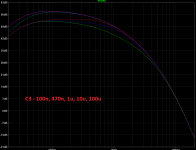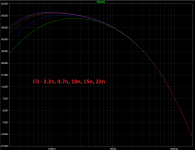
Hi, I made the Golden Falk. First compliments on the bias"islands". Those spots on the pcb makes it real easy to set those Jfets. I use the golden falk on the normal channel on my AC30, I mix a little treble channel sometimes. My question, If I want to temper the lowend of the pedal what are my options? I am a mod-newbee.

You are using an out of date browser. It may not display this or other websites correctly.
You should upgrade or use an alternative browser.
You should upgrade or use an alternative browser.
Mod Question Golden Falk
- Thread starter Einzeln
- Start date


Necro bumping this one, as I'm in the same boat: absolutely love the sound, just want less bass/less 'thick'.
Built one on vero last night (so I can have an extra toggle up top), and would love to find a way to make it a little 'leaner'. It's probably the best MIAB I've come across for nailing 'that sound'/clasic Marshall 'kerrang'.
Looking at the GF schem, are those 100n caps (C11, C13) 'couplers'? Would dropping those down in value help?
Just spitballing
Built one on vero last night (so I can have an extra toggle up top), and would love to find a way to make it a little 'leaner'. It's probably the best MIAB I've come across for nailing 'that sound'/clasic Marshall 'kerrang'.
Looking at the GF schem, are those 100n caps (C11, C13) 'couplers'? Would dropping those down in value help?
Just spitballing
Last edited:
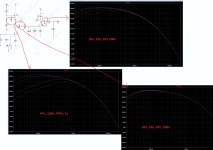
A lot of pedals cut bass before clipping. This is the most tried and true way to tighten things up.
C13 would be after all the clipping so I wouldn’t start there. I’m not sure where most of the clipping occurs, if at Q5, then reducing C11 would help. (Like a lot, I’d start at 4.7n or even 2.2n).
Other options would be even earlier on at C3 and C4, or C10 as suggested above.
C13 would be after all the clipping so I wouldn’t start there. I’m not sure where most of the clipping occurs, if at Q5, then reducing C11 would help. (Like a lot, I’d start at 4.7n or even 2.2n).
Other options would be even earlier on at C3 and C4, or C10 as suggested above.
Thanks guys - I'll probably play around with C10 this weekend (too much to do today thru Thurs night), as that looks like that has the widest array of levels.
Assuming the gray line represents the stock value in all examples?
Last edited:

temol
Well-known member
Correct. Lower cap value = less low freq content.Assuming the gray line represents the stock value in all examples?
In an actual Marshall amp the first way to cut low end is via the first stage cathode bypass cap. In a 1959 Super Lead the normal channel is biased cool with an 820R cathode resistor and a 330µA bypass cap, and the lead channel is biased hot with a 2K7 cathode resistor and a .68µF bypass cap. That's why the normal channel is quieter, cleaner and way bassier than the normal channel. The Super Lead is based very much on the 5F6-A Bassman after all and the normal channel uses what was original designed for both channels - look at a JTM45, for example. It has loads of low end because the bypass cap is shared on the first stage for both channels and is 330µF, bigger even than Fender's 250µF. When Marshall split the cathodes in the Super Lead they kept the cathode resistor of the normal channel the same when they should have used a 1K5 resistor. Keeping the 820R actually reduces the gain once the cathodes are split.
In my amps I will often keep the .68 cap for the lead channel because it is a key part of the Marshall sound. But to make the normal channel more useable I will swap the 330µF bypass cap to something like a 25µF cap with a 1K5 resistor, which is what Fender guitar amps typically use per triode. In my last build I used a .1µF bypass cap for the normal channel - so it's quite close to the bassiness of the lead channel. But there are other factors affecting the tone too, so the two channels still sound different.
You can see these values reflected in the source cap and resistor values in the Golden Falk. They're not identical because this is a pedal and I imagine JFETs react differently from tubes. This is probably where I would start experimenting. C5 will definitely have an effect too - C5 and C6 are the same values as used in the comparable place in a plexi. So yes, reducing the size of C5 will reduce the amount of lower frequency in the normal channel, and increasing C6 will make the lead channel sound fatter. Small changes can have results. But I would start with the source caps first.
In my amps I will often keep the .68 cap for the lead channel because it is a key part of the Marshall sound. But to make the normal channel more useable I will swap the 330µF bypass cap to something like a 25µF cap with a 1K5 resistor, which is what Fender guitar amps typically use per triode. In my last build I used a .1µF bypass cap for the normal channel - so it's quite close to the bassiness of the lead channel. But there are other factors affecting the tone too, so the two channels still sound different.
You can see these values reflected in the source cap and resistor values in the Golden Falk. They're not identical because this is a pedal and I imagine JFETs react differently from tubes. This is probably where I would start experimenting. C5 will definitely have an effect too - C5 and C6 are the same values as used in the comparable place in a plexi. So yes, reducing the size of C5 will reduce the amount of lower frequency in the normal channel, and increasing C6 will make the lead channel sound fatter. Small changes can have results. But I would start with the source caps first.