- Build Rating
- 5.00 star(s)
One of my earliest builds was the Aion Andromeda, which is a near-clone of the Nobels ODR-1. It was a kit build. I don't have a built report because it was before I discovered PedalPCB (PPCB's take on this circuit is the Nobleman). The Aion kit adds a Timmy-style bass cut.
Back then I remember really loving this drive. But as I got more into building, it didn't make the declutter cut, and got sold. A couple years ago, I revisited the circuit, this time building the Andromeda Deluxe, which is a clone of the Nordland ODR-C. This is the "upscale" version of the ODR-1, which adds a bass cut, an active mid boost/cut, and the "ODC" or overdrive de-compress knob. The bass cut is more sophisticated than what Kevin did in the non-Deluxe Andromeda: the ODR-C/Deluxe bass cut actually pans between two different filters. The ODC is a subtle but useful feature that pans soft clipping between 1n4148 diodes and green LEDs.
As is becoming a theme with me, the Andromeda Deluxe also didn't make the declutter cut, and was also sold.
With that preamble out of the way, I feel I've hit a kind of groove with pedal building: I've been pretty happy with the recent builds I've done, particularly those using my own PCBs. So now that I'm in this groove, I'm going back and revisiting some classic circuits using self-designed PCBs and my "idiomatic" features like p-channel MOSFET reverse polarity protection, microcontroller-based electronic switching, and minimal offboard wiring.
I originally set out to actually make a clone of the ODR-C/Andromeda Deluxe, but I ran out of PCB space before I placed all the components. Kevin at Aion managed to do it, so it's certainly possible. But I'm pretty sure he spent a lot of time on that layout! Certainly more time than I was willing to spend. So I simplified to what is essentially an ODR-1BC or "bass cut". Specifically, I made the following changes from the ODR-C/Deluxe:
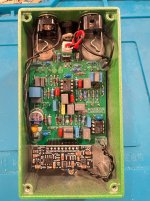
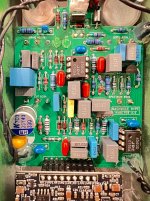
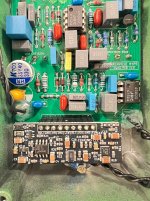
The buffered bypass quasi-IC is my latest version. It's the same circuit as what I used in the Dynamic Haircut v2.0 and Old Fashioned v2.0, except it's been shrunk down to 16x43mm. The intent is actually to use right-angle pin headers so that it can be mounted vertically (i.e. perpendicular to the effect PCB). But the right-angle pin headers I bought are just slightly too big for the female-mating parts I have on hand. This was my first time using the new board, so I didn't want to direct-solder in case there were problems; so this one actually ended up flat-mounted. While the circuit is the same, the newer version uses the ATtiny202. It's my first time using that microcontroller (firmware link). I ponied up for 4-layer, ENIG finished PCBs, assembled by JLCPCB. These weren't cheap!
But everything came together and worked great on the first power-up!
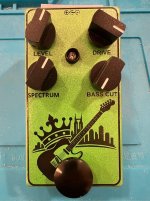
I originally called it "Nashville Hype", and that's what's on the PCB. But I later decided to call it "Nashville Nobility". The enclosure art tries to speak to that: a Telecaster with a crown, against the Nashville skyline. I had AI make that image, so I can't speak to the accuracy of the skyline. And the Tele only has five strings.
Back then I remember really loving this drive. But as I got more into building, it didn't make the declutter cut, and got sold. A couple years ago, I revisited the circuit, this time building the Andromeda Deluxe, which is a clone of the Nordland ODR-C. This is the "upscale" version of the ODR-1, which adds a bass cut, an active mid boost/cut, and the "ODC" or overdrive de-compress knob. The bass cut is more sophisticated than what Kevin did in the non-Deluxe Andromeda: the ODR-C/Deluxe bass cut actually pans between two different filters. The ODC is a subtle but useful feature that pans soft clipping between 1n4148 diodes and green LEDs.
As is becoming a theme with me, the Andromeda Deluxe also didn't make the declutter cut, and was also sold.
With that preamble out of the way, I feel I've hit a kind of groove with pedal building: I've been pretty happy with the recent builds I've done, particularly those using my own PCBs. So now that I'm in this groove, I'm going back and revisiting some classic circuits using self-designed PCBs and my "idiomatic" features like p-channel MOSFET reverse polarity protection, microcontroller-based electronic switching, and minimal offboard wiring.
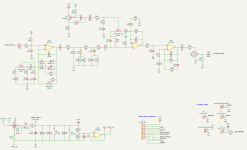
I originally set out to actually make a clone of the ODR-C/Andromeda Deluxe, but I ran out of PCB space before I placed all the components. Kevin at Aion managed to do it, so it's certainly possible. But I'm pretty sure he spent a lot of time on that layout! Certainly more time than I was willing to spend. So I simplified to what is essentially an ODR-1BC or "bass cut". Specifically, I made the following changes from the ODR-C/Deluxe:
- Removed the active mid sub-circuit
- Retained the ODC sub-circuit, but with a fixed resistor making it roughly set to the midway point
- Replaced the JFET input buffer and final opamp buffer with the opa1678 buffers on my buffered bypass quasi-IC module
- Omitting that final opamp buffer gave me a spare opamp, so I used it to buffer VREF
The buffered bypass quasi-IC is my latest version. It's the same circuit as what I used in the Dynamic Haircut v2.0 and Old Fashioned v2.0, except it's been shrunk down to 16x43mm. The intent is actually to use right-angle pin headers so that it can be mounted vertically (i.e. perpendicular to the effect PCB). But the right-angle pin headers I bought are just slightly too big for the female-mating parts I have on hand. This was my first time using the new board, so I didn't want to direct-solder in case there were problems; so this one actually ended up flat-mounted. While the circuit is the same, the newer version uses the ATtiny202. It's my first time using that microcontroller (firmware link). I ponied up for 4-layer, ENIG finished PCBs, assembled by JLCPCB. These weren't cheap!
But everything came together and worked great on the first power-up!
I originally called it "Nashville Hype", and that's what's on the PCB. But I later decided to call it "Nashville Nobility". The enclosure art tries to speak to that: a Telecaster with a crown, against the Nashville skyline. I had AI make that image, so I can't speak to the accuracy of the skyline. And the Tele only has five strings.