Hi all,
Fan of the SD-1 here. I built the PedalPCB Oddity and am actually liking it a lot. Sure, no tone pot, but the way it's set is fine. It's tight (Tuco from Breaking Bad comes to mind). And one less knob to worry about.
After I built the Oddity I put the circuit on a bread board. I replaced the first BJT buffer with a J201, also increased the biasing resistor to 1M for a bit more input impedance. Sounded the same, a little less background noise. Then I just changed both transistors out for a dual FET-input OPAMP, because why not.
I'm aware that at first there was an OD-1 with a quad opamp version and that people are raving about it. Also found a writeup by analogman where he said "I found the main difference was capacitors, several smaller value capacitors were used, sucking away low end and making a thin tone."
But when I go around the schematics of two OD-1 versions and do the math on the high and low pass filters, although the caps differ in value, the results are actually exactly the same, except for the high pass at the output, which doesn't matter.
He adds that the quad opamp doesn't matter a whole lot ("it sounded a little better but almost the same aswith just the capacitor mods").
Well, I certainly drew my own conclusions from all of this The quad opamp version had a different opamp and about half the input impedance. Other than that it's the same.
I also tried a mod from Mark Hammer at diystompboxes, where he replaced the 720Hz filter with one along the lines of the ODR-1. But that made the OD-1 go from tight to flubby, so I reverted it again.
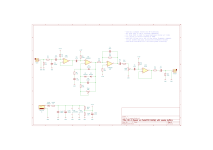
I ended up with a bunch of small utility mods, nothing that changes the sound of the OD-1. Except, I added a socket for a small pF cap into the feedback loop of the drive stage, in case I want to tame the high end a bit in the future.
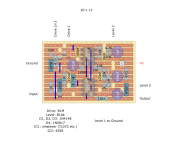
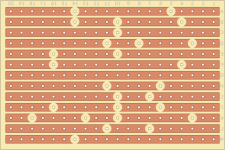
Be careful, the picture with the cuts is already mirrored!
Fan of the SD-1 here. I built the PedalPCB Oddity and am actually liking it a lot. Sure, no tone pot, but the way it's set is fine. It's tight (Tuco from Breaking Bad comes to mind). And one less knob to worry about.
After I built the Oddity I put the circuit on a bread board. I replaced the first BJT buffer with a J201, also increased the biasing resistor to 1M for a bit more input impedance. Sounded the same, a little less background noise. Then I just changed both transistors out for a dual FET-input OPAMP, because why not.
I'm aware that at first there was an OD-1 with a quad opamp version and that people are raving about it. Also found a writeup by analogman where he said "I found the main difference was capacitors, several smaller value capacitors were used, sucking away low end and making a thin tone."
But when I go around the schematics of two OD-1 versions and do the math on the high and low pass filters, although the caps differ in value, the results are actually exactly the same, except for the high pass at the output, which doesn't matter.
He adds that the quad opamp doesn't matter a whole lot ("it sounded a little better but almost the same aswith just the capacitor mods").
Well, I certainly drew my own conclusions from all of this
The quad opamp version had a different opamp and about half the input impedance. Other than that it's the same.I also tried a mod from Mark Hammer at diystompboxes, where he replaced the 720Hz filter with one along the lines of the ODR-1. But that made the OD-1 go from tight to flubby, so I reverted it again.
I ended up with a bunch of small utility mods, nothing that changes the sound of the OD-1. Except, I added a socket for a small pF cap into the feedback loop of the drive stage, in case I want to tame the high end a bit in the future.
Be careful, the picture with the cuts is already mirrored!