
You are using an out of date browser. It may not display this or other websites correctly.
You should upgrade or use an alternative browser.
You should upgrade or use an alternative browser.
Opamps for Dummies - part 2
- Thread starter Chuck D. Bones
- Start date
That post is over two years old and you are the first person to notice this, good catch! The text has now been corrected.
Now I'm the one who's embarrassed.


Locrian99
Well-known member
On non inverting amplifiers you’ll often see a resistor going to ground or vref right before. As we see here in the greengage.

I’m assuming this has to do with the impedance of the source for sizing? What determines if it goes to vref or gnd, and is it always necessary?
Thanks!
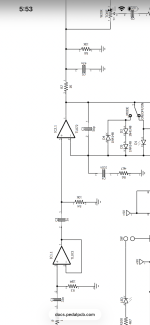
I’m assuming this has to do with the impedance of the source for sizing? What determines if it goes to vref or gnd, and is it always necessary?
Thanks!

Chuck D. Bones
Circuit Wizard
Dear God, you can't rotate the pic on your phone? 
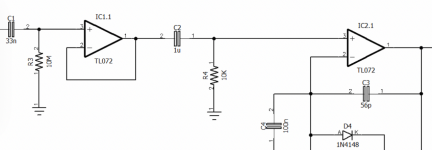
We're talking about R3 & R4, yes? Opamps need a DC bias source for every input pin. In other words, every input pin must have a DC path to somewhere. The output of that opamp, or another opamp, or GND or Vref, whatever is appropriate for a give circuit. The Greengage runs on split rail (±9V), so GND is appropriate here. I could make the case that C2 and R4 are superfluous since the output of IC1.1 is biased at GND. I could also make the case that IC1.1 is superfluous because IC1.1 has unity gain and the same input impedance as IC2.1. C2 & R4 make a 16Hz high-pass filter. does the circuit need one? I doubt it. Sorry, I kinda drifted off course there...

We're talking about R3 & R4, yes? Opamps need a DC bias source for every input pin. In other words, every input pin must have a DC path to somewhere. The output of that opamp, or another opamp, or GND or Vref, whatever is appropriate for a give circuit. The Greengage runs on split rail (±9V), so GND is appropriate here. I could make the case that C2 and R4 are superfluous since the output of IC1.1 is biased at GND. I could also make the case that IC1.1 is superfluous because IC1.1 has unity gain and the same input impedance as IC2.1. C2 & R4 make a 16Hz high-pass filter. does the circuit need one? I doubt it. Sorry, I kinda drifted off course there...
Last edited:
Locrian99
Well-known member
Yea I guess that makes sense that ground is basically vref there.Dear God, you can't rotate the pic on your phone?
We're talking about R3 & R4, yes? Opamps need a DC bias source for every input pin. In other words, every input pin must have a DC path to somewhere. The output of that opamp, or another opamp, or GND or Vref, whatever is appropriate for a give circuit. The Greengage runs on split rail (±9V), so GND is appropriate here. I could make the case that C2 and R4 are superfluous since the output of IC1.1 is biased at GND. I could also make the case that IC1.1 is superfluous because IC1.1 has unity gain and the same input impedance as IC2.1. C2 & R4 make a 16Hz high-pass filter. does the circuit need one? I doubt it. Sorry, I kinda drifted off course there...
View attachment 114261
So if there was an op amp stage directly before without the cap between to block dc then that wouldnt be necessary?
Chuck D. Bones
Circuit Wizard
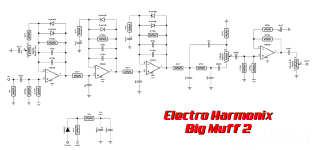
Correct. The DC bias can come from anywhere, as long as it's the right voltage. Check out the biasing in the Big Muff II. Stage 1 biases stage 2. Stage 2 biases stage 3.

Locrian99
Well-known member
Oh ok, does it matter if you are going from inverting to non inverting? Is there a way that is considered... IDK best? I'm currently working on a circuit I guess I could just remove the coupling and roll with it without that resistor... coming out of a baxandall into a non inverting with a gain of 2.
Edit:
I guess inverting is connected to vref already typically. So you’d want to block that dc…
Edit:
I guess inverting is connected to vref already typically. So you’d want to block that dc…
Last edited: