Outboard processors DIY?

beachbum

Active member
I have about 2 dozen pedal projects on standby and I can kind of see the light at the end of the tunnel. I don't foresee myself doing much more after this year. I was interested in moving on to try my hand at amp building and outboard FX. But the former can cost a fortune and requires woodworking that I don't have the knowhow or space for. But might splurge on a champ kit sometime down the line.

That said, looking at making some sort of combo of the famous EQ/Comp processors. Anyone know what path to take to source and make good quality replicas for someone like me with no background in electronics ?

Looking specifically to start with the 4 standards:
Stereo Neve 1084 (1073 with additional controls)
LA2A (is there a good stereo link version floating in the DIY world?)
a Pultec EQ
1173
 
I was looking through a gear catalog the other day, and was blown away at how much some of these units costs. Never thought much about rack-mount processors.

Hive mind, can you explain this to me - why does a pedal-based compressor cost $80-140ish, but a the LA2A goes for $4299. I know there's some hype and mojo mixed in with that price, but it also has to do something different than the circuitry in a pedal... right?
 

How The LA-2A Works​

The LA-2A Leveling Amplifier has only a single gain stage and is one of the simplest compressors to operate with two knobs: Gain and Peak Reduction. The fact that it offers 40 dB of gain from input to output allows it to also be used as a preamp and compressor.

la-2a_t4a.jpg

The inside of a T4A optical attenuator. Note the
electroluminescent panel on the top.
Let’s look inside the T4 optical attenuator, which is the heart of the LA-2A. The T4 cell’s primary components include an electro-luminescent panel and dual cadmium-sulfide photo resistors, one of which controls gain reduction, and the other the VU meter in Gain Reduction mode. How does it work? As the input signal increases, the light panel gets brighter. As the light gets brighter, the photo resistor’s impedance increases which reduces the gain. As the input level decreases, the light dims and the resistor’s impedance decreases. Whether by serendipity or intent, Jim Lawrence’s T4 design had a musical response that allowed the LA-2A the sonic and technological longevity it still retains.

“The heart and soul of the LA-2A is in the T4 cell,” explains Bill Putnam Jr. “All of the characteristics are right there. The photocell and the physics behind it are what immediately result in the two-stage release.”

Though the T4 cell makes the LA-2A shine, the overall transformer and tube amplifier design of the LA-2A also plays a huge part in its longevity and popularity. Though there have been reissues of the LA-2A, very little has changed from the original design, which is a testament to its reliability and linear response.

* cough...cough* yup...mojo.
 
I spent faaar to much time in the past reading hot takes on gearslutz that my opinions have probably been permanently skewered by the morons there (probably their plan). Guys arguing endlessly on how new clones that are copied down to the molecule still don’t sound as good as the originals.

so maybe because of that influence, I’ve always erred on spending a bit more for the ‘higher grade’ stuff than save a few bucks and the possibility of regretting the purchase.
Thankfully there seem to be enough monkeys like me reading audio forum cesspools that the stuff I’ve bought has kept its value or even gone up significantly in price.

All that to say, for these big old school boxes, there are lots of people who swear some special NOS juice circuit mojo is the only way to hear the magic they produce and cutting corners or buying the bargain copies is not worth the effort or money. I haven’t been around enough old units or copies to compare but I’m sure there’s a point where “good enough“ gets you 99% of the sound without hunting down unicorn parts.

The problem is you have a lot of people preying on nostalgia with a fancy faceplate and a shoddy board and or marking things up exponentially for the same reasons.

There’s a lot of noise about what really/technically makes the classic outboard boxes special and I wish there was some wise man who would come down from the mountain up high to announce pro audio Truths. Like the equivalent in the pedal world of “SMD and through hole sound the same” , “carbon resistors are almost never worth the trouble” and my personal favorite “if people are buying a pedal because it’s touting enclosure dimensions optimized for tone shaping , maybe we deserve 4 more years of trump
 
@beachbum that seemed....cathartic

Without waning too philosophical; we are all wired a bit differently and therefore respond differently to stimuli. Our likes and dislikes are at least partly formed through external bias that we deem authoritative. "I buy brand X because of the very endorsements you harbor disdain for".

As for price; "value" can be described as one's reasoning when assigning price, or the level of satisfaction regarding a purchase. These are both susceptible to the same external bias, regardless of realized gain on the part of the seller - or perceived loss on the part of the buyer.

Life is a series of choices that produce positive and negative results. I prefer zen to turmoil.

As for politickin' ...faith is a strange and powerful force.
 
And just to give an update to your original post @fig, the DIY Pultec from analogvibes touts the following features:
  • carbon composition resistors as used in vintage units
  • audiophile Audyn film caps for the low freq. filter section
  • authentic can capacitor by CE Manufacturing for the PSU
  • audio grade can capacitor by Mundorf for the amp section
  • high-end Russian made Genalex Gold Lion 12AX7 6 12AU7 tubes
  • NOS (new old stock) rectifier tube
  • high quality hook-up wire by Alpha Wire
From the little I know, the only ones that can really influence the quality of the product are the tubes. Everything else is making it a museum piece and not using more reliable modern parts if available.

For the LA2A, ballpark for the BOM I eyeballed seems about 500USD in parts + Tubes + Chassis + faceplate. So maybe close to $1000 total. Factor in labour, not hard to see why even some DIY ones are going for 2k+

There's a stereo LA2A BOM and with the premium parts, you're almost at $2k in parts without the front faceplate
 
  • Like
Reactions: fig
I have had good luck with seventh circle audio, the n72 (neve) and a12 (api) sound really great. Hairball audio has some really great stuff if you want a 1176 he has kits for every version and available in a 2u rack or 500 series format. Diyre also has a la2a or la3a thing and pultec eq, i have t built them specifically but have heard nothing but great things
 
  • Like
Reactions: fig
If you'd be interested in 500 series stuff I've had great success with kits from CAPI, DIYRE, Hairball, and Sound Skulptor. Here's what I've built and would recommend (I also don't have an engineering background, but I am handy with an iron)

CAPI:
511-VPR rack - this was a relatively easy to build unit and has been rock solid. Really great bang for your buck. Supports 11 modules!

Sound Skulptor:
MP566 - super fun tube pre. Sounds lovely and soft. Especially nice on bass and has a little fun fuzz in it as well.
MP573 - This is my main voice pre, but also sounds great with guitar. It's a Neve style thing.
EQ573 - A really fun and adventurous build. Connects with the MP573 with a special cable that can insert it between the two gain stages, or you can use it like any other 500 series module.

Hairball Audio:
FET/500 Rev A - has a bit of cronch when driven. A challenging but rewarding build. It can sound transparent or smoosh the heck out of stuff and is really versatile.

DIYRE:
OLA5 - A super duper fun to build opto compressor. The quality of the build instructions is really, really good. Has a great gooey smooth character and pairs really great with the FET/500. You can catch fast transients with the Hairball and smooth everything else out with the OLA5
EQP5 - A pultec style eq with some nice frequency choices.

I use the MP573 > EQ573 > (non DIY DS101 gate) > FET/500 > OLA5 > EQP5 for voice and it's a wonderful chain.
 
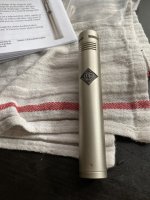
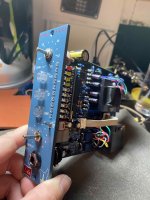
+1 to all of Junderwood's picks, though I haven't personally used sound skulptor kits. I've a pair of Lolas from Hairball, a CP5 and EQP5x2 from DIYRE, and most recently a pair of DIY Neumann KM 84 from Microphone-parts.com and I love them all dearly.


IMG_1987.jpg IMG_1811.jpg

I'm totally in love with the microphones, but to @beachbum 's point, I mentioned them to my professional engineer friend and wondered out loud how they'd stand up to his vintage KM84. He kinda dismissed the DIY kit out of hand, saying that they mic kits never 'sound as good as the real thing'. He also mentioned how his one(1) KM84 is priced at over $2000 and will continue to appreciate, like a pile of gold underneath your mattress (my take). But he's also the kinda guy that feels that, if you're going to spend $500 on a thing, might as well spend $2,500 and get 'the real deal.' I totally understand where that comes from, but won't change my opinion on my stuff, they kick ass and at least get me into the venue of the ballpark.
 
Thanks for all the suggestions.

I actually kind of wanted to stay out of the 500 series stuff, it felt too addictive and crack-like. Like modular synths for outboard. I've made some DIYRE reamp boxes and like them enough. I also didn't want to deal with those chassis and then deciding I need 1 more slot have to replace with a bigger one etc.. etc...


Here's the BOMs I've found :
Stereo LA2a
LA2A Drip
LA2A Analog Vibes
Pultec Analog Vibes
Neve 1073/1084 pre and eq separate: Preamp, can't find a 1084 BOM and it seems they are not readily available :(


KM84 specifically are the best SDC mics no question, but finding a pair that's in good condition and won't give you any problems down the road is a crapshoot unless you're buying them from a reliable seller and try them out first hand. So for 99% of people, getting that sound will mean trying alternatives. If KM84 were more surefire purchases, I think they would sell for even more than $2k each.
 
I'd avoid P C B Grinder. I ordered two EQ PCBs that never arrived; I don't want a refund, I want the PCBs that I ordered and paid for. The issue is unresolved more than a year later; he's complained about losing past shipments to China (I'm in HK), I told him to send the PCBs to my Canada-address and then the email trail went cold.
The guy is dropping his kits (1176, various EQs etc) to pursue some other project, but may still be offering PCBs. Proceed at your own risk.

I was looking through a gear catalog the other day, and was blown away at how much some of these units costs. Never thought much about rack-mount processors.

Hive mind, can you explain this to me - why does a pedal-based compressor cost $80-140ish, but a the LA2A goes for $4299. I know there's some hype and mojo mixed in with that price, but it also has to do something different than the circuitry in a pedal... right?
Economies of scale. Easier to pump out 1,000 pedals to a market potentially able to devour 5,000 pedals, than to make 10 studio rack units and sell maybe 3. I guess.


Sorry if any of the following is a repeat from another post:

BUMBLEBEE PRO RIBBON MIC RM5
www.bumblebeepro.com/rm-5-diy-ribbon-mic-full-kit/
Also a DI with custom wound transformer offered.

www.vintagemicrophonepcbkit.com/
Vintage U87i


DIY BASS TRAPS/ACOUSTIC TREATMENT


SOUND SKULPTOR 
500 series mic-pres, comps, eq, tape-sim


HAIRBALL AUDIO
Seattle-based Co focusing on quality components/builds.


GYRAF DIY


DIY-2A COMPRESSOR


BEST SMALL TUBE AMPS FOR RECORDING STUDIOS


I had a look at all the proposals here.
Conclusion for me is, I'd like to stay away from 500 series for the time being. Just trying to avoid ADD acting up for another never-ending hobby buying blitz. Goal of this is to build familiar circuits, entice people to come hang out in my studio when covid ends (how else does one make friends but telling them you have a Fairchild compressor?) and have some big knobs to twiddle around that make everything sound better.

There seem to be 2 avenues - PCB and P2P.
A) The PCB route actually seems the more difficult and expensive option, and unless getting a kit, you have to have everything made, including the chassis. Bonus is you can build on existing designs i.e. LA2A from Drip comes as a stereo PCB.

B) There's the Turret Board option from Analog Vibes. Your given the chassis and a BOM to source all the parts. Various options are also presented for parts to suit budget or sonic preference. Big plus for clean and clear design of guides and manuals. Easy to follow along. Cheaper than PCB options, but more traditional. Kits are sometimes offered as part of limited time deals for relatively reasonable prices.

I'm leaning to the latter option for a few reasons.
1) Overall, seems to be cheaper option. On account of the premade chassis and lack of extra bells and whistles.
2) Turret assembly might segway into amp building
3) Guides are more clear and idiot proof, which is necessary for dunces like me
4) No Chassis construction/machine drilling nonsense. I already hate making holes for pedal enclosures. Having someone do it for me would also raise the cost enormously. So, I'm content with chassis option when available.

Both main options seem to offer excellent support and build docs so it might come down to individual preference for others. For me, neat Graphic design layout and lower budget were deciding factors.

The big one I'm interested in that will be hard to find is a pair of 1084 pre/Eqs. For those that don't know, They are basically suped up 1073s with following additions:
1) dual concentric Variable hi shelf (instead of fixed 12k)
2) Mid range has Q peak goes from -18 to -12 with additional button
3) Extra lo pass filter on concentric pot shared with hi pass filter
4) There's even a slightly more programmable version made by BAE called the 1028 which has a bigger mid range sweep that overlaps with the hi and lo shelves.

1073 should be a fairly easy project to find, but I don't know enough to know if they could be easily modified to include the above-mentioned additions or if they require a circuit redesign (it should be fairly simple from my limited knowledge but then again, maybe not?). I have found someone who makes seasonal sales for 1084 PCBs but it's just for the EQ. So I would have to make the DI/Preamps in an other module I think.

I did find a AMS Neve Manual with schematics for 1073 and 1084 modules which are purportedly identical to the bigger 19" rackmount units. If anyone with any sense can see how the two differ and how the additions to a 1073 would impact circuit design or modifying an existing PCB.

Here is a DIY 1073 mic pre EQ build doc with schematic for reference if anyone is interested. I'm typing this all out fast during my break so if something looks wrongly worded, let me know I will try to make it clearer.

 
  • Like
Reactions: fig
Back
Top