

owlexifry
Well-known member
runoffgroove describes this circuit as providing “two buffered parallel effects loops with a Blend control. Also, a phase polarity switch is included to allow phase matching of the effect loops. Possible uses are blending two sets of effects placed in the loops, a signal splitter, a simple mixer, or to blend an effect with the dry signal.”

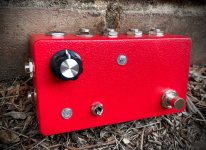
it puzzles me that there isn’t a board (that I’ve been able to find) that can do what this circuit does.
yes there’s quite a few blending circuit pcbs, but all that i’ve seen are too small and deficient of features.
ie. phase inverter switch is mandatory, and to my great satisfaction - i found immediately on initial testing how valuable this is to have.
i built this mostly because i wanted something that would allow me to clean blend my fuzzes in front of/with the tight/modern high gain distortion that i normally use, and i've found it certainly makes for more versatility/accessibility.

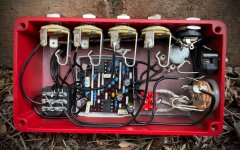
this took me a long time to build and im glad i didn’t rush.
the circuit is designed with one channel having the phase inversion toggle, and the other channel is setup so that with nothing plugged into the return jack, the send can go direct to return via switching jack (for an easy clean blend).
nearly got myself into a few pickles but caught them before potential disaster eventuated.
notably, the input buffer JFET bias on the 'green channel' return.
schematic specifies 2N5457 so i went with one that i’d used for breadboarding a distortion recently.
then i read this thread describing some issues that were pointed towards incorrect JFET bias, with one poster suggesting that the Source should ideally be idling at 4.5v for maximum headroom/full response.
i checked mine just before i was moving toward the -can’t really turn back now buddy- phase of assembly, and found it was idling at 0.42V.
yikes.
so yep, it was breadboard time.
pulled out some JFETs, a 1M, x2 4K7 and setup the input buffer on the breadboard.
- all of my 5457s idled at ~0.4v
- J201 - 1-3v
- J113 - ~3.0v
- PN4393 - ~3.5v
- 2N5458 - 3.0-4.8v
i was curious about how much difference all of this would make, so i set up the protoboard w/ a DAW and a clean plugin and played my P-Bass through it.
at 0.4V idle bias with 5457 - a diminished response was noticeable. glad i caught that. but not as terrible as i thought.
it was difficult to hear much difference between 3v-4.8v bias, as i tried all the JFETs listed above and then just settled on a 2N5458 that idled at 4.8v

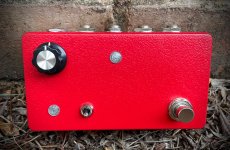
this is definitely gonna get used and im glad i built it.
here’s a demo running two fuzzes in parallel:
- Big Muff V2
- EQD Black Ash
it puzzles me that there isn’t a board (that I’ve been able to find) that can do what this circuit does.
yes there’s quite a few blending circuit pcbs, but all that i’ve seen are too small and deficient of features.
ie. phase inverter switch is mandatory, and to my great satisfaction - i found immediately on initial testing how valuable this is to have.
i built this mostly because i wanted something that would allow me to clean blend my fuzzes in front of/with the tight/modern high gain distortion that i normally use, and i've found it certainly makes for more versatility/accessibility.
this took me a long time to build and im glad i didn’t rush.
the circuit is designed with one channel having the phase inversion toggle, and the other channel is setup so that with nothing plugged into the return jack, the send can go direct to return via switching jack (for an easy clean blend).
nearly got myself into a few pickles but caught them before potential disaster eventuated.
notably, the input buffer JFET bias on the 'green channel' return.
schematic specifies 2N5457 so i went with one that i’d used for breadboarding a distortion recently.
then i read this thread describing some issues that were pointed towards incorrect JFET bias, with one poster suggesting that the Source should ideally be idling at 4.5v for maximum headroom/full response.
i checked mine just before i was moving toward the -can’t really turn back now buddy- phase of assembly, and found it was idling at 0.42V.
yikes.
so yep, it was breadboard time.
pulled out some JFETs, a 1M, x2 4K7 and setup the input buffer on the breadboard.
- all of my 5457s idled at ~0.4v
- J201 - 1-3v
- J113 - ~3.0v
- PN4393 - ~3.5v
- 2N5458 - 3.0-4.8v
i was curious about how much difference all of this would make, so i set up the protoboard w/ a DAW and a clean plugin and played my P-Bass through it.
at 0.4V idle bias with 5457 - a diminished response was noticeable. glad i caught that. but not as terrible as i thought.
it was difficult to hear much difference between 3v-4.8v bias, as i tried all the JFETs listed above and then just settled on a 2N5458 that idled at 4.8v
this is definitely gonna get used and im glad i built it.
here’s a demo running two fuzzes in parallel:
- Big Muff V2
- EQD Black Ash
Last edited:


