Safety questions about repairing guitar transistor amplifiers

eh là bas ma

Well-known member
Hello,

I have 2 transistor guitar amplifiers, both made in the 90's, that need some repairs.

One just stopped passing signal (not even the usual "pop" when i turn it on and off) but the power switch lights up, so i'd like to test the capacitors, see if one of them is dead.
The other has a glitchy Gain pot, and the signal is inconsistant. I'd like to change the pot, but i need to dismantle the amp to access the pcb.

I wonder what are the necessary safety precautions ?

I know there are lethal charges in some capacitors, so i think we need to use a screwdriver and short both legs to empty them ?

What about the transformer ? Can we touch that ?

Are there other risky aeras ?

Thanks in advance for your help !
 
Last edited:
If you’re worried just discharge the power filter caps, and check with a multimeter before you poke around.

Only solid state amps I’ve worked on was a couple earky 80’s jc120’s and a jc50, there wasn’t any high voltage in it but I just checked before I touched anything out of caution.
 
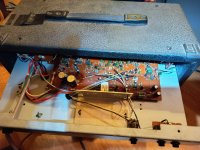
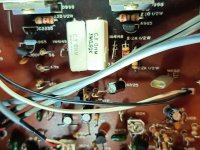
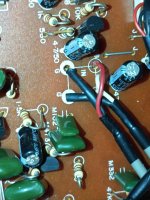
here are a few pictures

50W amp
IMG_20261003_030123.jpg
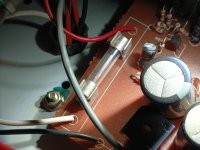
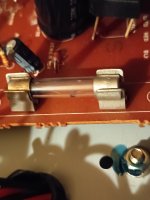
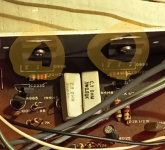
Not sure what this is, maybe the safety diode, which is likely fried to protect the circuit ?
IMG_20261003_030149.jpg
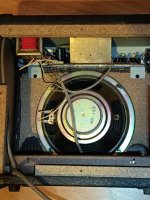
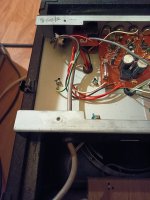
15W little amp, just need to change a pot :
IMG_20261003_025207.jpg
 
If you’re worried just discharge the power filter caps, and check with a multimeter before you poke around.

Only solid state amps I’ve worked on was a couple earky 80’s jc120’s and a jc50, there wasn’t any high voltage in it but I just checked before I touched anything out of caution.
Thanks for your reply !

What are the power filter caps ? the biggest ones ?

I read 3300 uF on the biggest caps from the 50W amp. A standard multimeter can handle that much ?

I discharge them by touching both legs with a standard screwdriver with a wooden handle ?

Can there be some sparks with 3300 uF capacitors ?
 
Last edited:
Not sure what this is, maybe the safety diode, which is likely fried to protect the circuit ?
View attachment 125541
You mean the fuse on the left or the bridge rectifier on the bottom right?

Looks like there's some analog delay or chorus built in. Nice.

If it's the fuse, you'll need replacements of the same type. Voltage and current rating as well as slow/fast blow.
Would be nice to confirm the rating via schematic or manual as well in case the last guy put a higher rated one in there because it kept blowing.
Also, don't assume you only need one fuse. You'll always need one more than you bought.

Again, schematic would be handy. That way you know what voltages should be where.
I would pull the BBD chips for the time being. That will keep them safe until you know your voltages are good. Blowing them up will add unneeded expense. Use ESD precautions. The amp should still pass clean audio with them removed and you can use their sockets as voltage test points. Worst case, no schematic, you can reference their data sheet for maximum rated voltage and confirm that's in spec before reinstalling them.

Power supply caps are going to be tougher to desolder than pedal caps. There's a lot more mass and probably a lot more ground plane. That's going to suck heat out of your iron.
Indium solder can help. Another method is to use a cheap iron, the kind with no temp adjustment, and stab the cap. Let it cook until it's ready to remove. Yes, it smells and you shouldn't breathe it. No, this shouldn't be your first corae of action.

If the amp has been powered off for a while(week or so) and unplugged, you're likely good. With it unplugged, turn the power to on for a few seconds.
Shorting the cap should be a last resort, not a primary method of draining. There are discharge pens. You can also use a high value high wattage resistor. Something like 8-10 watts. 200 ohm or higher on "likely discharged caps" and something 1k-100k on "just came out of the power station rack."
Check with the DMM, discharge with the resistor as needed, check with the DMM again. Sanity check with the screwdriver.
Mind your grounding. Insulated shoes, one hand behind your back. Don't hold the chassis or a ground with your left hand and discharge with your right. Mind your wrists.
 
Power supply caps are going to be tougher to desolder than pedal caps
If the power indicator lights up when i turn the amplifier on, i guess it means the power filter caps are fine ?

And i can check them with a multimeter on capacitor mode while they're still soldered to the pcb, to make sure they didnt fail ?

I never had a fried capacitor, but i guess if we test one with a DMM on capacitor mode, it would read 0 uF ?
 
You mean the fuse on the left or the bridge rectifier on the bottom right?
I meant the fuse.

The bridge rectifier is probably fine even after 30 years ?

This amplifier was working great a week ago, and recently when i turned it on to play a bit it was total silence from all the outputs, no warning sign whatsoever. I didnt even move the amp or do anything special.

What the purpose of the fuse, and is there a way to test if it's still ok ?

It's an Avenger AX-50RC and unfortunately i cant find any manual or schematics online.
 
Last edited:
If the power indicator lights up when i turn the amplifier on, i guess it means the power filter caps are fine ?
Hard to say because you likely have at least 2 different voltages g3nerated inside and the indicator could be an AC bulb.
You need to follow the incoming AC power. Is there a PT? Don't see one unless there's a small one tucked in the back. If so, follow the outputs. Wherever they land, there will be an AC to DC stage. Caps and diodes or a bridge rectifier. I'm guessing you have a higher voltage line a +/-15( stepped down by the zeners on the lower right.
And i can check them with a multimeter on capacitor mode while they're still soldered to the pcb, to make sure they didnt fail ?
You can try. Helps to know if they are in series or parallel with other caps.
I never had a fried capacitor, but i guess if we test one with a DMM on capacitor mode, it would read 0 uF ?
They would only read that way if they were open or short. Elcaps derate with age and heat.
I meant the fuse.

The bridge rectifier is probably fine even after 30 years ?
Probably. It's just a package of diodes. But they can fail, usually from heat or large issues(incorrect voltage, shorted PT)
This amplifier was working great a week ago, and recently when i turned it on to play a bit it was total silence from all the outputs, no warning sign whatsoever. I didnt even move the amp or do anything special.
Fuse probably popped then. The question is why did it pop.
What the purpose of the fuse, and is there a way to test if it's still ok ?
Its a wire that melts when is current rating is exceeded. How long it can survive over current conditions is determined by fuse type(slow blow or fast blow).
If it's visibly black, it's blown. You can test, power off, with continuity or resistance. Caveat being that I've seen on 2 occasions where they blow at the base and the element still has continuity until voltage is applied. First time screwed me up for a day and a half on a mobile x-ray.
It's an Avenger AX-50RC and unfortunately i cant find any manual or schematics online.
Damn. Are there power transistors heatsinked to the back of the amp? I don't see anything that looks like a power stage.
I would suspect a power transistor possible failed. While your in there, change the big caps. They're cheap and it will ensure many more years of service. Get high hour high temp(105C or better) rated caps.
But I don't think, via initial pictures, that caps are the main problem. If a power cap fails in a way that blows a fuse, there's usual visual evidence and often a certain scent in the air.
And there's very little else that's going to suck a bunch of current on failure. That's basically a bipolar supply preamp into a power stage(unseen) and I'm betting that fuse is a handful of amps.
 
Are there power transistors heatsinked to the back of the amp?
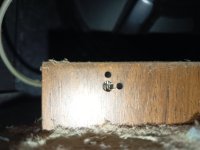
i dont see anything except a wooden case fixed on some piece of carpet on the bottom of the amplifier's chassis, with 2 connectors plugged into that wooden box.
IMG_20261003_053902.jpg
Through the little holes i can see some springs
IMG_20261003_060021.jpg
...No idea what this is. And no obvious way to open this box.
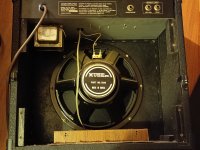
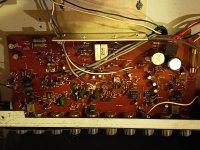
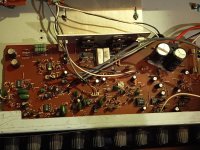
Here are a few more pictures, no smell and the fuse isnt dark.
Should i remove it and listen if i can hear something rattling inside, like i would do with a light bulb ?
IMG_20261003_054325.jpg IMG_20261003_054232.jpg IMG_20261003_054547.jpg IMG_20261003_054454.jpg
 
I did a continuity test on the fuse, no continuity, i guess it's blown but changing that probably wont solve anything.
If i replace it i guess i ll blow the next one unless i find what's the issue in the circuit.
 
Back
Top