Stickman builds his first tube amp

Update!

I've been doing a bit of fab work for this thing.

Updates: fuck it, I'm gonna put it in a pre-made cab.

Why? Cause I want to get this one done faster, and my router table needs some attention before I'm gonna be ready to make a cabinet. So, whatevs.

But, I have made a little progress.

Toroid mounting:

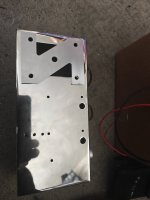
Originally I thought "eh, fuck it, I'll just make a little adapter plate that has recesses in it to route the wires through".

1000059092.jpg

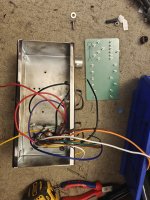
V1 wasn't so great. Not enough clearance underneath, would have squished the wires. No bueno.

1000059093.jpg

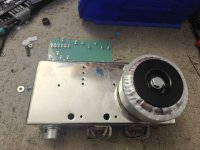
So, trimmed the fat. Made it a diagonal piece. Much better now.
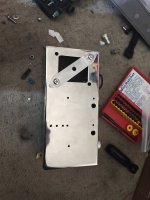
1000059094.jpg

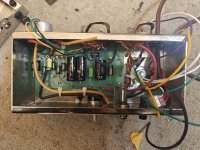
Then, I cut up the turret board. Easy nuff. I'm using the hoffman layout in lieu of the original setup.
1000059096.jpg

1000059097.jpg

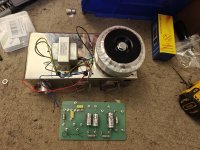
Got my caps in place & a couple of the higher current resistors.

Now, wait for the rest of my parts to come in.
1000059099.jpg

And it's gonna have a name.

The Stickman Chump* (all rights reserved).

Ya know. Like a champ. But really, like a chump (eyyyyyy).

More to come.
 
Little note:

The toroid is an atypical design choice. I did it because I don't know any better, and I'm trying to do this relatively economically.

In truth: EI transformers are far more economical on a large scale manufacturing basis, but they're also *extremely specialized* when we're talking about tube amps.

You know. Secondary voltages in excess of 250vac, maybe with a 50v tap. Add to that a separate 6.3 or 12.6vac winding, and if you really wanna get esoteric: a 5v winding for a rectifier tube.

Step up transformers exist, but in industry you're typically stepping up to specific (common) voltages. You know: 115 to 277. 230 to 460. They're far less common than step down transformers, though.

So, folks make fewer of them. And those economics of scale filter down to us, where the boutique options are basically all that remain.

So, yeah. There are some fantastic, vintage-spec, extremely well made power transformers out there made by folks like mercury magnetics, or edcor, or whomever. But they have a price tag to match.

For folks who aren't interested in adhering to old-skool vintage accurate builds, there are alternatives, but the market is pretty sparse.

Antek makes a variety of Toroids that are affordable and come in the secondary voltages that we want. They don't fit traditional chassis', but those can be modified to accept them. Toroids have some advantages to them: they're slightly lighter weight at the same VA rating, and they don't quite experience the same voltage sag under load as EIs.

That could be a problem for a vintage builder. That sag is part of what makes a vintage amp a vintage amp.

There are other options. Pacific Audio Magnetics makes a relatively affordable blackface deluxe reverb transformer:


I've also recently picked up a little bit of an experiment...

Aliexpress sellers offer a switchmode power supply that provides 300vdc@600ma, and 6.3 or 12.6vdc at 4 amps.

That's a lot of juice. I wouldn't necessarily recommend this thing, nor would I recommend using it at those current draws...but I bought one.

Why? I'm curious. I don't know enough about switching power supplies, but I wanted to see A) whats the noise floor like if I use this thing to power a tube amp and B) how well did these folks do with controlling EMI?

Its probably not cleared by any regulatory agency regarding interference. I'll likely end up looking out for an isolation transformer to use upstream of it before I start experimenting with it, but it was 50 bucks and weighs about a pound.

And I think to myself: fuck it would be cool to run a 20 watt JCM800 head with this little thing. I could make that thing soooo goddamned light.

But, I won't get ahead of my skis here. That's on the backburner.
 
Last edited:
Little note:

The toroid is an atypical design choice. I did it because I don't know any better, and I'm trying to do this relatively economically.

In truth: EI transformers are far more economical on a large scale manufacturing basis, but they're also *extremely specialized* when we're talking about tube amps.

You know. Secondary voltages in excess of 250vac, maybe with a 50v tap. Add to that a separate 6.3 or 12.6vac winding, and if you really wanna get esoteric: a 5v winding for a rectifier tube.

Step up transformers exist, but in industry you're typically stepping up to specific (common) voltages. You know: 115 to 277. 230 to 460. They're far less common than step down transformers, though.

So, folks make fewer of them. And those economics of scale filter down to us, where the boutique options are basically all that remain.

So, yeah. There are some fantastic, vintage-spec, extremely well made power transformers out there made by folks like mercury magnetics, or edcor, or whomever. But they have a price tag to match.

For folks who aren't interested in adhering to old-skool vintage accurate builds, there are alternatives, but the market is pretty sparse.

Antek makes a variety of Toroids that are affordable and come in the secondary voltages that we want. They don't fit traditional chassis', but those can be modified to accept them. Toroids have some advantages to them: they're slightly lighter weight at the same VA rating, and they don't quite experience the same voltage sag under load as EIs.

That could be a problem for a vintage builder. That sag is part of what makes a vintage amp a vintage amp.

There are other options. Pacific Audio Magnetics makes a relatively affordable blackface deluxe reverb transformer:


I've also recently picked up a little bit of an experiment...

Aliexpress sellers offer a switchmode power supply that provides 300vdc@600ma, and 6.3 or 12.6vdc at 4 amps.

That's a lot of juice. I wouldn't necessarily recommend this thing, nor would I recommend using it at those current draws...but I bought one.

Why? I'm curious. I don't know enough about switching power supplies, but I wanted to see A) whats the noise floor like if I use this thing to power a tube amp and B) how well did these folks do with controlling EMI?

Its probably not cleared by any regulatory agency regarding interference. I'll likely end up looking out for an isolation transformer to use upstream of it before I start experimenting with it, but it was 50 bucks and weighs about a pound.

And I think to myself: fuck it would be cool to run a 20 watt JCM800 head with this little thing. I could make that thing soooo goddamned light.

But, I won't get ahead of my skis here. That's on the backburner.
Do you have a link to the 300vdc inverter you were talking about?
 
Here's a link. Aliexpress links can be short-lived, but the seller is topPCB.


I haven't plugged it in yet, and some of what I've read from other forums is that your ultimate B+ voltage on this thing is going to depend on your heater current. Meaning, you gotta be drawing from the 6.3v line to get the full 300vdc out of it.

Which...now that I think about it, it's supposed to have a delay built in where the B+ comes on a few seconds after the 6.3 or 12.6v switches on. So...maybe that's part of it.
 
  • Like
Reactions: gtt
In America use of the word "cunt" is dicey at best. Great word but varies person to person. I don't see it being in the vernacular anytime soon.
 
Oh you definitely have to be careful where you use the word cunt in Australia. But hey, we're mad cunts so who cares?

Hey Mr Stick - I made a 1x12 Champ with a Celestion G12H not too long ago. Put it in a home-made finger-jointed pine cab and the fella I built it for actually gigs with it! And FWIW I do recommend using solid pine for the cab because it is lightweight and sounds really good. I used to make my Marshall style cabs out of baltic ply but damn they're heavy. The last 50W Marshall style 1x12 combo I built I used solid finger-jointed pine and it is way lighter and man it sounds good. Lots more mids and lows. Less directional too. No more plywood cabs for me. Well, no more amps for me either because if you think transformers etc are expensive in the States try adding shipping to Australia... The shipping costs more than the transformers.
 
And another thing! I put a switch in my Brown Deluxe build for the NFB. The 6G3 normally has NFB but I found that if you switch it off when playing at home levels - using pedals for dirt - it sounds much bigger and sweeter without the NFB. But when you crank it you really want the NFB for control over the lows and overall cohesion. It sounds bit messy without the NFB as you turn it up.
 
And another thing! I put a switch in my Brown Deluxe build for the NFB. The 6G3 normally has NFB but I found that if you switch it off when playing at home levels - using pedals for dirt - it sounds much bigger and sweeter without the NFB. But when you crank it you really want the NFB for control over the lows and overall cohesion. It sounds bit messy without the NFB as you turn it up.
Same observations here with UL output induced superlead/bassman circuit. NFB is necessary when using dört pedals and playing loud.
 
Back
Top