Tau Pipe Phaser V1.02 Build (Joint Effort)

Getting down to the actual wiring of my Tau build. Because of the board's complexity and novelty, it's a tedious process for me. Meanwhile, here's a diagram for how I'll be doing the bypass switch - using a 4PDT stomp switch.

View attachment 115252
Because the input is mono, when bypassed, the output will also be mono for both the Main & Aux outputs.
Will probably need to add a voltage divider in front of the Bypass LED because I'm not too sure about using the +15V rail to supply that LED.

I'll have photos of the wiring layout soon.
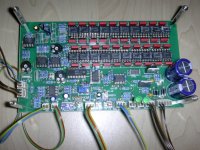
For that bypass LED... Couldn't you tap into the source from the boards' LEDs? Old board, but still counts in this respect.

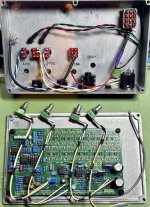
jHTauPipe-04-JHPrototype_lm394_photo.jpg

It's from this build report

 
Last edited:
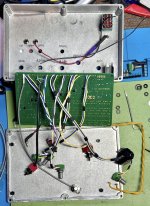
Prepping the off-board bits for wiring to the PCB. All wiring, except the LEDs, will be fed beneath the PCB to their respective connection points. The input signal (including jack to 4PDT switch) and the Phase/Vibe switch will use shielded cable. Probably the outputs as well.

Will shorten the wires of the Frequency pot to connect to the Expression jack, then from there, on to the PITCH connection points.

Tau_Phaser_Wiring_00.jpg
 
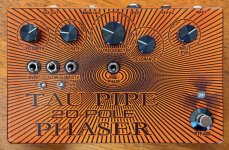
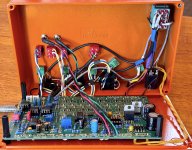
Finished populating, wiring and assembling the Tau Pipe 20-Pole Phaser. Next thing to do is fire it up and see if I did it right. It's late in the day here at home so, tomorrow morning it is! Although I think I need to apply a jumper across one of the CV connection points group.

Tau_Phaser_Done.jpg

Tau_Phaser_Gutshot_01.jpg
 
Last edited:
Finished populating, wiring and assembling the Tau Pipe 20-Pole Phaser. Next thing to do is fire it up and see if I did it right. It's late in the day here at home so, tomorrow morning it is! Although I think I need to apply a jumper across one of the CV connection points group.

View attachment 115754

View attachment 115755
Amazing! Really a source of inspiration for those who are on the fence. And those of us a little insecure about going at it with the iron
 
Amazing! Really a source of inspiration for those who are on the fence. And those of us a little insecure about going at it with the iron
Thanks! It's really a lot of study (to know what's where on the board connection-wise), planning, measuring, mockup guts & art layouts, and in my situation even a sacrificial enclosure test drilling before committing the artwork & real drills for a test fitting. Really glad I did that last part. The drill for the stomp was off by 6mm and the stomp switch collided with the large caps on the PCB. After moving it over, everything was good for fit.

Next, one by one I worked out the wiring layouts for each pot, switch & LED (to minimize the amount of folded wiring when closed); giving each set of wire leads an extra inch for flexibility when re-opening the enclosure. For that part, there was a LOT of trial & error.

Then I committed the wiring to solder for test fitting. Had to change the wire length on only a couple of the controls. I ran the UP/DOWN LEDs on top of the PCB to make it easier to mount them to the underside of the top of the enclosure. The bypass LED was positioned such that it allowed for ease of mounting even with its wires routed beneath the PCB. Also, I chose to use a resistance voltage divider (47K & 47K) across the unused +15V supply connection points in the "MTA-156" grouping, silkscreened on the PCB for the bypass LED. I couldn't get two wires into the "UP+" or "DOWN-" for it.

The older version docs suggested using shielded wiring on the INPUT & OUTPUT connections, but newest build docs I could find suggested only the INPUT connection(s) required shielded wire. I went with shielding bot the INUT & OUTPUT wiring. And the input jack is a switching jack so the input lead goes to ground when nothing is connected.

I'll be firing it up for the first time after coffee this morning and report back. But even before that, I need to find that web-based document that shows which CV connection points need to be jumped. It has something to do with either the "1V/OCT", "CV-IN" or "INV IN CVPRO" connection pads. My recall suggests the "1V/OCT" needs to be jumpered. But I want to verify.

[EDIT]: Ah! Found it! And looking at the 'Control Circuit' portion of the schematics, it's verified - noting that the "CV-IN" needs to be jumper for the Pith control to work. The output of U5B feeds the "CV-OUT" then goes to the "CV-IN" where it ends unless a jumper is inserted or an actual "CV-IN" type of input is called for. I'm not using an external CV, so jumper it is.

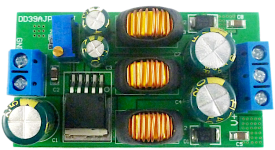
I'm also guessing that even more inside room can be had by NOT using the 18V AC supply (eliminating the large/tall caps and TO-220 regulators) and instead using a D039AJP (+9V DC In to ±15V DC Out) DC-to-DC Buck converter that runs at 180kHz. That way, a standard 9V DC supply could be used to power the pedal. That may worth the ~$10 investment to see if the operating frequency and ~1A current output are sufficiently high enough to run the pedal without injecting any noise. Really wish I'd found that Buck converter sooner.

9v_to_Dual_15V_Buck_Converter_D039AJP.png
 
Last edited:
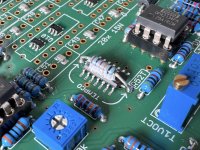
Well, the unit fires up and passes signal in bypass - but no cool phasing effect yet. So I guess those trimmers are for setting things up.

On to the calibration routine exploration.
 
Well, the unit fires up and passes signal in bypass - but no cool phasing effect yet. So I guess those trimmers are for setting things up.

On to the calibration routine exploration.
Oh :(

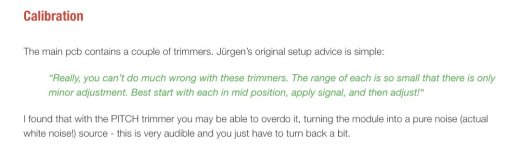
The calibration process is more about details, it seems. No effect at all is strange. From the eurorack module...
25871.jpg
 
I think the "1V/OCT" jack connection points need to be jumpered too. I found some other build notes that show the "1V/OCT" connection points as an input jack that is grounded when nothing is connected. So, adding another jumper to see.
 
Well, after futzing with the trimmer adjustments in calibration, it seems I need to troubleshoot my build. None of the user controls seem to do much of anything - yet the unit still passes sound when engaged; just filtered a good bit. The INVERT toggle changes the tone, but that's about it.
At one point when starting the calibration over the 4th time, I got a very short burst of awesome phasing. But then it just went away and I could not get it back. I may have an intermittent somewhere. More later after I get caught up on springtime household responsibilities.
 
So after a few days of futzing with the build layout in Photoshop, I think I finally came up with a nice solution for stuffing everything into a Mammoth 1590DD enclosure that I was able to procure from Banzai - can't seem to find them anywhere else. Even Google searches do not show Mammoth enclosures anywhere. (The difference between a Mammoth 1590DD and a Hammond 1590DD is the the Mammoth uses only 4 screws - instead of 6 - to fix the lid. That opens up the center area of sides open with no screw-tang well.) Was able to save a few mm here and there with the omitted screw-tang wells and using 9mm pots.

I'm considering the addition of an expression jack to allow the Frequency range some foot action. There's room for one.

View attachment 114893

The PCB will mounted to the inside of the lid with ¼" spacers screwed thru the plate.
View attachment 114894

Still waiting on a few precious parts to finish populating the board.
Just a heads up in case anyone else is curious, I recently did a (different) build with a 1590DD from tayda and it too only uses 4 corner screws opening up the middle area a bit

 
Back
Top