Test Signal Generator

genXslacker

Well-known member
I'm planning an I/O box and, while looking to see what others have done, ran into @jwin615's idea here about adding a signal generator at the input.

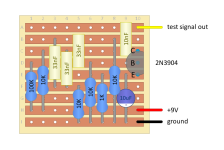
An RC/phase-shift oscillator seemed like the simplest way to go. This circuit produces a signal of about 185Hz or so on a breadboard. That's a frequency that is easily heard but doesn't grate on my nerves while I'm troubleshooting.

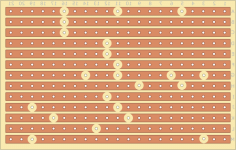
I haven't built the vero version yet, so consider it unverified, but I've been over it a few times and think I've got a functional layout drawn up.

tsg.png
 
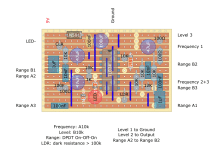
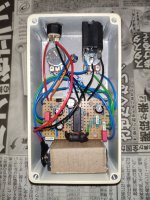
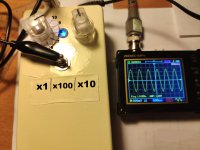
I built the sig generator from Valvewizard in '24. It's got a pretty good range and I like that I can set the output volume. The oscilloscope in one of the pics also has a sig gen, but you can only select the frequency (and also it offers other shapes than sin, which the Valvewizard does not), not the volume, which after a while felt like a major limitation. That's why I built the Valvewizard sig gen. Pretty happy with it. It can run on battery, so it's just a matter of inserting a single cable.
 

Attachments

  • siggen-new-vero.gif
    siggen-new-vero.gif
    84.6 KB · Views: 5
  • siggen-new-vero-cuts-mirrored.gif
    siggen-new-vero-cuts-mirrored.gif
    22.7 KB · Views: 5
  • Image4261154503877786211.jpg
    Image4261154503877786211.jpg
    497.6 KB · Views: 5
  • siggen-front.jpg
    siggen-front.jpg
    320 KB · Views: 5
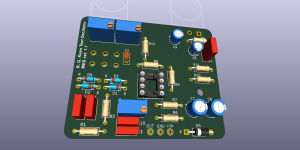
Since I wanted to learn KiCAD and PCB design, I built a version of RG Keen's signal generator. It was good learning experience, but clearly not the most compact design. It is boxed as a regular pedal so that I can alternate between the generator and a guitar.

View attachment 121355

That looks awesome. I've dallied a bit with KiCAD for PCB design, but the learning curve is steep enough that I've always gotten distracted by a shiny object before I learn much about it.

I also considered using those multi-turn trimmers in the filter network before remembering that (1) I have a serviceable function generator if I actually need to dial things in and (2) the smaller the better for the purpose of shoehorning it into the enclosure.

Now that I say that, I'm remembering that there's a such thing as SMD prototyping boards. I don't stock a ton of SMD components, but I'm pretty sure I have enough on hand to build the original post's circuit. I have a special fondness for needlessly over-complicating something for marginal space saving.
 
Back
Top