Chuck D. Bones
Circuit Wizard
First off, I want to thank CyberCow for putting me onto this strange and unusual application for the TL431.
The TL431 is a "programmable zener." It has three leads: Anode, Cathode and Ref. By connecting a resistor between Anode & Ref and another between Ref & Cathode, we can dial-in any zener voltage we want between 2.5V and 36V. This device is intended to be used as a shunt regulator, not as a clipping diode or amplifier. But we pedal designers are not easily deterred from doing something crazy.
Inside the TL431 looks like this:

In some ways, it behaves like a BJT with a Vbe = 2.5V and a lot more gain than a typical BJT. I put it in a Fuzz-Face circuit, to wit:

Q1 is there to buffer the input and make the FAT knob more effective. A typical fuzz face has a gain between 70dB and 80dB. The 431 FF has a little over 90dB gain. It's kind of a fun experiment. There are other ways to get that much gain from a FF.
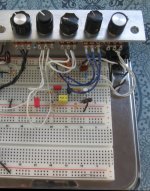
I shot this pic before I added the input buffer.
Knobs (L-R): LEVEL - TONE - BIAS - GAIN - FAT

The TL431 is a "programmable zener." It has three leads: Anode, Cathode and Ref. By connecting a resistor between Anode & Ref and another between Ref & Cathode, we can dial-in any zener voltage we want between 2.5V and 36V. This device is intended to be used as a shunt regulator, not as a clipping diode or amplifier. But we pedal designers are not easily deterred from doing something crazy.
Inside the TL431 looks like this:
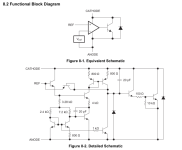
In some ways, it behaves like a BJT with a Vbe = 2.5V and a lot more gain than a typical BJT. I put it in a Fuzz-Face circuit, to wit:
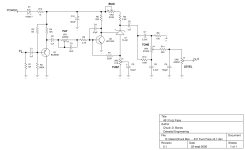
Q1 is there to buffer the input and make the FAT knob more effective. A typical fuzz face has a gain between 70dB and 80dB. The 431 FF has a little over 90dB gain. It's kind of a fun experiment. There are other ways to get that much gain from a FF.
I shot this pic before I added the input buffer.
Knobs (L-R): LEVEL - TONE - BIAS - GAIN - FAT