Chuck D. Bones
Circuit Wizard
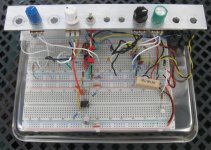
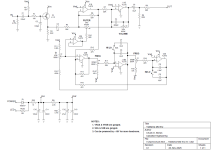
This EQ pedal kicks ass. My breadboard is built pretty much per the build docs, but I subbed a few parts when I didn't have a few oddball values. A word of warning, this circuit does not take kindly to mods. Don't ask me how I know that. If I had to guess, this design is based on an earlier design that used 4558 opamps or something like them. TL072 opamps are much closer to an ideal opamp and don't need a bootstrapped bias circuit (C3) on the input. It works fine if you follow the build docs.
Parts I subbed:
R16 = 220Ω
R17 = 330Ω The Q still goes plenty high
R18 = 24K
I didn't have a B10K dual, so I subbed a B50K dual for the FREQ pot and made these changes to accommodate the change from 10K to 50K:
R14 & R20 = 22K
R15 & R19 = 10K
C8 & C10 = 1.5nF
C9 & C11 = 6.8nF
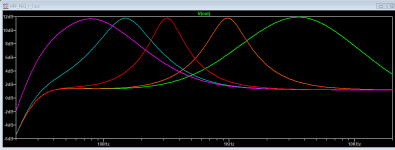
With these changes, the Bass tuning range is 100Hz to 850Hz. The Treble tuning range is 600Hz to 4.8KHz.
This tuning range is about the same as stock, but doesn't go quite as high. There's not much going on above 5KHz anyway. The tuning range is easily altered by changing C8-C11.
The Q knob goes from mild to extreme.
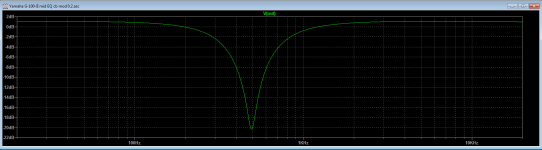
The GAIN knob sweeps from notch (0 to 5) to bandpass (5 to 10) with 5 being flat freq response. I think of it as a Filter Intensity knob. It does affect the gain, but only near resonance. The gain everywhere else is 6dB no matter the GAIN setting.
You're likely to saturate the filter if you dime both Q and GAIN.
While it definitely does the "Stuck Wah" sound, that's just the tip of the iceberg. With variable Freq, Q and Filter Intensity (GAIN), this pedal does everything the VarioBoost or Haunting Mids does, and then some. In fact, it bears some resemblance to the VarioBoost and Haunting Mids circuits, except it has a State Variable filter inside the feedback loop instead of a Wien Bridge filter. More features requires more parts, which is why the FreakZEQ contains three dual opamps.
Run it on 18V for additional headroom.
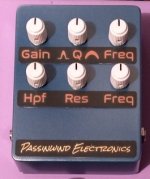
Knobs (L-R): Q - FREQ - Bass/Treble sw - VOLUME - GAIN

Parts I subbed:
R16 = 220Ω
R17 = 330Ω The Q still goes plenty high
R18 = 24K
I didn't have a B10K dual, so I subbed a B50K dual for the FREQ pot and made these changes to accommodate the change from 10K to 50K:
R14 & R20 = 22K
R15 & R19 = 10K
C8 & C10 = 1.5nF
C9 & C11 = 6.8nF
With these changes, the Bass tuning range is 100Hz to 850Hz. The Treble tuning range is 600Hz to 4.8KHz.
This tuning range is about the same as stock, but doesn't go quite as high. There's not much going on above 5KHz anyway. The tuning range is easily altered by changing C8-C11.
The Q knob goes from mild to extreme.
The GAIN knob sweeps from notch (0 to 5) to bandpass (5 to 10) with 5 being flat freq response. I think of it as a Filter Intensity knob. It does affect the gain, but only near resonance. The gain everywhere else is 6dB no matter the GAIN setting.
You're likely to saturate the filter if you dime both Q and GAIN.
While it definitely does the "Stuck Wah" sound, that's just the tip of the iceberg. With variable Freq, Q and Filter Intensity (GAIN), this pedal does everything the VarioBoost or Haunting Mids does, and then some. In fact, it bears some resemblance to the VarioBoost and Haunting Mids circuits, except it has a State Variable filter inside the feedback loop instead of a Wien Bridge filter. More features requires more parts, which is why the FreakZEQ contains three dual opamps.
Run it on 18V for additional headroom.
Knobs (L-R): Q - FREQ - Bass/Treble sw - VOLUME - GAIN