This Week on the Breadboard: The Germanium Filter

I am curious about R3 and R4. I like to put filter pedals after dirt and sometimes modulation, delay. Buffers will change the sound so what happens if I change R3,4 to 10M like a typical Sho boost? I tried it on the breadboard and I dont think it affects the tone much. But my ears are fallible. What effect will the 10M resistors have?
 
Good question!
The input impedance is lower then you might think because the Miller Effect reduces R3's impedance by the gain of Q1. Q1's gain in the is circuit is around 36x, which reduces the input impedance to around 26K. Increasing R3 & R4 to 10M increases the input impedance to around 260K. The lower input impedance will dampen the pickup's resonance a bit and make the pedal more responsive to the guitar's Volume setting.

BTW, this is a filter and a dirt pedal. It's all about the knob settings.
 
Good question!
The input impedance is lower then you might think because the Miller Effect reduces R3's impedance by the gain of Q1. Q1's gain in the is circuit is around 36x, which reduces the input impedance to around 26K. Increasing R3 & R4 to 10M increases the input impedance to around 260K. The lower input impedance will dampen the pickup's resonance a bit and make the pedal more responsive to the guitar's Volume setting.

BTW, this is a filter and a dirt pedal. It's all about the knob settings.
Thanks for the answer! Good to know. I googled Miller Effect so I have some reading to do. 👍
 
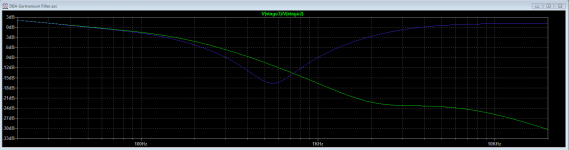
It affects the shape of the FILTER knob's freq response above 1KHz. There would be a lot less high freq content without C5. Q3 has a very low input impedance and it loads the FILTER network. This is not the typical BMP filter circuit.
The plot below shows the the FILTER circuit's freq response with the FILTER knob at noon. The blue trace is with C5 installed and the green trace is with C5 removed.

1781102854256.png
 
Back
Top