

Chuck D. Bones
Circuit Wizard
This pedal has received some rave reviews in the Build Reports forum, so I had to breadboard it and see what it was all about.
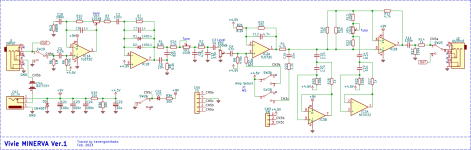
The circuit starts out simple, with the first two stages looking pretty similar to the BluesBreaker. After that, there is a whole lotta EQ. At low GAIN settings, all of the clipping comes from D1 & D2 and we get only odd-order harmonics. When the GAIN is turned up, the first stage (IC1A) starts to saturate and then we get some additional even-order harmonics. R1, R8, C5 & C6 provide a very broad mid-cut centered at 1KHz. The TONE pot, R24, R2, C6 & C7 form a 2-stage low-pass filter. Then comes the LEVEL control, followed by a 9dB gain stage (IC2A). Now it gets interesting. The 1st gyrator (IC3B) creates a narrow -7dB notch at 5KHz. I'm guessing that's supposed to mimic a resonance in a tube amp's output transformer. The 2nd gyrator (IC3A) creates a narrow peak at 1.4KHz. The TUBE knob varies the height of the peak from 0 to 9dB. The net effect is that the 1.4KHz peak brightens the tone and emphasizes certain harmonics while the 5KHz notch reduces higher hamonics. There is a lot of interplay between the TONE and TUBE knobs. And then there is Amp Select switch. In one position, there is no additional filtering. In the other position, there is an additional 8dB of treble cut at high frequencies.
This circuit sounds great in stock form and I only have 3 complaints:
1. The reverse voltage protection (D3) has no current limiting and could burn up traces if the voltage is reversed. Sheepylove fixed this in his version.
2. R16 & R19 do absolutely nothing. It's bad enough that there is one resistor doing nothing, but Vivie saw fit to put a pair of do-nothing resistors. If you build this board, don't bother installing them.
3. The Q of the 1.4KHz peak is too high IMHO and does not sound good when TUBE is dimed. There are a couple of simple remedies for this.

Here's my breadboard. I made a few simple mods.
Knobs (L-R): LEVEL - TUBE - TONE - GAIN. The MODE switch is to the right of the LEVEL knob and is shown in the OFF (no additional treble cut) position.

1st mod was to correct the reverse voltage protection. It's now wired like the PPCB boards with a series 1N5817 diode.
2nd mod was to delete R16 & R19.
3rd mod was to retune the peak gyrator (IC3A) in order to reduce the Q slightly. Changes are:
C14 = 12nF
C19 = 6.8nF
R27 = 1.5K
R32 = 100K
I also changed the TUBE pot to C10K for a more uniform sweep.
4th mod is to increase the range of the TONE circuit by decreasing R24 to 1K and increasing the TONE pot to B25K. It now goes brighter and darker. The darker end of rotation obviates the need for the MODE switch. At the same time, I increased the LEVEL pot to B250K, returned pin 1 of the LEVEL pot to Vref, deleted R9 & R37 and jumpered C2 & C4, saving 4 parts.
5th mod is to increase the impedance of IC2A's feedback path so that it doesn't push as hard on Vref. Changes:
R20 = 150K
R21 = 82K
C12 = 470pF
Mods 1 & 5 are highly recommended, the other mods are optional.
The only other mod worth considering is to replace IC3 with a pair of emitter-followers. Saves power and one opamp.
The circuit starts out simple, with the first two stages looking pretty similar to the BluesBreaker. After that, there is a whole lotta EQ. At low GAIN settings, all of the clipping comes from D1 & D2 and we get only odd-order harmonics. When the GAIN is turned up, the first stage (IC1A) starts to saturate and then we get some additional even-order harmonics. R1, R8, C5 & C6 provide a very broad mid-cut centered at 1KHz. The TONE pot, R24, R2, C6 & C7 form a 2-stage low-pass filter. Then comes the LEVEL control, followed by a 9dB gain stage (IC2A). Now it gets interesting. The 1st gyrator (IC3B) creates a narrow -7dB notch at 5KHz. I'm guessing that's supposed to mimic a resonance in a tube amp's output transformer. The 2nd gyrator (IC3A) creates a narrow peak at 1.4KHz. The TUBE knob varies the height of the peak from 0 to 9dB. The net effect is that the 1.4KHz peak brightens the tone and emphasizes certain harmonics while the 5KHz notch reduces higher hamonics. There is a lot of interplay between the TONE and TUBE knobs. And then there is Amp Select switch. In one position, there is no additional filtering. In the other position, there is an additional 8dB of treble cut at high frequencies.
This circuit sounds great in stock form and I only have 3 complaints:
1. The reverse voltage protection (D3) has no current limiting and could burn up traces if the voltage is reversed. Sheepylove fixed this in his version.
2. R16 & R19 do absolutely nothing. It's bad enough that there is one resistor doing nothing, but Vivie saw fit to put a pair of do-nothing resistors. If you build this board, don't bother installing them.
3. The Q of the 1.4KHz peak is too high IMHO and does not sound good when TUBE is dimed. There are a couple of simple remedies for this.
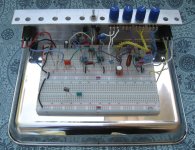
Here's my breadboard. I made a few simple mods.
Knobs (L-R): LEVEL - TUBE - TONE - GAIN. The MODE switch is to the right of the LEVEL knob and is shown in the OFF (no additional treble cut) position.
1st mod was to correct the reverse voltage protection. It's now wired like the PPCB boards with a series 1N5817 diode.
2nd mod was to delete R16 & R19.
3rd mod was to retune the peak gyrator (IC3A) in order to reduce the Q slightly. Changes are:
C14 = 12nF
C19 = 6.8nF
R27 = 1.5K
R32 = 100K
I also changed the TUBE pot to C10K for a more uniform sweep.
4th mod is to increase the range of the TONE circuit by decreasing R24 to 1K and increasing the TONE pot to B25K. It now goes brighter and darker. The darker end of rotation obviates the need for the MODE switch. At the same time, I increased the LEVEL pot to B250K, returned pin 1 of the LEVEL pot to Vref, deleted R9 & R37 and jumpered C2 & C4, saving 4 parts.
5th mod is to increase the impedance of IC2A's feedback path so that it doesn't push as hard on Vref. Changes:
R20 = 150K
R21 = 82K
C12 = 470pF
Mods 1 & 5 are highly recommended, the other mods are optional.
The only other mod worth considering is to replace IC3 with a pair of emitter-followers. Saves power and one opamp.


