jessenator
Well-known member

I have no clue, but it looks corrosive-y.


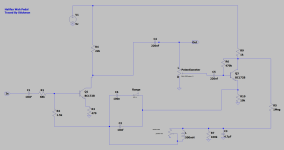

That is most certainly an odd one. Think it can be made on a ShamWah or Tearjerker board?View attachment 125167
So, this is a strange one.
Gonna need to triple check some of these connections, but I've already gone over it twice.
Not quite what I was expecting!
Let me know when you do, I would be interested in how it sounds on bass.Could. But it wouldn't be super neat and clean. Gonna have some flying parts.
I'll probably end up making a turret board for this one.
Thanks for the info. And it has a TS power jack as a cherry on top.Yup. That's the lottery loser right there.
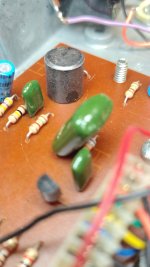
That's the one they transitioned to immediately after they ran out of Stack Of Dimes inductors.
Probably because they were cheap and, at least nominally, looked like the right component for the job. If you only looked at inductance at 1Khz.
But the DCR on those is around 160ohms, and the Q is pitiful. It's a very lossy component.
The circuit itself is still the same as the Thomas Organ pedals, though. Can't remember if they had altered the 470r Q1 emitter resistor or the 100K bias resistor at that point.

From what I recall of inductors in audio, they rely heavily upon the magnetic flux density of the coil assembly. Depending on the coil-shape, housing & mounting material, the smaller they are physically, the less magnetic-flux impact they will have on the signal. The theory and practice is really much deeper than just that tho.Thanks for the info. And it has a TS power jack as a cherry on top.
And it does sound like hot dogsh*t. Anemic and oddly unbalanced across the sweep.
Yeah. There's a reason there's plenty of iron in inductor based eqs. You can make small inductors if your aiming for one spec, like for noise filtering in a psu. But trying to develop one with a usable Q across the audio spectrum... It takes a bit more space than this little guy occupies.From what I recall of inductors in audio, they rely heavily upon the magnetic flux density of the coil assembly. Depending on the coil-shape, housing & mounting material, the smaller they are physically, the less magnetic-flux impact they will have on the signal. The theory and practice is really much deeper than just that tho.
Geometry and the magnetic properties of the material the core is wrapped around is important as well.Yeah. There's a reason there's plenty of iron in inductor based eqs. You can make small inductors if your aiming for one spec, like for noise filtering in a psu. But trying to develop one with a usable Q across the audio spectrum... It takes a bit more space than this little guy occupies.
I saw Pedal Pawn are releasing a wah (Say Wah) soon and are wrapping their own inductors for it.